
Every accelerator code speaks its own dialect. A lattice written for TraceWin cannot be read by MAD-X, and one written for Elegant means nothing to IMPACT-Z, so the same machine gets rebuilt by hand for every code and quietly loses detail each time.
lattix reads a deck into one code-neutral representation and writes it back out in another code's language. It tells you exactly what changed on the way, and it checks its own work against the real simulation codes rather than against itself.
Translate a TraceWin achromatic bend line into an Elegant lattice:
$ lattix convert bend_line.dat bend_line.lte --read-option species=h- --read-option kinetic_energy_eV=2.1e6

fidelity tracewin→elegant: EXACT=41 EQUIVALENT=3 LOSSY=0 DROPPED=1
  EQUIVALENT INSTRUMENT_AS_MARKER  ×3   elegant has no diagnostic type for family 'DIAG_SIZE'; the
                                        zero-length diagnostic is written as MARK (same optics, the
                                        family label survives only in provenance)
  DROPPED    FOREIGN_DIRECTIVE     ×1   format-specific directive written as a comment only
That summary is the point of the tool. Forty-one elements came through untouched, three diagnostics became markers because Elegant has no equivalent type, and one TraceWin directive had nowhere to go. Nothing was lost silently. The written file carries the reference particle so it can be read back:
! lattix 0.1.0 from IR
! lattix: reference species="h-" mass_eV=939294086.06 charge=-1 kinetic_energy_eV=2100000 rf_frequency_Hz=352210000

DRIFT_0001: DRIF, L=0.1
QUAD_0001: KQUAD, L=0.06, K1=-14.3111295671334
Add --strict and the conversion stops at the first element it cannot carry across, which is what
you want in a script. Add --report out.json and the whole ledger lands in a file.
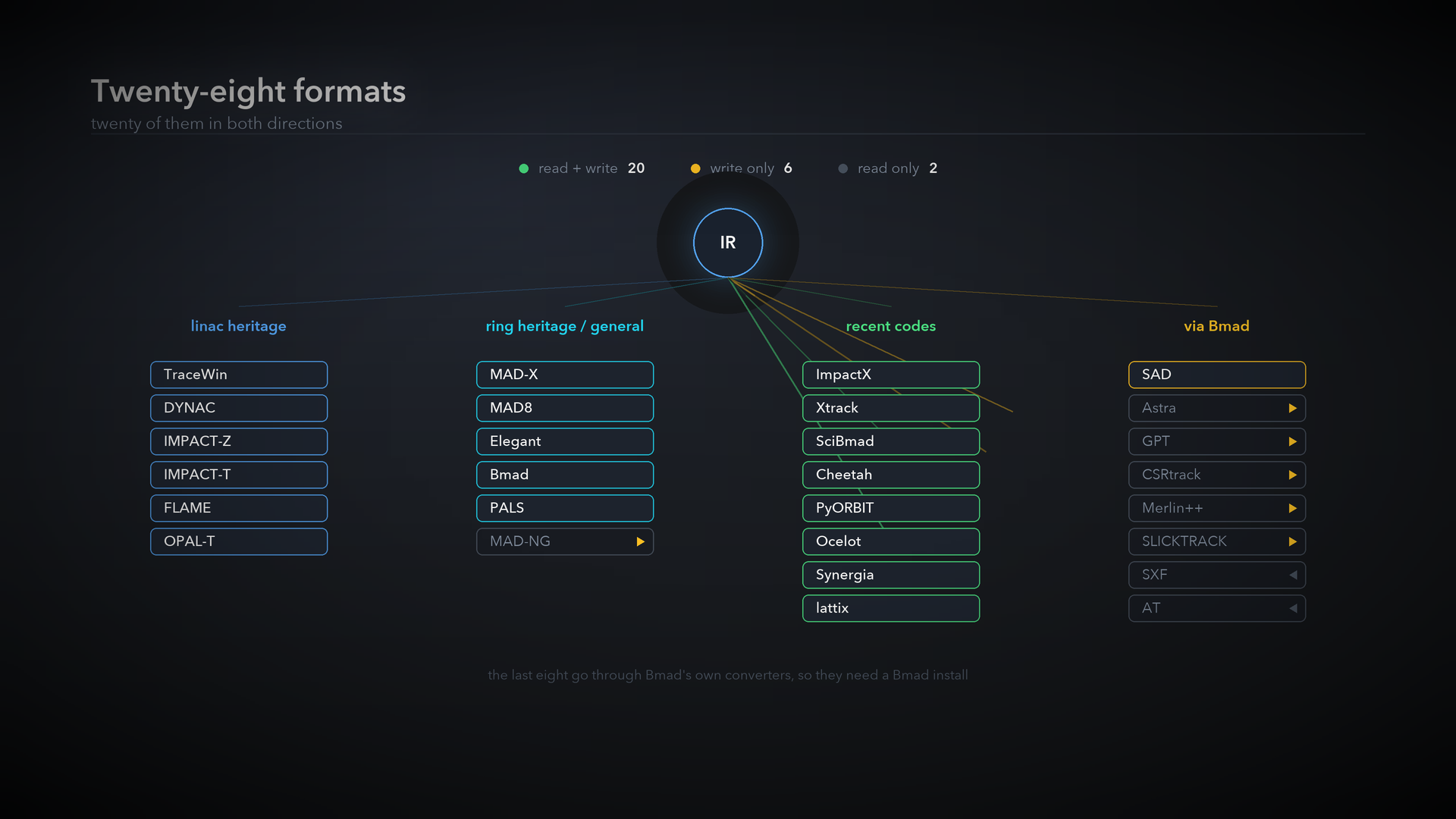
Twenty of them work in both directions. Six can only be written and two can only be read, which is a limit of the formats themselves rather than of the translator.
| group | formats |
|---|---|
| linac heritage | TraceWin, DYNAC, IMPACT-Z, IMPACT-T, FLAME, OPAL-T |
| ring heritage and general | MAD-X, MAD8, Elegant, Bmad, PALS, MAD-NG |
| recent codes | ImpactX, Xtrack, SciBmad, Cheetah, PyORBIT3, Ocelot, Synergia, lattix JSON |
| through Bmad's converters | SAD, Astra, GPT, CSRtrack, Merlin++, SLICKTRACK, SXF, Accelerator Toolkit |
The groups are a reading aid, not a statement of what each code can simulate. Several of these codes serve linacs and rings alike. ImpactX, for one, is used for the Fermilab Booster and for IOTA as well as for linacs, and it is also the engine that agrees most closely with MAD-X in the plot further down.
The last group is worth understanding before you rely on it. lattix does not write those formats itself. It writes a Bmad deck and then calls the converters that ship with Bmad, so those eight need a Bmad installation present. The other twenty need nothing beyond lattix.
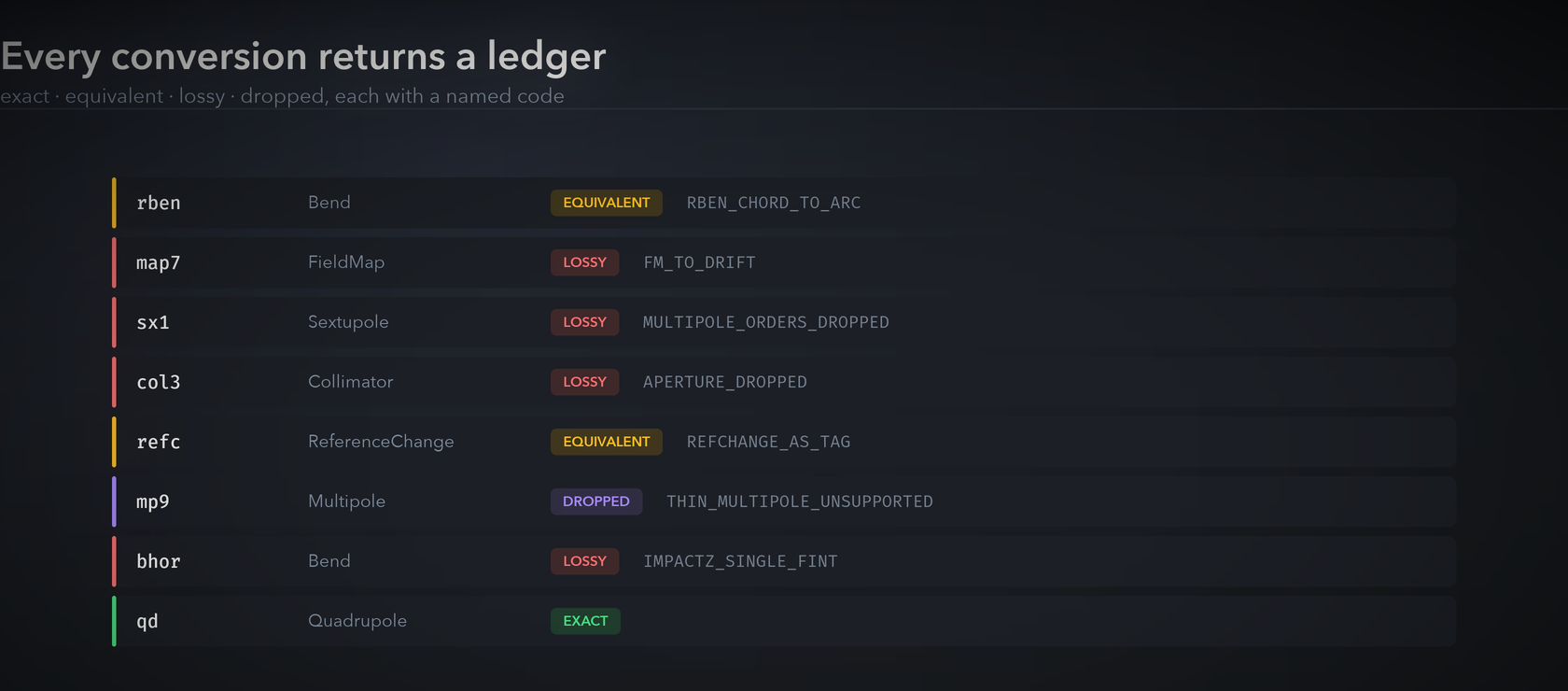
Every element in every conversion is marked exact, equivalent, lossy or dropped, and each mark carries a named code saying precisely what happened. There are 589 of them, all catalogued in docs/fidelity.md with the source line that raises each one.
The distinction matters in practice. RBEN_CHORD_TO_ARC is equivalent, meaning the optics survive and
only the bookkeeping differs. IMPACTZ_NO_REF_TILT is lossy, meaning a vertical bend was written
horizontal because that code has no other option, and your results will differ. You can see which one
you got before you run anything.
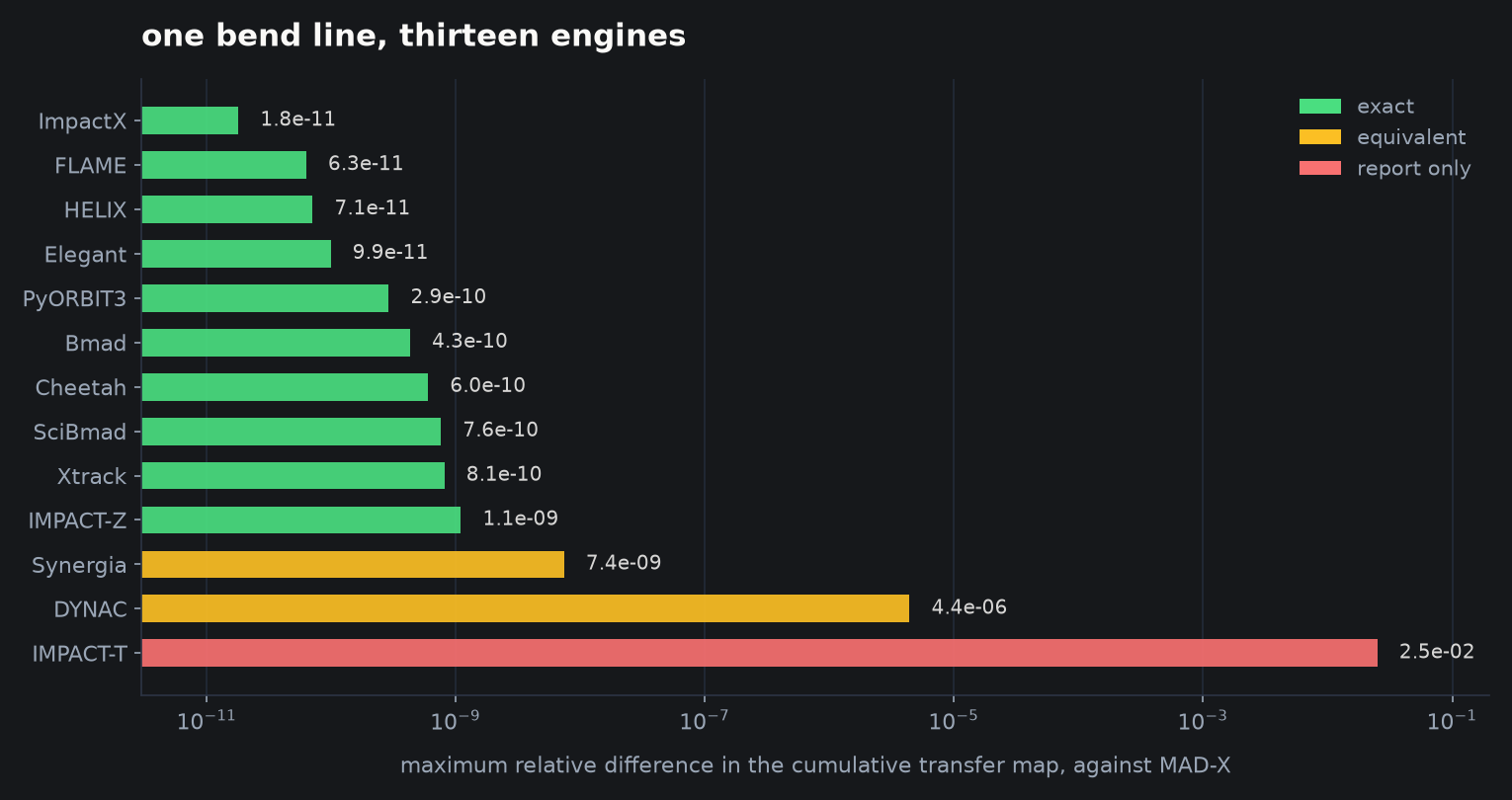
lattix does not take its own word for it. The same lattice is written out for as many of the seventeen supported engines as can accept it, each engine is run, and their element-by-element transfer maps are compared. The plot above is one bend line with pole faces and a negative bend, measured against MAD-X.
Most engines land between 1e-11 and 1e-9, which is arithmetic noise. Two sit higher for reasons that are understood and documented: DYNAC prints six digits in its dump files, and IMPACT-T has no pole-face focusing at all. Those are labelled rather than hidden.
A harder case, a proton synchrotron ring with thirty-two dipoles, agrees with HELIX to two parts in ten to the thirteenth on the transverse block.
Being clear about this is more useful than a longer feature list.
- IMPACT-T bends are reported, not asserted. Its dipole turns the whole bunch by the reference angle with no pole-face focusing, so bend lines are compared and shown, never held to a tolerance.
- GPT decks cannot carry bends. GPT is reached through Bmad's converter, which does not translate bends; every bend in such a deck is marked as a converter loss in the ledger rather than dropped quietly.
- Codes that hold one reference momentum cannot follow strong acceleration. MAD-X, Xtrack and SciBmad are not run on a line where the beam gains more than a factor of two, rather than reporting a comparison nobody should trust.
- Ion species cannot yet be handed to most engines, so those decks translate but do not validate.
Full detail, with the measurement behind each one, is in docs/oracles.md.
pip install lattix                 # numpy, pydantic, lark and pyyaml, nothing else
pip install "lattix[oracles]"      # adds cpymad, xtrack and friends for validation
Requires Python 3.11 or newer. Two things the base install does not do, on purpose. Reading a
MAD-X deck runs MAD-X itself to evaluate it, which is what makes that reader exact, so it needs
cpymad from the oracles extra. And the eight formats reached through Bmad's converters need a
Bmad installation. The optional engine extras stay optional because several simulation codes are
GPL, and lattix keeps them at arm's length by running them as separate processes, which is what
lets the translator itself stay BSD licensed.
Two conda environments cover the engines that are not pip installable. environment-ci.yml builds
the env used by continuous integration, with Elegant, ImpactX, IMPACT-Z and cpymad.
environment-bmad.yml builds the Bmad and Tao environment used out of process by the Bmad adapter
and by the eight bridged formats.
lattix ui --root tests/data/public     # a browser workbench: translate, then compare the beam lines
lattix inspect mebt.dat --elements     # what the reader made of a deck
lattix oracles                         # which engines this machine can actually run
lattix fingerprint                     # measure each engine's longitudinal conventions
lattix validate --deck madx=fodo.madx --deck bmad=fodo.bmad --oracles madx,xtrack,bmad --ke 800e6pytest -m "not corpus and not slow and not crossval" # engine free, about ninety seconds
pytest -m oracle_bmad # one engine
pytest tests/crossval -m crossval # the full cross-format batteryThe battery is the acceptance gate. It writes every registered deck to every format that can hold it, reads it back, and runs both ends through their engines, so a regression in one writer shows up as a failing pair rather than as a surprise months later.
- docs/tutorial.md, install, convert, read a fidelity summary, use the Python API
- docs/conventions.md, units, rigidity, the energy walk, RF phase per format, bends
- docs/fidelity.md, the ledger and the catalogue of every code
- docs/crossval.md, the cross-format battery
- docs/oracles.md, every engine, adapter and measured convention
- docs/formats/, one page per format
- CITATION.cff, how to cite this work
BSD 3-Clause. Copyright 2026 Abhishek Pathak.