
ai remembers. revora learns. · Graph Hacks — Track 2: Agent Memory and Coordination · powered by FalkorDB
▶ Watch the demo video · Live app: revora-anvitdevadiga.vercel.app · Full technical reference: docs/TECHNICAL.md
The problem. Agents that run infrastructure forget. A release agent that rolled back v7 at 2am will ship v7 again at 3am, and it will happily ship v8 too, even though v8 carries the same broken SDK. Meanwhile the agent that planned the fix has no durable way to see what the measuring agent observed.
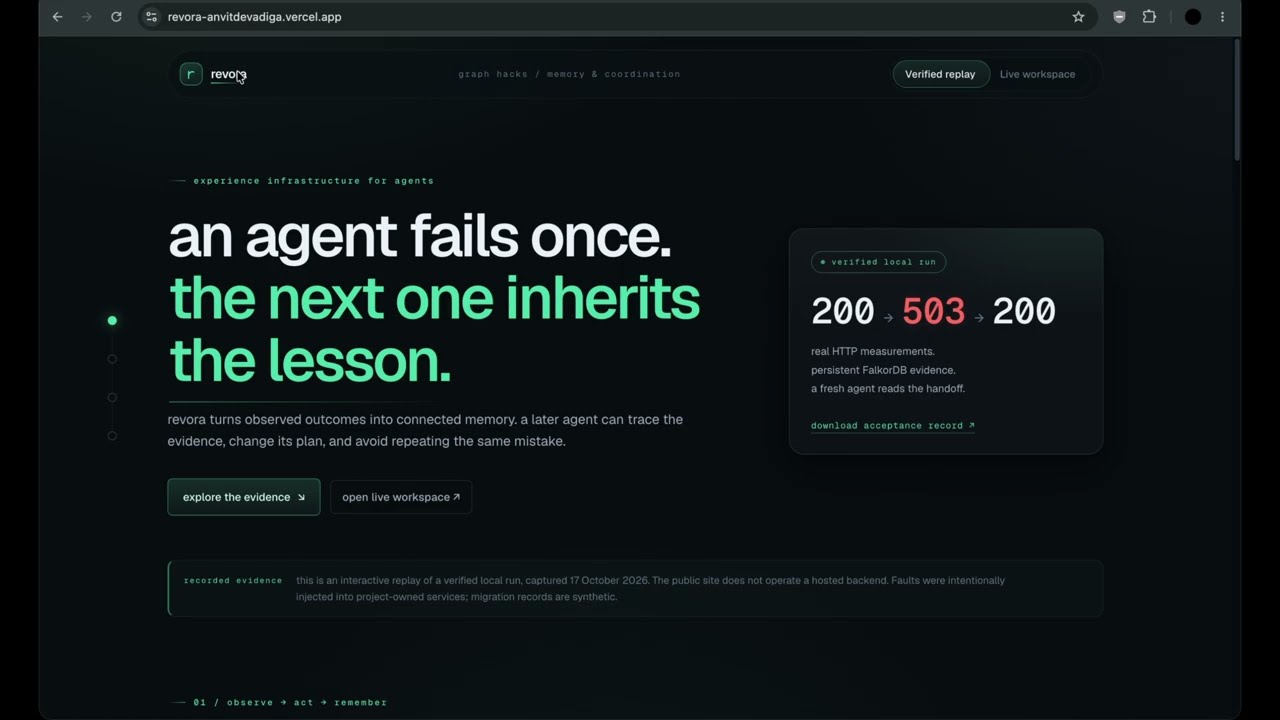
What revora does. Three agents (Release Analyst → Evidence Reviewer → LLM Recovery Planner) operate a live HTTP gateway and coordinate only through FalkorDB. Every incident, handoff, review, decision and shipped component is a graph node. Before a candidate serves a single request, revora traverses the graph:
- Same version failed before? → blocked, linked with
BASED_ON. - Shares a component that only ever appeared in failed releases? → blocked, via
(new)-[:USES]->(component)<-[:USES]-(failed release).
Zero requests reach the bad candidate. Remove the graph and the same retry serves HTTP 503.

| Agent decision | Graph read that drives it |
|---|---|
| Block a retried version | ReleaseIncident {service, version} lookup before any traffic |
| Block a new version that shares a failed component | 2-hop USES traversal, excluding components that ever shipped healthy |
| Planner proposes and explains recovery | Recent incidents, their components and BASED_ON links are retrieved and given to the LLM as context |
| Planner runs in another process | Reads the analyst's persisted AgentHandoff back from FalkorDB |
| Backend restarts mid-incident | ReleaseControllerState restores the route and the in-flight incident |
Each handoff, review and decision is written in one Cypher mutation, so a crash never leaves a half-recorded coordination step.
flowchart LR
  UI["Next.js dashboard<br/>coordination graph · inspector · timeline"] -->|REST / SSE| API[FastAPI]
  API --> GW["Live HTTP gateway<br/>stable ⇄ candidate"]
  API --> A[Release Analyst] -->|AgentHandoff| R[Evidence Reviewer] -->|EvidenceReview| P["Recovery Planner<br/>LLM + guardrail"]
  A & R & P -->|parameterised Cypher| F[("FalkorDB<br/>graph: revora")]
  GW -->|incidents · gate metrics · components| F
  F -->|"memory gate: block before traffic"| API
  F -->|"graph context"| P
  F -->|"/api/coordination/graph"| UI
| Agent | Kind | Reads from graph | Writes to graph |
|---|---|---|---|
| Release Analyst | deterministic | active incident | AgentHandoff + HANDED_OFF |
| Evidence Reviewer | deterministic | handoff, raw HTTP samples | EvidenceReview + REVIEWED_BY |
| Recovery Planner | LLM (Groq) behind a guardrail | handoff, review, recent incidents, components, prior plans | CoordinationDecision with proposed_action, guardrail, BASED_ON, RETRIEVED, EXECUTED |
The planner proposes one allowlisted action and cites graph IDs. The guardrail accepts the proposal only if it matches what the measured evidence requires; otherwise it records vetoed. The model never picks a tool, URL or command. Without GROQ_API_KEY, the planner runs deterministically.
cp .env.example .env          # optional: add GROQ_API_KEY for the LLM planner
docker compose up -d --build  # FalkorDB + FastAPI + Next.js on localhost
Open http://localhost:3000 → Live workspace → Connect (http://localhost:8000). Stop with docker compose stop; graph memory persists in the named volume.
| Variable | Default | Purpose |
|---|---|---|
FALKORDB_URL |
set by Compose | e.g. falkor://falkordb:6379; required when APP_ENV=production |
FALKORDB_GRAPH |
revora |
Graph name |
GROQ_API_KEY |
empty | Enables the LLM Recovery Planner (and the optional Groq agent panel) |
GROQ_MODEL / GROQ_PLANNER_MODEL |
openai/gpt-oss-20b |
Model for the agent panel / planner override |
REVORA_API_KEY |
empty | Workspace key sent as x-api-key |
ALLOW_ANONYMOUS |
false |
Allow calls without a key (local only) |
APP_ENV / ALLOW_MEMORY_FALLBACK |
development / true |
Production disables the in-memory fallback |
REVORA_SERVICE_NAME |
revora-demo |
Service scope for incidents |
REVORA_STABLE_URL / REVORA_CANDIDATE_URL |
empty | Gate two real services instead of the built-in demo |
CORS_ORIGINS |
http://localhost:3000,http://127.0.0.1:3000 |
Allowed frontend origins (add your hosted URL) |
- Introduce failure. Inject
v7shippingbase@1, payments-sdk@2.1. The live gateway serves HTTP 503. - Investigate, hand off & restore. The analyst measures 12 requests, the reviewer recomputes the gates from raw samples, and the LLM planner proposes rollback citing the graph. The guardrail accepts, stable is restored, and HTTP 200 is verified.
- Retry v7. Blocked from memory with 0 probes; the new incident is linked
BASED_ONto the rollback. - Ship v8 with the same SDK. It's a different version but is still blocked: it
USESpayments-sdk@2.1, which only ever appeared in failed releases.base@1is ignored because it also shipped in a healthy release. - Click any node in the coordination graph to see its properties, its edges and the exact Cypher that wrote it.
graph LR
  C1["Component<br/>payments-sdk@2.1"]
  I3["ReleaseIncident<br/>v8 · blocked"] -- USES --> C1
  I2["ReleaseIncident<br/>v7 · blocked"] -- BASED_ON --> I1
  I3 -- BASED_ON --> I1["ReleaseIncident<br/>v7 · rollback<br/>error_rate · p95_latency_ms"]
  I1 -- USES --> C1
  I1 -- HANDED_OFF --> H["AgentHandoff"]
  H -- REVIEWED_BY --> R["EvidenceReview"]
  R -- FORWARDED_TO --> D["CoordinationDecision<br/>proposed_action · guardrail"]
  H -- HANDED_OFF_TO --> D
  D -- BASED_ON --> I1
  D -- EXECUTED --> I1
  D -. RETRIEVED .-> H0["prior AgentHandoff"]
-- 1. exact-version memory gate, read before any candidate traffic
MATCH (i:ReleaseIncident {service:$service, version:$version})
WHERE i.decision IN ['rollback','promote']
RETURN i.id, i.timestamp, i.failed ORDER BY i.timestamp DESC LIMIT 1

-- 2. multi-hop component gate: shared with a failed release, never shipped healthy
MATCH (c:Component) WHERE c.key IN $components
MATCH (c)<-[:USES]-(bad:ReleaseIncident {service:$service, decision:'rollback', failed:true})
WHERE bad.version <> $version
  AND NOT (c)<-[:USES]-(:ReleaseIncident {service:$service, decision:'promote'})
RETURN c.key, bad.id, bad.version

-- 3. incident + memory link + components, one mutation
MERGE (i:ReleaseIncident {id:$id}) SET i.version=$version, i.decision=$decision,
  i.error_rate=$error_rate, i.p95_latency_ms=$p95_latency_ms
WITH i OPTIONAL MATCH (prior:ReleaseIncident {id:$prior_id})
FOREACH (_ IN CASE WHEN prior IS NULL THEN [] ELSE [1] END | MERGE (i)-[:BASED_ON]->(prior))
FOREACH (key IN $components | MERGE (c:Component {key:key}) MERGE (i)-[:USES]->(c))

-- 4. review + planner decision + provenance, one mutation
MATCH (i:ReleaseIncident {id:$incident_id})-[:HANDED_OFF]->(h:AgentHandoff {id:$handoff_id})
CREATE (r:EvidenceReview {id:$review_id, status:$review_status}) CREATE (h)-[:REVIEWED_BY]->(r)
CREATE (d:CoordinationDecision {id:$id, action:$action, planner_source:$planner_source,
        guardrail:$guardrail, proposed_action:$proposed_action})
CREATE (r)-[:FORWARDED_TO]->(d) CREATE (h)-[:HANDED_OFF_TO]->(d) CREATE (d)-[:BASED_ON]->(i)

-- 5. planner context: what the LLM is shown
MATCH (i:ReleaseIncident {service:$service})
WHERE i.decision IN ['rollback','blocked_from_memory','promote']
WITH i ORDER BY i.timestamp DESC LIMIT 6
OPTIONAL MATCH (i)-[:USES]->(c:Component)
OPTIONAL MATCH (i)-[:BASED_ON]->(p:ReleaseIncident)
RETURN i.id, i.version, i.decision, i.error_rate, collect(DISTINCT c.key), collect(DISTINCT p.id)

-- 6. live coordination view (GET /api/coordination/graph)
MATCH (i:ReleaseIncident {service:$service}) WITH i ORDER BY i.timestamp DESC LIMIT $limit
OPTIONAL MATCH (i)-[:HANDED_OFF|REVIEWED_BY|FORWARDED_TO|HANDED_OFF_TO
                   |BASED_ON|EXECUTED|RETRIEVED|USES*1..4]-(n)
WITH collect(DISTINCT i) AS seeds, collect(DISTINCT n) AS reached
WITH seeds + [n IN reached WHERE NOT n IN seeds] AS ns
UNWIND ns AS a OPTIONAL MATCH (a)-[r]->(b) WHERE b IN ns
RETURN ns, collect(DISTINCT r)
All values are query parameters; labels and relationship types are fixed in source. Range indexes cover every lookup key.
| Endpoint | What it does |
|---|---|
POST /api/release/inject |
{version, mode, components}: activate a faulty candidate, or block it from memory |
POST /api/coordination/recover |
Analyst → reviewer → planner handoff, then guarded recovery |
POST /api/release/run |
Off-route preflight gate (force_recheck overrides memory for a repaired build) |
GET /api/coordination/graph |
Live coordination subgraph for the UI |
GET /api/release/history · /api/coordination/history |
Incident trail and saved handoffs |
GET /api/release/traffic |
What a real caller receives (returns the actual HTTP status) |
cd backend && python3.12 -m venv .venv && . .venv/bin/activate
pip install -r requirements-dev.txt && python -m pytest       # unit + API tests
FALKORDB_URL=falkor://127.0.0.1:6379 PYTHONPATH=. python tests/integration_submission.py
cd ../frontend && npm ci && npm run build
The integration script restarts the API mid-incident against real FalkorDB and checks restored-state recovery, graph links, ablations, and adverse-memory rejection.
revora is a single-workspace, single-worker system that gates a project-owned (or one operator-configured) service pair. The fault is intentionally injected; HTTP traffic, measurements, routing and recovery are real. More experiments (customer-migration learning proof, memory ablations, the Groq tool-calling agent, and the replay lab) and the full operating limits are in docs/TECHNICAL.md and docs/SUBMISSION_AUDIT.md.
Project lead: Anvit Devadiga. Anvit drove Revora’s product direction, established project priorities, and spearheaded the design and development from end to end. He identified issues, conducted thorough reviews, and refined the implementation throughout the process. DeepSeek V4 and Claude Code provided assistance, mainly with bug fixing and code audits, along with code implementation and documentation support. Anvit takes full responsibility for the final architecture, design, and submitted work.