




Documentation: https://delonecommons.github.io/pyvoro2/
pyvoro2 is a scientific Python package for computing 2D and 3D Voronoi and power/Laguerre tessellations, with particular support for periodic topology and inverse fitting of power weights from partial geometric data.
pyvoro2 0.8.0: this source describes the finalized v0.8 release contract. One exact source commit is independently reviewed and qualified with its artifacts under issue #33 before the public tag is created. The archived v0.6.3 release remains the software baseline cited by the current separator-inverse manuscript.
The v0.8 tree provides:
- standard Voronoi tessellations;
- power/Laguerre tessellations directly from mathematical weights, with the existing radius representation retained;
- a dedicated
pyvoro2.planarnamespace for 2D rectangular domains; - bounded, partially periodic, and triclinic periodic 3D domains;
- explicit periodic neighbor-image shifts;
- diagnostics, validation, topology normalization, and visualization helpers;
- separator-based inverse fitting in 2D and 3D, including graph/connectivity diagnostics, hard-constraint witnesses, realized-boundary matching, and an optional realization-aware active-set loop.
The package is evolving toward a stable architecture for forward and inverse weighted tessellations. v0.8 is a feature-free maintenance and compatibility-removal release. v0.9 is reserved for functional/API stabilization and downstream readiness, 1.0 stabilizes the existing core, prescribed cell measures begin in v1.1, and mixed separator-plus-measure fitting begins in v1.2.
pyvoro2 is designed to be explicit and predictable:
- it vendors and wraps upstream Voro++ sources, including a small numeric robustness fix already accepted upstream for power/Laguerre pruning;
- 3D and planar APIs remain separate where their backends and domain support differ;
- power weights are the mathematical quantities, while Voro++ radii are a backend representation;
- algebraic inverse fit and realized geometry are reported as separate layers;
- numerical and topological failure modes are exposed through diagnostics rather than hidden fallback.
License note: pyvoro2-authored code is released under LGPLv3+ starting with version 0.6.0. Earlier versions were released under MIT. Vendored third-party code remains under its own licenses.
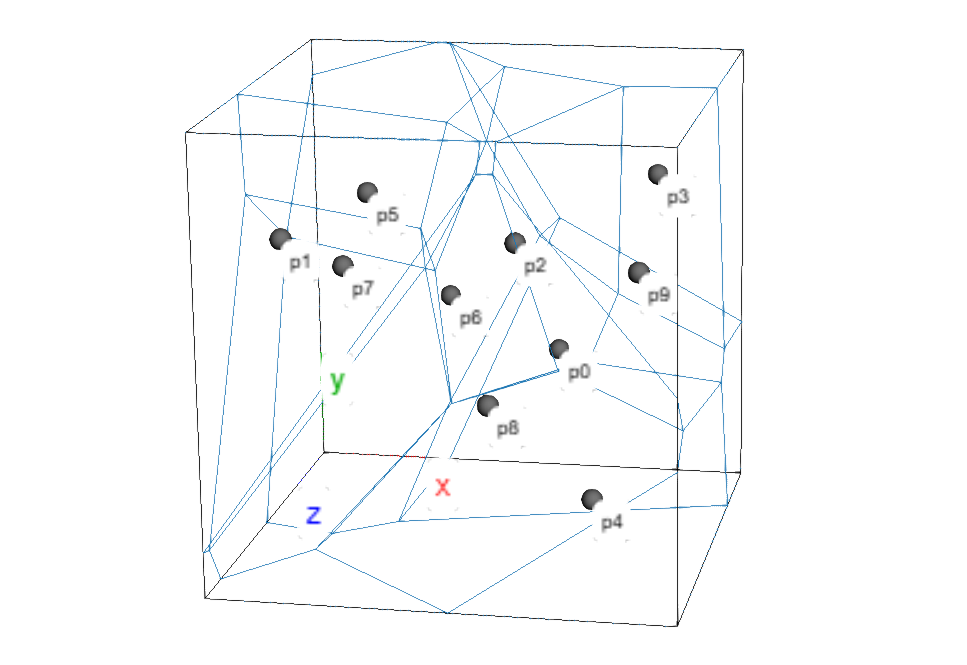
For 3D visualization, install the optional dependency with
pip install "pyvoro2[viz]".
import numpy as np
import pyvoro2 as pv
from pyvoro2.viz3d import view_tessellation

points = np.random.default_rng(0).uniform(-1.5, 1.5, size=(10, 3))
box = pv.Box(((-2, 2), (-2, 2), (-2, 2)))
result = pv.compute(points, domain=box, mode='standard')

view_tessellation(
    result.cells,
    domain=box,
    show_vertices=False,
)
import numpy as np
import pyvoro2.planar as pv2

points2d = np.array([
    [0.2, 0.2],
    [0.8, 0.25],
    [0.4, 0.8],
], dtype=float)

cell2d = pv2.RectangularCell(
    ((0.0, 1.0), (0.0, 1.0)),
    periodic=(True, True),
)
result2d = pv2.compute(
    points2d,
    domain=cell2d,
    return_diagnostics=True,
    normalize='topology',
)

diagnostics2d = result2d.require_tessellation_diagnostics()
topology2d = result2d.require_normalized_topology()The forward compute(...) APIs accept mathematical power weights directly:
weights = np.linspace(-0.2, 0.2, len(points))

result = pv.compute(
    points,
    domain=box,
    mode='power',
    weights=weights,
    include_empty=True,
)
The power function is ||x - p_i||^2 - w_i: weights have squared-length
units, may be negative, and are converted to non-negative backend radii using
one common global shift. Adding the same constant to every weight leaves the
complete diagram unchanged. Existing radii= calls remain available, but the
resulting length-unit radii are a non-unique backend representation rather than
necessarily physical radii. Supply exactly one of weights= or radii= in
power mode. Finite representability is necessary for conversion but does not
guarantee a numerically resolvable native tessellation. Voro++ evaluates radical
geometry with binary64 squared-radius arithmetic, so very large absolute
radii**2 values or genuine weight ranges relative to squared coordinate/domain
scales can lose geometric resolution. There is no universal safe cutoff: the
onset depends on scale, geometry, platform, and compiler, and periodic power
tessellations are a particularly sensitive regime. See
Power diagrams for the precise distinction.
cell = pv.PeriodicCell(
    vectors=(
        (10.0, 0.0, 0.0),
        (2.0,  9.0, 0.0),
        (1.0,  0.5, 8.0),
    )
)

result = pv.compute(points, domain=cell, return_face_shifts=True)

# result.require_boundaries() returns faces aligned with input-site order.
# Each face can include:
#   adjacent_cell  (neighbor site id)
# adjacent_shift (which periodic image produced the face)import pyvoro2.inverse as inverse
import pyvoro2.inverse.separator as separator
points_pair = np.array([
[0.0, 0.0, 0.0],
[2.0, 0.0, 0.0],
])
pair_box = pv.Box(((-5, 5), (-5, 5), (-5, 5)))
observations = inverse.resolve_separator_observations(
points_pair,
[(0, 1, 0.25)],
measurement='fraction',
domain=pair_box,
)
fit = inverse.fit_weights_from_separators(
points_pair,
observations,
model=separator.FitModel(mismatch=separator.SquaredLoss()),
)The small pyvoro2.inverse surface is the normal fixed-observation route.
Advanced models, realized-boundary checks, reports, and the experimental
active-set workflow are available explicitly from
pyvoro2.inverse.separator.
Voro++ uses fixed absolute tolerances internally. pyvoro2 always rejects
generator pairs whose squared distance is at most 1e-10 before native
insertion; very small or very large coordinate systems can still lose
geometric accuracy.
pyvoro2 does not silently rescale coordinates. Rescale explicitly when using unusual units.
A user policy can add a diagnostic range above the mandatory 1e-5 safety
distance:
result = pv.compute(
    points,
    domain=cell,
    duplicate_check='raise',
    duplicate_threshold=1e-3,
)duplicate_check='off', warn, and raise affect only safe pairs below the
configured user threshold. Mandatory violations always raise. For periodic
domains mandatory safety always uses certified minimum-image geometry;
duplicate_wrap=False changes only the optional diagnostic metric.
Inserted generators must lie in each non-periodic half-open interval
[lo, hi); periodic axes are remapped. This includes temporary ghost
generators. Locate query points themselves are not inserted.
For stricter post-hoc checks, see:
pyvoro2.validate_tessellation(..., level='strict');pyvoro2.validate_normalized_topology(..., level='strict');pyvoro2.planar.validate_tessellation(..., level='strict');pyvoro2.planar.validate_normalized_topology(..., level='strict').
The vendored Voro++ snapshot includes the upstream robustness fix for radical pruning in power mode. This avoids rare cross-platform cases where fully periodic power tessellations could produce a non-reciprocal face/neighbor graph under aggressive floating-point code generation.
Voro++ is fast and mature, but its low-level C++ interface does not provide all of the Python-side contracts needed in scientific workflows. pyvoro2 adds:
- triclinic periodic cells and coordinate mapping in 3D;
- partially periodic orthorhombic cells for slabs and wires;
- explicit planar support through
pyvoro2.planar; - periodic image-labelled faces and edges for graph construction;
- diagnostics and normalization for reproducible topology;
- owner lookup with
locate(...); - non-inserting probe cells with
ghost_cells(...); - separator-based inverse fitting with inspectable graph, feasibility, realization, and active-set diagnostics.
| Section | What it contains |
|---|---|
| Choosing an API | Preferred forward and inverse entry points, lifecycle status, result layers, and the static scalability contract. |
| Capabilities and limitations | Current supported contracts, wrapper restrictions, backend limits, unsupported geometry, and open architecture decisions. |
| Concepts | A concise user introduction to Voronoi and power/Laguerre tessellations. |
| Glossary | Power weights, backend radii, gauge, separator observations, realization, and active-set terminology. |
| Domains (3D) | Box, OrthorhombicCell, and PeriodicCell. |
| Planar (2D) | The planar namespace, rectangular periodicity, diagnostics, normalization, and plotting. |
| Operations | Forward tessellation, owner lookup, and ghost-cell workflows. |
| Topology and graphs | Periodic image-labelled adjacency and normalized topology. |
| Separator fitting | Current inverse API, result diagnostics, realization matching, and active-set refinement. |
| v0.6.3–v0.8 migration | Canonical replacements and the completed v0.8 compatibility removal. |
| Theory | API-independent definitions of power diagrams, weights, gauge, and separator inversion. |
| Development | Architecture, workflow, documentation conventions, release plans, API lifecycle, and decision records. |
| Visualization | Optional py3Dmol and matplotlib helpers. |
| Examples | Executable notebook workflows. |
| API reference | Exact signatures and docstring reference for spatial, planar, and separator-fitting APIs. |
| v0.8.0 release notes | Removals, fixes, maintenance, documentation, and the release distribution contract. |
| Roadmap | v0.8 cleanup, v0.9 functional stabilization, the stable 1.0 core, v1.1 prescribed measures, v1.2 mixed fitting, and future research. |
Most users should install a prebuilt wheel:
pip install pyvoro2The v0.8 qualification workflow targets 20 standard GIL-enabled CPython wheels: Python 3.10, 3.11, 3.12, 3.13, and 3.14 for each of manylinux x86_64, Windows AMD64, macOS arm64, and macOS x86_64. It also builds one source distribution. Other operating systems, architectures, interpreter implementations, free-threaded CPython builds, musllinux, 32-bit targets, Windows arm64, and macOS universal2 do not have v0.8 prebuilt wheels.
Optional extras:
pyvoro2[sparse]for optional SciPy sparse-direct static quadratic separator fitting;pyvoro2[viz]for 3Dpy3Dmoland 2D plotting;pyvoro2[viz2d]for 2D matplotlib plotting only;pyvoro2[all]for the full local notebook, docs, lint, test, and release validation stack.
Supported source builds use standard GIL-enabled CPython 3.10–3.14 and require a C++17 compiler, CMake 3.20 or newer, and Python development headers. Free-threaded CPython builds are not currently supported. Ninja is recommended because the build backend uses CMake efficiently with it. Typical toolchains are GCC or Clang on Linux, Xcode Command Line Tools on macOS, and Visual Studio Build Tools with the "Desktop development with C++" workload on Windows. These are source-build requirements, not pyvoro2 runtime dependencies.
For an editable runtime-only build:
python -m pip install --upgrade pip
python -m pip install -e .
For local repository development and all validation tools:
python -m pip install --upgrade pip
python -m pip install -e ".[all]"
See Contributing for platform notes and clean-environment verification.
The default suite includes deterministic tests and seeded fuzz/property tests
with --fuzz-n=10:
pip install -e ".[test]"
pytest -q
Increased seeded fuzz coverage and the optional independent-wrapper group:
# Explicitly select fuzz tests and raise their iteration count
pytest -m fuzz --fuzz-n 100

# Independent wrapper cross-checks; requires pyvoro
pip install pyvoro
pytest -m pyvoro --fuzz-n 100
For a complete local publishability pass:
python tools/release_check.pypyvoro2 is currently beta. This source describes v0.8.0, including the completed compatibility removal, Python 3.14 and wheel-matrix preparation, and the accepted bounded API-contract corrections. The v0.8 source is finalized before one exact commit and its artifacts are qualified under issue #33; any tracked correction changes that candidate. The archived v0.6.3 release remains the software baseline cited by the separator-inverse manuscript. The v0.8.0 release uses the project Git tag, GitHub Release, and package-distribution process and intentionally creates no new pyvoro2 Zenodo software-version record. Existing historical pyvoro2 and project/reproducibility Zenodo records remain valid. New inverse families begin after the stable 1.0 core. See the v0.8.0 release notes and the completed v0.8 plans.
Reproducible bugs and focused feature proposals are welcome through GitHub
issues. Development is currently led by one maintainer, so support is
best-effort. Contribution and decision policies are described in
CONTRIBUTING.md.
The project has used the latest Chat and Codex models available at the time of development for planning, implementation support, testing, and documentation. The maintainer reviews and validates all integrated changes and remains responsible for the software and scientific claims.
See AI-assisted development for details.
- pyvoro2-authored code is LGPLv3+ starting with version 0.6.0;
- versions before 0.6.0 were released under MIT;
- vendored Voro++ code remains under its upstream license.
This README is auto-generated from the MkDocs sources in docs/.
To update it, edit the docs pages and re-run: python tools/gen_readme.py.