🧬 Consensus Subclonal Inference and Phylogenetic Reconstruction Framework

-276DC3?style=flat-square&logo=R)

Welcome! This repository serves as the structural and methodological demonstration for our comprehensive pipeline designed to reconstruct and quantify tumor evolutionary histories.
This framework was successfully applied to systematically profile the evolutionary histories of >10,000 tumors across 33 cancer types.
Our manuscript is currently under review at Genome Medicine. To comply with journal embargo policies and protect intellectual property, the core source code (comprising >1,500 commits) and raw analytical pipelines remain PRIVATE until publication.
This repository outlines the computational architecture, quantitative metrics, and visualization paradigms developed in this study.
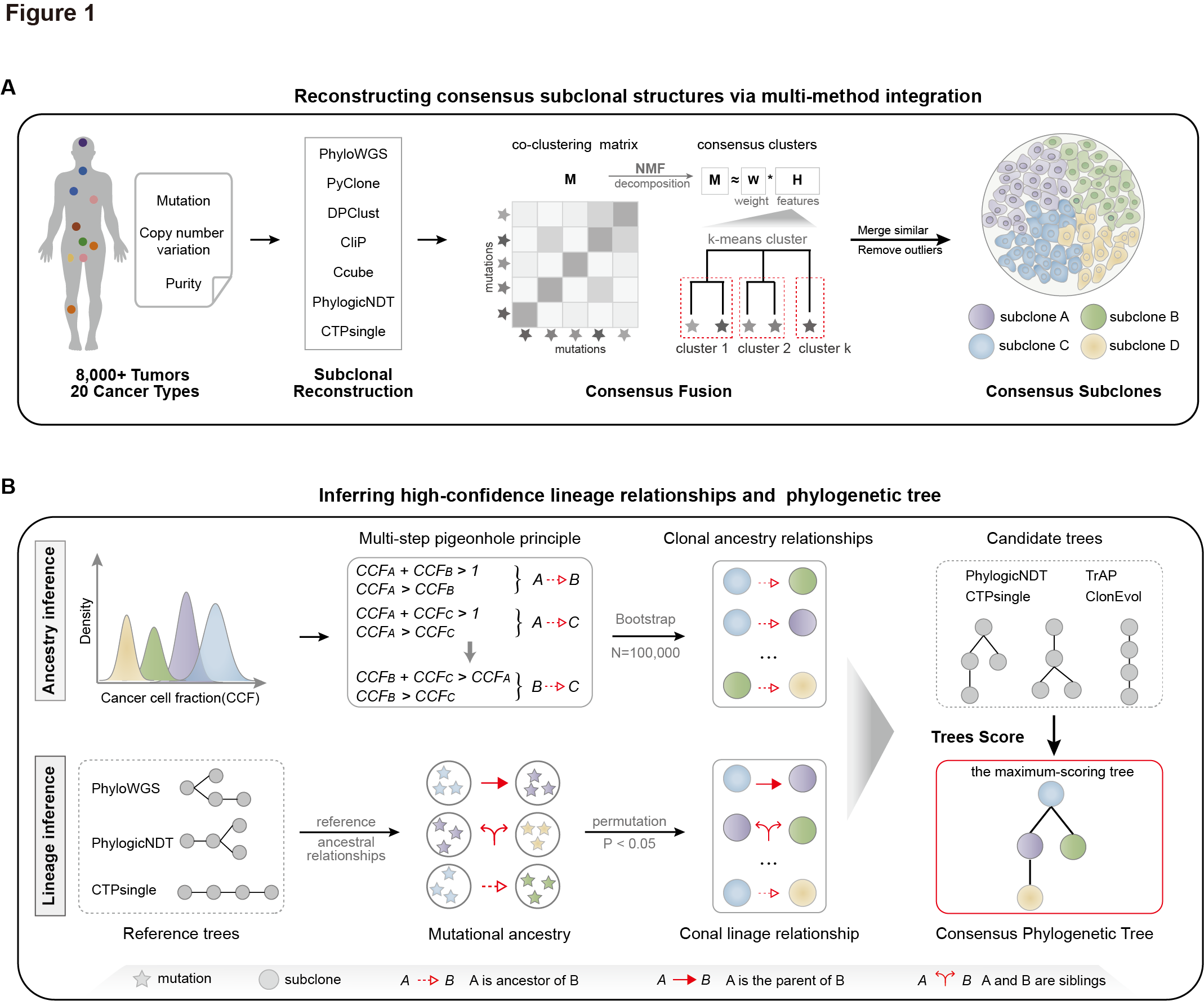
Traditional subclonal inference methods often suffer from single-model biases. To overcome this, our pipeline leverages a highly robust Consensus Subclonal Inference Framework:
- Multi-Algorithm Integration: Systematically integrates 7 independent computational algorithms to resolve clonal structures from bulk sequencing data.
- Constraint-based Phylogenetic Reconstruction: Applies the pigeonhole principle and consensus voting strategies to accurately reconstruct the spatiotemporal phylogenetic trees of tumor sub-clones.
- Temporal Evolutionary Mapping: Decodes the temporal sequence of somatic events, driver mutations, and their co-occurrence patterns along specific clonal lineages.
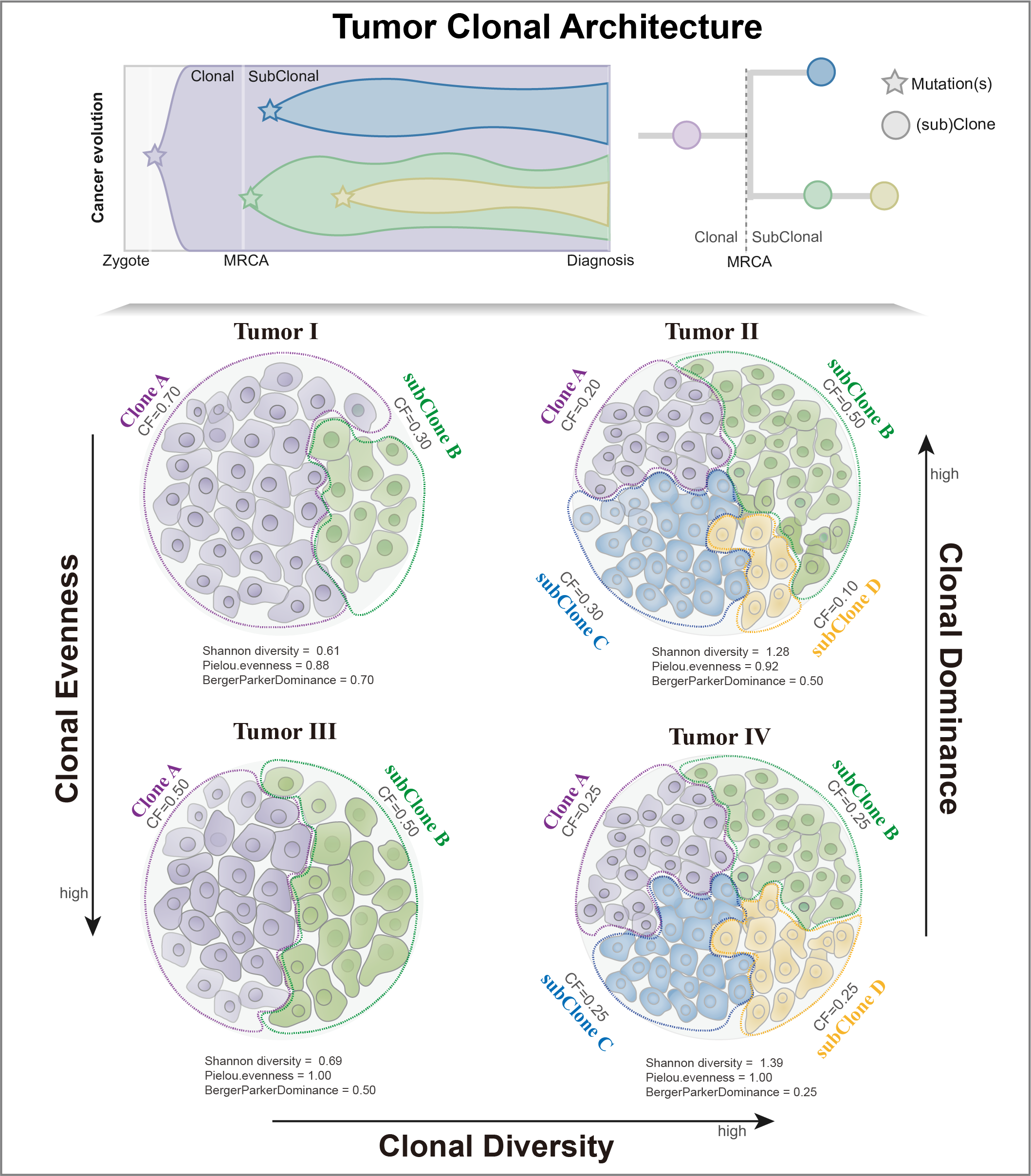
We established a systematic set of 6 ecologically-inspired quantitative metrics across 3 interpretable dimensions to evaluate pan-cancer clonal architecture:
- 🌳 Clonal Diversity: Reflects the branching potential and evolutionary expansions within the tumor.
- 👑 Clonal Dominance: Indicates the presence and strength of selective sweeps driven by specific sub-clones.
- 🧬 Mutational Heterogeneity: Captures the ongoing diversification and genomic instability at the subclonal level.
The entire analytical pipeline is written in highly optimized R, utilizing robust statistical and genomic packages:
- Genomic Analysis: (List a few key R packages you used, e.g.,
GenomicRanges,VariantAnnotation, etc.) - Phylogenetics & Math: (e.g.,
ape,igraph) - Data Wrangling & Visualization:
tidyverse,ggplot2,ComplexHeatmap
Lead Developer / Bioinformatician: Wei Liu