



A free, standalone skill that stops every subagent from running on your biggest model.
Unless the call, the subagent's definition or CLAUDE_CODE_SUBAGENT_MODEL sets a model, Claude
Code runs every subagent on the model you selected for the session
(docs). So when a
task fans out, the agents that translate a messages.json cost the same per token as the one
that designs the architecture. This skill makes the split explicit before anything launches:
the model is picked by the type of task, never by the importance of the project.
☕ If this saves you time, buy me a coffee.

Or in USDC. Send USDC only and only on the network shown; on any other network it is lost with no way to recover it.
| Network | USDC address |
|---|---|
| Solana | 5n6Gfosk7SdwbvdtE9xiLWpcGPBBBGDZYRfAkWyCk86g |
| Ethereum (ERC-20) | 0xe176866f9d7fdb498e0d4a983d3e34d84dcd6bfc |
| Type of task | Examples | Model · effort |
|---|---|---|
| Mechanical | translations of fixed strings, listing, counting, extracting fields in a fixed format, cutting a long log down to its errors | small (e.g. Haiku) · low |
| Bounded analysis | summarizing a module, mapping dependencies, writing tests from a clear spec, one mechanical change across many files | mid (e.g. Sonnet) · medium |
| Judgment | architecture, writing the code that decides how something works, choosing between options, the final review, anything that ships | the session's model · the session's |
Before any of that it asks the cheaper question first: should this be delegated at all, and how
many? The default is no, and the count starts at zero: most work is inline work, and checking
what a command can check (grep, running the tests) is never a reason to delegate.
Plus five guardrails the skill tells the agent to keep: the final reviewer never gets cheapened; a small or mid agent that fails gets its one retry a tier up, never on the same model; fewer agents beat more agents, and no agent exists just to re-check another's conclusion; every subagent gets a self-contained brief and a return contract (goal, minimum context, what it must not touch, what the reviewer will check, output format, definition of done), because it never sees your conversation; and every loop declares its cap before it starts: the success condition and the maximum number of rounds, one retry of the same approach at most. On top of that, every run declares its split and its cap before launching and reports the measured spend after, or says "not measured". No invented savings.
In Claude Code the tiers map to the Agent tool's own parameters: model: "haiku" or
model: "sonnet" with effort per call (Claude Code 2.1.292 or later), and neither model nor
effort for judgment, so it inherits both from the session: use a subagent type whose definition
sets neither, and if CLAUDE_CODE_SUBAGENT_MODEL is set, pass the session's alias, such as
model: "opus". For other clients, see
the model names per client.
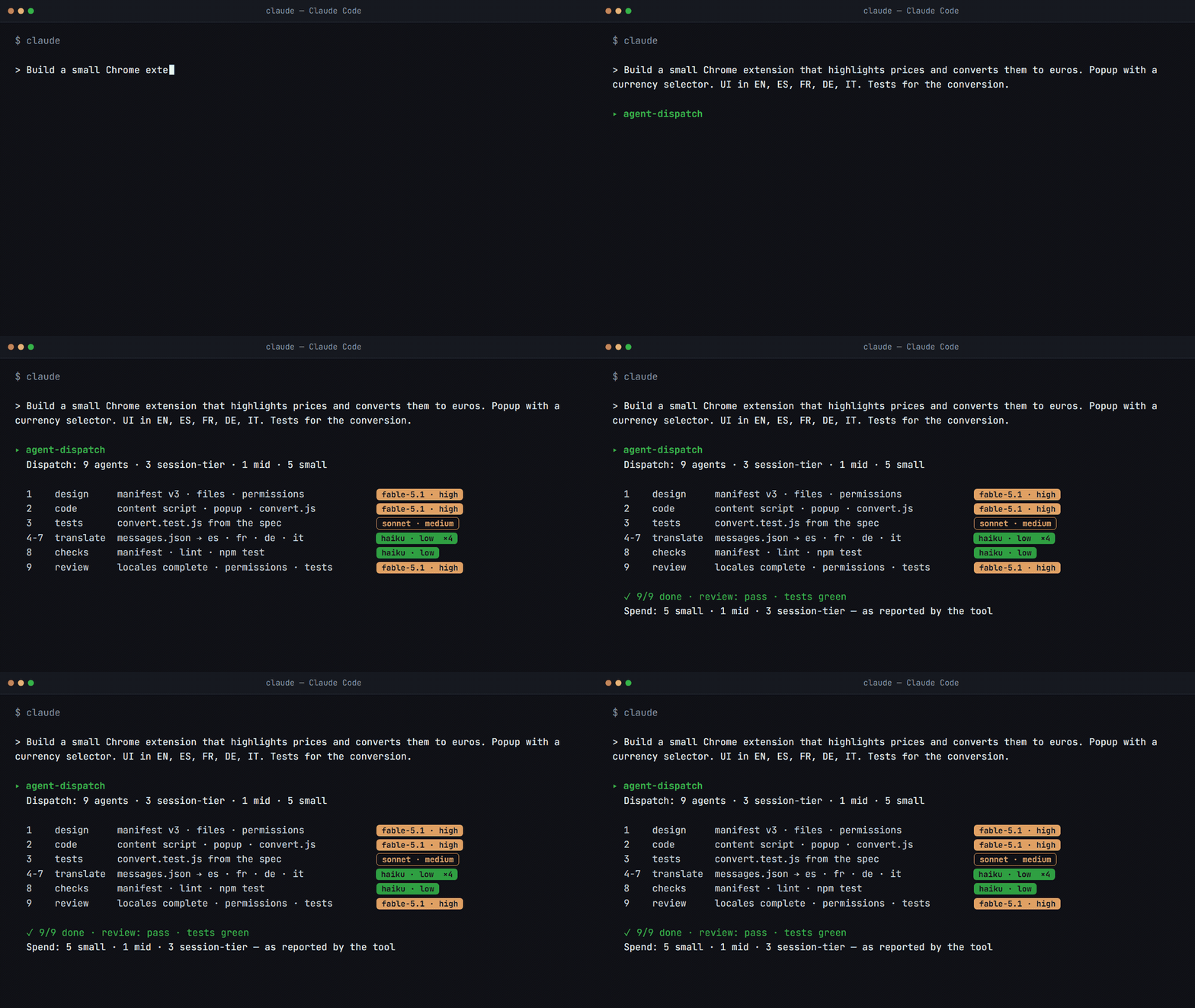
Build a small Chrome extension that highlights prices on any page and converts them to euros. Popup with a currency selector. UI in English, translated into Spanish, French, German and Italian. Tests for the conversion.
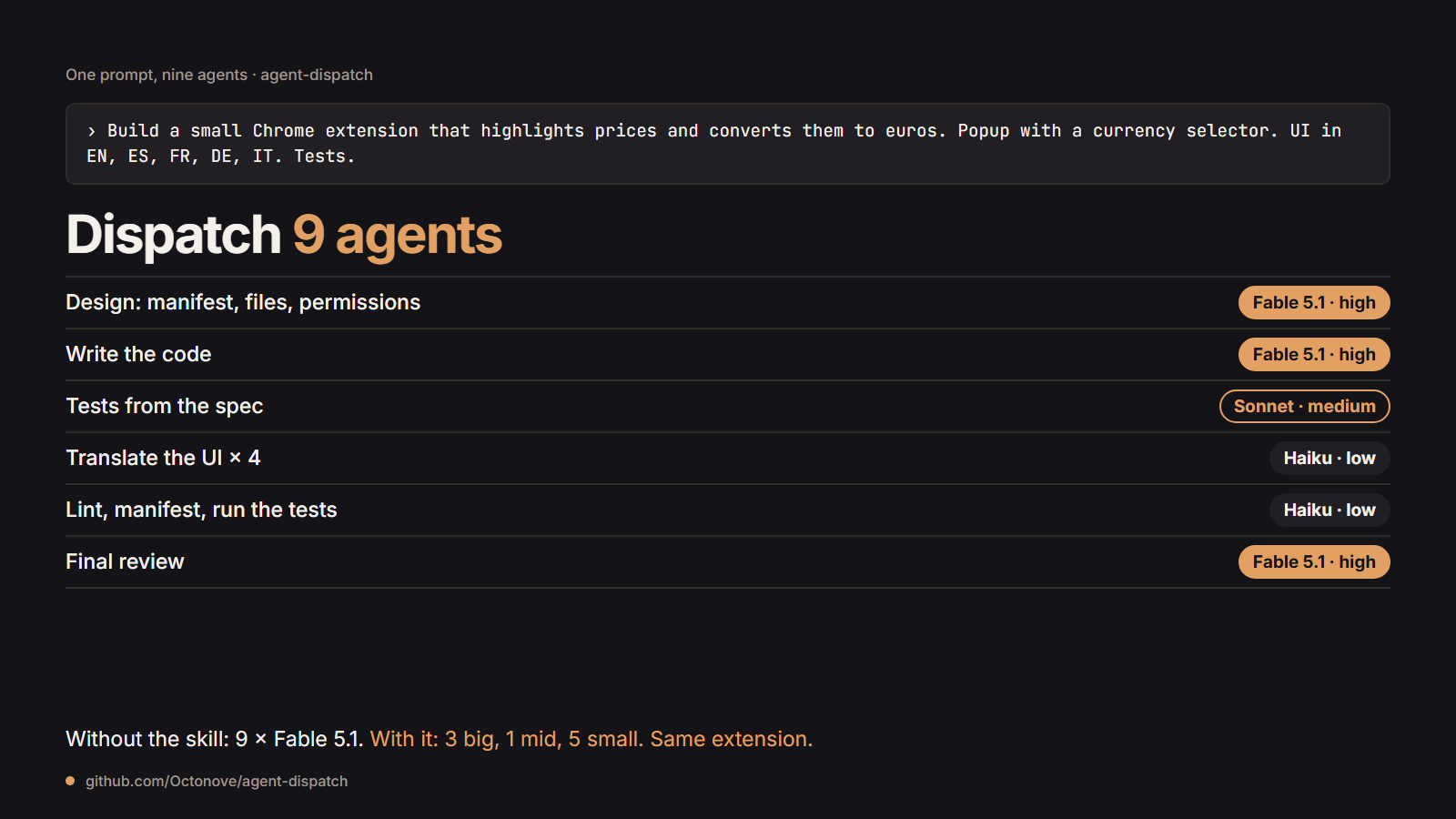
| # | Subtask | Runs on |
|---|---|---|
| 1 | Design: manifest v3, files, permissions, how content script and popup talk | inline · session model |
| 2 | Write the code: content script, popup, service worker, conversion module | inline · session model |
| 3 | Write the conversion tests from the spec | 1 agent · mid · medium |
| 4–7 | Translate messages.json into ES, FR, DE, IT, one agent per language |
4 agents · small · low |
| 8 | Validate the manifest, run lint and the tests | inline · a command checks it |
| 9 | Final review: locales complete, permissions match the code, tests green | inline · session model |
Dispatch: 5 agents · 1 mid (tests) · 4 small (translations) · inline: design, code, lint + tests, final review · cap: 1 fix round
Design and code are one chain of judgment, so they stay with the session; lint and tests are a
command, not worth a subagent. What runs in parallel on cheaper tiers is the work that is truly
independent: the tests and the four translations. The skill puts no number on the saving; the
spend your client reports after the run does. The full walkthrough, with the brief each agent
receives, is in examples/chrome-extension.md, and more cases (no
delegation, one agent, several slices, a failing agent) are in
examples/decisions.md.
Pick one. The Spanish skill is es/SKILL.md: swap SKILL.md for es/SKILL.md in
the URLs, or install the agent-dispatch-es plugin.
Personal skill, for every project on your machine:
mkdir -p ~/.claude/skills/agent-dispatch
curl -fsSL https://raw.githubusercontent.com/Octonove/agent-dispatch/main/SKILL.md \
  -o ~/.claude/skills/agent-dispatch/SKILL.md
Project skill, committed so your team gets it too:
mkdir -p .claude/skills/agent-dispatch
curl -fsSL https://raw.githubusercontent.com/Octonove/agent-dispatch/main/SKILL.md \
-o .claude/skills/agent-dispatch/SKILL.mdPlugin, from the marketplace in this repository:
/plugin marketplace add Octonove/agent-dispatch
/plugin install agent-dispatch@agent-dispatch
From the shell: claude plugin marketplace add Octonove/agent-dispatch, then
claude plugin install agent-dispatch@agent-dispatch. On Claude Code 2.1.275 or later it is one
step: /plugin install agent-dispatch --marketplace Octonove/agent-dispatch. The Spanish plugin
is agent-dispatch-es@agent-dispatch. Third-party marketplaces do not auto-update by default:
claude plugin update agent-dispatch@agent-dispatch fetches the latest commit.
Check it: /skills lists it and /agent-dispatch runs it by hand (installed as a plugin, the
skill is namespaced: /agent-dispatch:agent-dispatch). A new skill is picked up without a
restart; if ~/.claude/skills or the project's .claude/skills did not exist when the session
started, run /reload-skills. A plugin installed or updated from the shell needs
/reload-plugins in a session that is already open.
Make it apply every time. A skill is not always on: Claude Code keeps only its description in
context and loads the body when the description matches what you asked
(claude plugin details agent-dispatch estimates about 170 and 2,200 tokens). To make it fire
whenever delegation comes up, add one line to your CLAUDE.md:
Before launching any subagent, parallel agents, workflow or loop, apply the agent-dispatch skill.
As a skill, which Cursor loads by its description from .cursor/skills/ (project) or
~/.cursor/skills/ (user):
mkdir -p .cursor/skills/agent-dispatch
curl -fsSL https://raw.githubusercontent.com/Octonove/agent-dispatch/main/SKILL.md \
  -o .cursor/skills/agent-dispatch/SKILL.md
Or as a rule applied to every request, which then pays for the whole file every time:
mkdir -p .cursor/rules
body=$(curl -fsSL https://raw.githubusercontent.com/Octonove/agent-dispatch/main/SKILL.md) &&
{ printf '%s\n' '---' 'description: Before launching subagents, decide whether to delegate, how many, and which model each one gets' 'alwaysApply: true' '---'
  printf '%s\n' "$body" | awk 'n >= 2; /^---$/ { n++ }'
} > .cursor/rules/agent-dispatch.mdc
To give each tier its own model, define the subagents in .cursor/agents/ with a model field
(see the model names per client).
Clients that read the Agent Skills format from .agents/skills/
(Codex, Gemini CLI, GitHub Copilot and OpenCode, according to their docs):
mkdir -p .agents/skills/agent-dispatch
curl -fsSL https://raw.githubusercontent.com/Octonove/agent-dispatch/main/SKILL.md \
  -o .agents/skills/agent-dispatch/SKILL.md
Use ~/.agents/skills/ for every project. Clients without skills: paste the body of SKILL.md
(everything after the second ---) into the system prompt, AGENTS.md or the project
instructions. If the client cannot choose a model per subagent, the skill says so in the dispatch
line and applies the rest: whether to delegate, how many, briefs, loop caps, declare and measure.
The Claude Code commands above were run while writing this README: the plugin with
claude plugin install and claude plugin details, the skill folders with curl and
claude plugin validate. The Cursor and other-client paths come from each vendor's documentation
and are untested here.
- You get a line like
Dispatch: 5 agents · 1 mid · 4 small · inline: design, code, review · cap: 1 fix roundbefore anything runs, and the spend the tool reports when it is done. - You do not get a savings number from the skill. It cannot measure what your tool does not report, and it refuses to invent one. Measure your own runs; that is the point.
- Judgment never gets cheaper. If you want everything on Haiku, this is not the skill for you.
python3 scripts/check.py runs the repository checks that CI runs on pull requests and on pushes
to main: valid frontmatter; the same sections, rules and numbers in English and Spanish; working
internal links; SKILL.md under its length limit; and the plugin manifests. CI also runs
claude plugin validate . and claude plugin validate es. Change both languages in the same
commit.
- Invokard — skill "cards" for Claude and any MCP client. This rule is section 1G of The Orchestrator, the free card that routes every request to the right specialist; if you use that card, the dispatch is already inside it.
- CRBRO — an open-source MCP server that gives your AI persistent memory: neurons, sessions and a search index on your own disk, no account. It is where the measured spend of each run ends up when I want to compare weeks.
MIT — do what you want with it, keep the notice. Built by Octonove.