


Okami builds AI, AppSec and DevSecOps systems for companies that want modern automation without surrendering control of cost, security, data or provider choice.
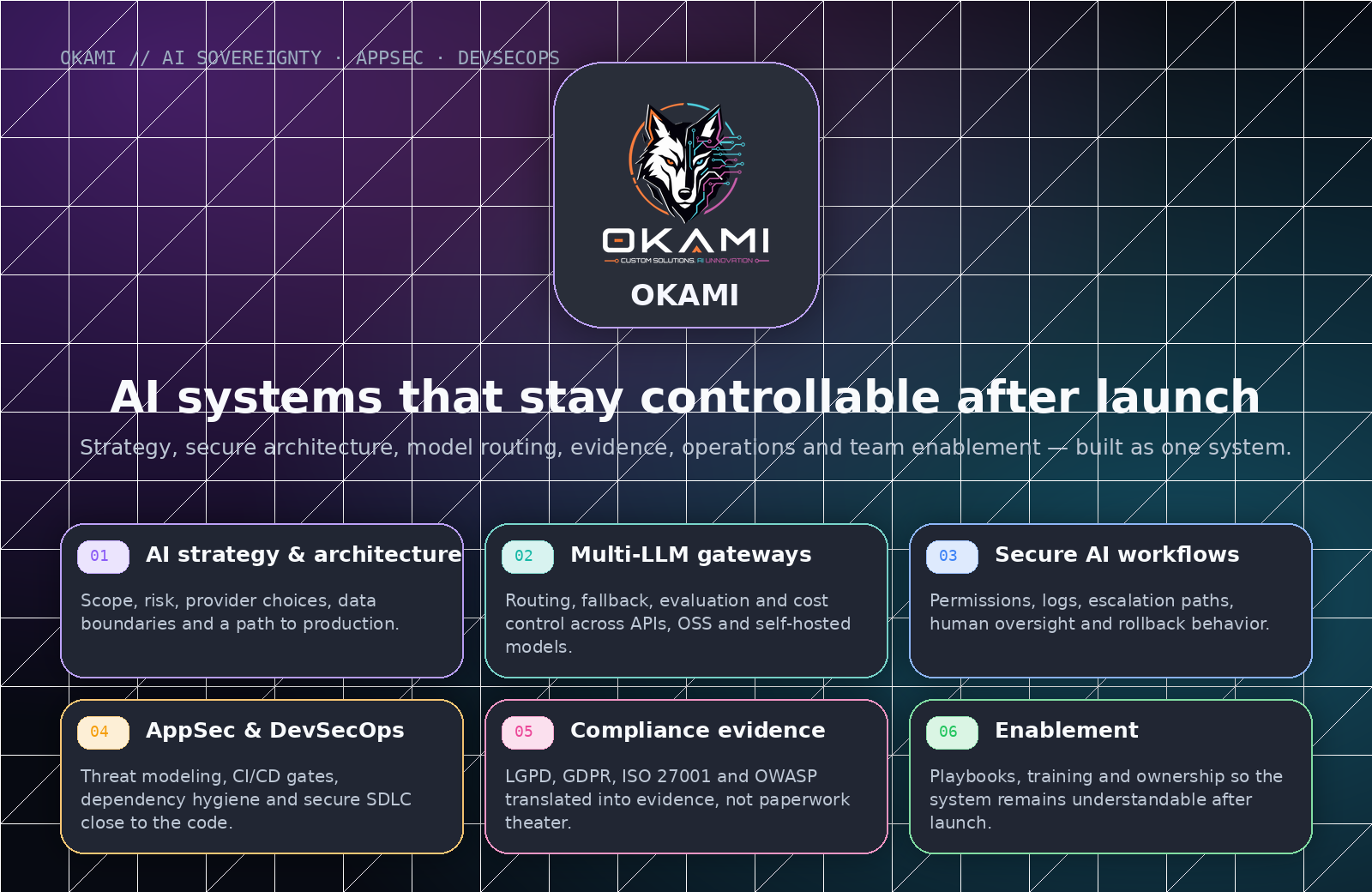
We work where AI ideas start touching production risk: model routing, secure workflows, internal tools, compliance evidence, CI/CD gates, observability and operating discipline.
Useful AI. Security by design. Provider freedom. Evidence before scale.
Important
AI prototypes usually fail after the demo. Okami designs the operating layer around them: permissions, logs, fallback behavior, evaluation, rollback and ownership.
Note
Security is not a late review. We bring AppSec and DevSecOps into the architecture, delivery pipeline and evidence model from the beginning.
Tip
Provider choice should stay open. We design for model routing, fallback and evaluation across commercial APIs, open-source models and self-hosted deployments.
- Architecture that can be defended — decision records, diagrams, provider strategy and data boundaries.
- A working PoC with numbers — real inputs, measurable quality, cost, latency and failure cases.
- A security model close to the code — threat model, controls, CI/CD gates and dependency posture.
- Evaluation that survives change — model comparisons, regression checks and practical acceptance criteria.
- Operational ownership — runbooks, observability, fallback behavior, rollback and responsibility.
- Evidence instead of theater — logs, test output, audit artifacts and compliance-ready documentation.
What “controlled PoC” means at Okami
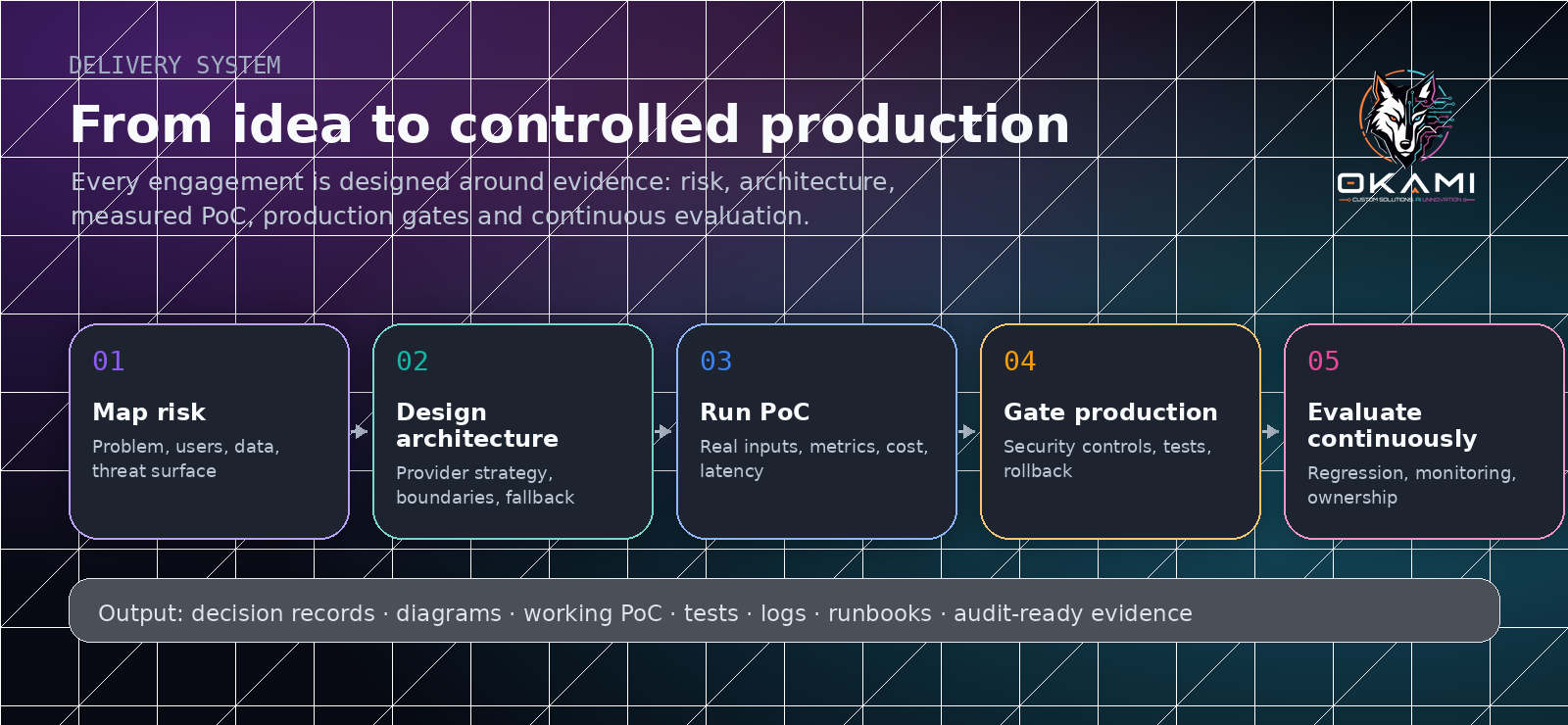
A PoC is not a pretty prototype with no accountability. It needs real inputs, measurable output quality, visible cost, latency numbers, security boundaries, fallback behavior and a clear answer to:
Should this go to production, change shape or die early?
What “production-ready” means here
Production-ready means the system has boundaries, monitoring, rollback, ownership and evidence. If nobody knows what changed, why it changed, what it cost, how to reverse it or who owns it, it is not ready.
okami:
  posture: "AI sovereignty"
  security: "AppSec + DevSecOps"
  architecture: "multi-LLM, provider-flexible"
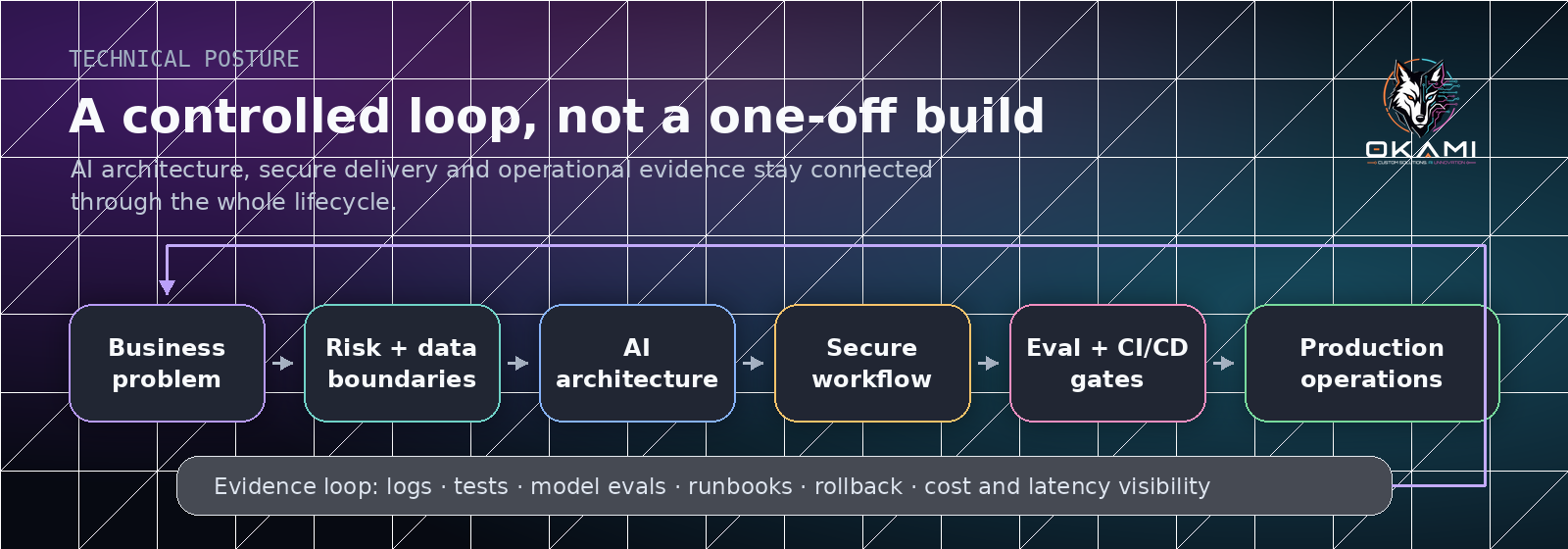
  delivery: "risk map → controlled PoC → production gates"
  evidence: "logs, tests, evals, runbooks, rollback"
  regions: ["São Paulo", "Munich"]
LGPD
GDPR
ISO 27001
OWASP SAMM
OWASP ASVS
NIST
PCI-DSS


okami-SAMM— security maturity and AppSec-oriented public work.Okami-Monitor— monitoring and operational visibility experiments..github— public organization profile and GitHub surface.
- Useful technology beats hype. If it does not survive real inputs, it is decoration.
- Security belongs in the architecture. Not as a panic meeting two days before launch.
- Compliance should produce evidence. The artifact matters because the operating habit matters.
- Cost must be visible before scale. AI without cost visibility becomes a billing surprise.
- The system must remain understandable. Teams should know how it works after the first launch.