Add campaign CRUD client methods and check management#611
Conversation


 jamescarr
force-pushed
the
jamescarr/add-campaign-crud
branch
from
jamescarr
force-pushed
the
jamescarr/add-campaign-crud
branch
from
7877f45 to
ea1f16b
Compare
jamescarr
changed the title

Adds GetCampaign, CreateCampaign, UpdateCampaign, DeleteCampaign,
ScheduleCampaign, and UnscheduleCampaign client methods along with
their corresponding input and payload types. These are needed by
the terraform-provider-opslevel campaign resource.

Made-with: Cursor
jamescarr
force-pushed
the
jamescarr/add-campaign-crud
branch
from
ea1f16b to
2fc76ed
Compare
The OpsLevel API doesn't have a campaignSchedule mutation. Scheduling
is done by passing startDate/targetDate in campaignCreate/campaignUpdate.
Removes ScheduleCampaign method and CampaignScheduleUpdateInput.

Made-with: Cursor
The OpsLevel API uses a separate campaignScheduleUpdate mutation
(not campaignSchedule, and not fields on create/update inputs).
Also uses generic DeleteInput for campaignDelete/campaignUnschedule.

Made-with: Cursor
Made-with: Cursor
Replace CheckIdsToCopy on CampaignCreateInput with a dedicated
CopyChecksToCampaign method that calls the checksCopyToCampaign
GraphQL mutation. This is the correct API for associating rubric
checks with a campaign after creation.

Changes:
- Add ChecksCopyToCampaignInput and ChecksCopyToCampaignPayload types
- Add Client.CopyChecksToCampaign method
- Remove CheckIdsToCopy from CampaignCreateInput (not a real API field)
- Add comprehensive tests for all campaign CRUD operations
  (Create, Get, Update, Delete, Schedule, Unschedule, CopyChecks)
- Add test fixtures in campaigns.tpl for all operations

Made-with: Cursor
Adds a lightweight query for fetching a campaign's checks (id + name only)
to enable matching and deleting campaign checks when rubric check IDs are
removed from the Terraform resource's check_ids list.

Made-with: Cursor

|
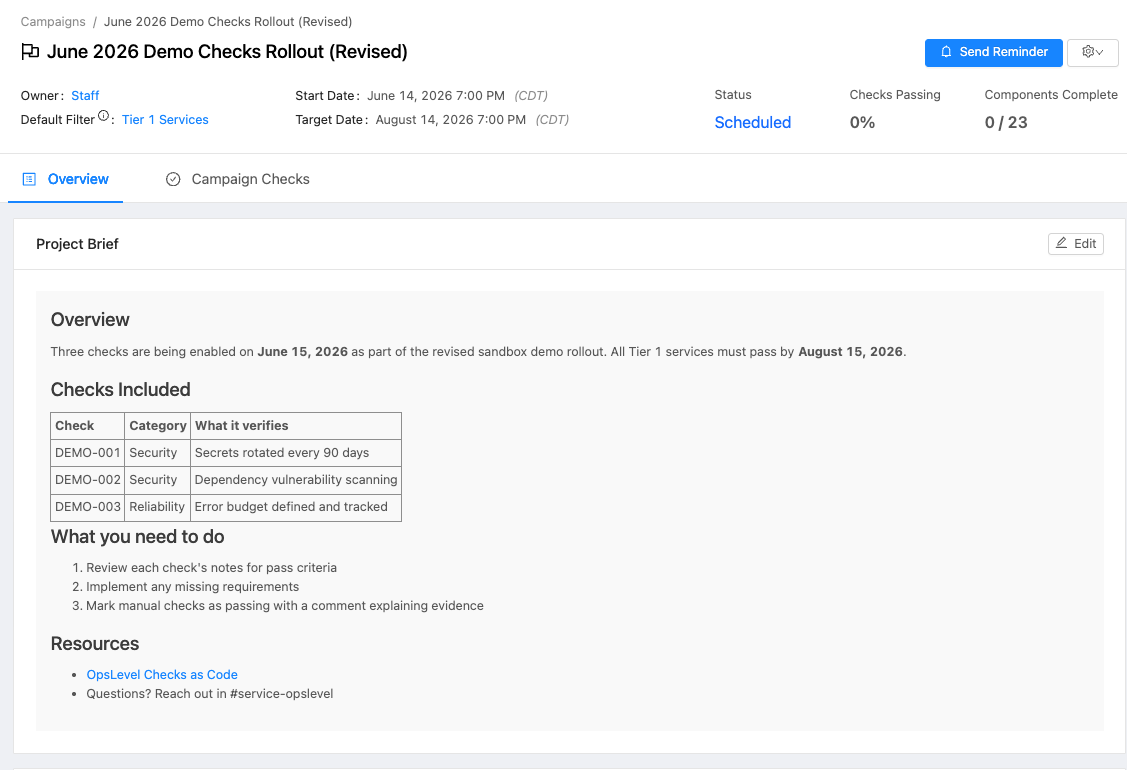
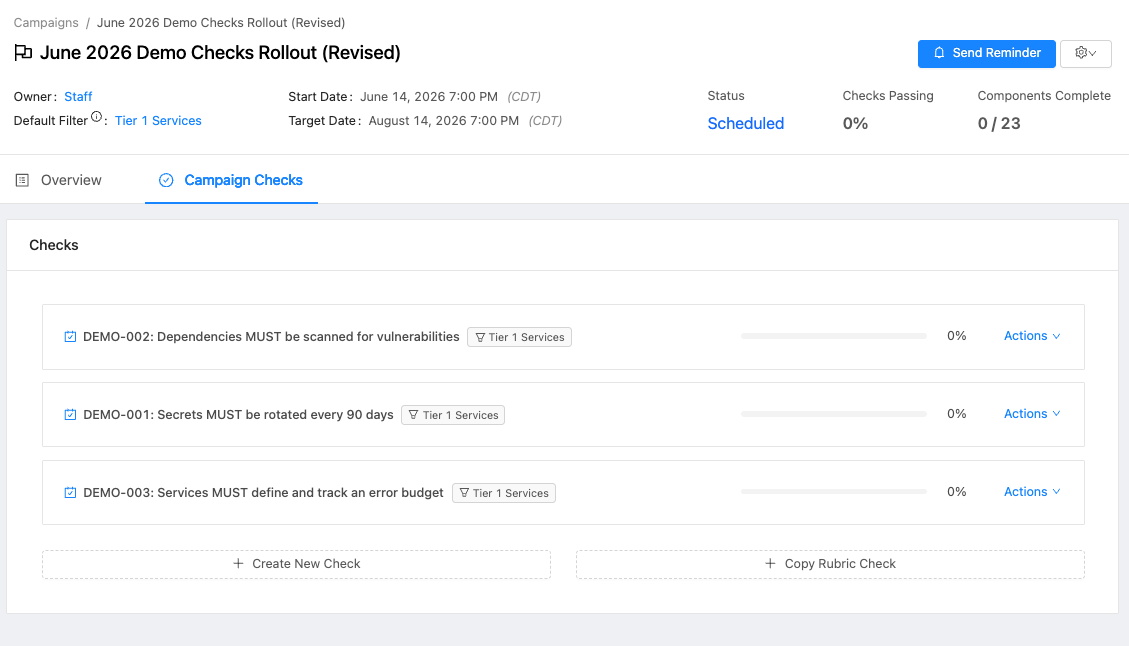
Alright, tested a full path of create, update and delete. required_providers {
opslevel = {
source = "jamescarr/opslevel"
version = "1.10.9"
}resource "opslevel_campaign" "demo_may_rollout" {
name = "June 2026 Demo Checks Rollout (Revised)"
owner_id = data.opslevel_team.staff.id
filter_id = data.opslevel_filter.tier1.id
start_date = "2026-06-15"
target_date = "2026-08-15"
check_ids = [
opslevel_check_manual.demo_secret_rotation.id,
opslevel_check_manual.demo_dependency_scanning.id,
opslevel_check_manual.demo_error_budget.id,
]
project_brief = <<-EOT
## Overview
Three checks are being enabled on **June 15, 2026** as part of the
revised sandbox demo rollout. All Tier 1 services must pass by **August 15, 2026**.
## Checks Included
| Check | Category | What it verifies |
|-------|----------|-----------------|
| DEMO-001 | Security | Secrets rotated every 90 days |
| DEMO-002 | Security | Dependency vulnerability scanning |
| DEMO-003 | Reliability | Error budget defined and tracked |
## What you need to do
1. Review each check's notes for pass criteria
2. Implement any missing requirements
3. Mark manual checks as passing with a comment explaining evidence
## Resources
- [OpsLevel Checks as Code](https://engineering.index/guides/architecture/opslevel-checks/)
- Questions? Reach out in #service-opslevel
EOT
}Opslevel Output
|
Adds a test verifying ListCampaignChecks returns an empty slice
when a campaign has no checks, plus the supporting template.

Made-with: Cursor
jamescarr
changed the title
jamescarr
changed the title
…cursive pagination

Aligns GetCampaign with the empty-ID convention used by GetCategory,
GetScorecard, etc. Converts ListCampaignChecks from iterative to
recursive pagination to match the rest of the SDK.

Made-with: Cursor
jamescarr
force-pushed
the
jamescarr/add-campaign-crud
branch
from
c154bf6 to
5795287
Compare

|
@andrewstillv15 🔴 P0 —
|
2 participants


Closes #612
Add full campaign lifecycle management to the Go SDK via GraphQL.
Problem
The OpsLevel GraphQL API exposes full campaign mutation support (
campaignCreate,campaignUpdate,campaignDelete,campaignScheduleUpdate,campaignUnschedule,campaignEnd) pluschecksCopyToCampaignfor associating checks, but the Go SDK only has aListCampaignsquery. There are no client methods for creating, reading, updating, deleting, scheduling, or managing campaign checks — which blocks the Terraform provider from managing campaigns as code.Solution
Input types (
input.go):Added GraphQL input structs matching the API schema:
CampaignCreateInput— name, ownerId, filterId, projectBrief, checkIdsToCopy, reminderCampaignUpdateInput— id + optional fields for name, ownerId, filterId, projectBrief, reminderCampaignScheduleUpdateInput— id, startDate, targetDateCampaignEndInput— id, checksToPromoteCampaignUnscheduleInput— idCampaignReminderInput— frequency, frequencyUnit, timeOfDay, timezone, channels, message, daysOfWeek, defaultSlackChannelChecksCopyToCampaignInput— campaignId, checkIdsPayload types (
payload.go):Added response types for each mutation:
CampaignCreatePayload,CampaignUpdatePayload,CampaignDeletePayload,CampaignScheduleUpdatePayload,CampaignUnschedulePayload,CampaignEndPayload,ChecksCopyToCampaignPayload.Client methods (
campaign.go):GetCampaign(id)account.campaign(id:)CreateCampaign(input)campaignCreateUpdateCampaign(input)campaignUpdateDeleteCampaign(id)campaignDeleteScheduleCampaign(input)campaignScheduleUpdateUnscheduleCampaign(id)campaignUnscheduleEndCampaign(input)campaignEndCopyChecksToCampaign(input)checksCopyToCampaignListCampaignChecks(id)account.campaign.checksAll methods follow the existing SDK patterns (
client.Mutate/client.Query+HandleErrors).GetCampaignuses theaccount { campaign(id: $id) }query path discovered via schema introspection.Tests (
campaign_test.go):Full test coverage for all new methods including edge cases:
CopyChecksToCampaignListCampaignChecks(with results and empty campaign)Checklist