





linkgym is a reinforcement-learning environment (Gymnasium API) for 5G NR link adaptation
(MCS selection) built on NVIDIA Sionna: Sionna SYS models the link, and the channel is 3GPP
TDL fading or ray-traced with Sionna RT. It comes with classical baselines and a fixed
evaluation protocol. Its building blocks can also be used to build other environments, such
as beam management: link-level functions (linkgym.phy), DFT beam codebooks
(linkgym.beams) and per-antenna channels rebuilt from ray-traced paths (linkgym.paths),
the last two experimental.
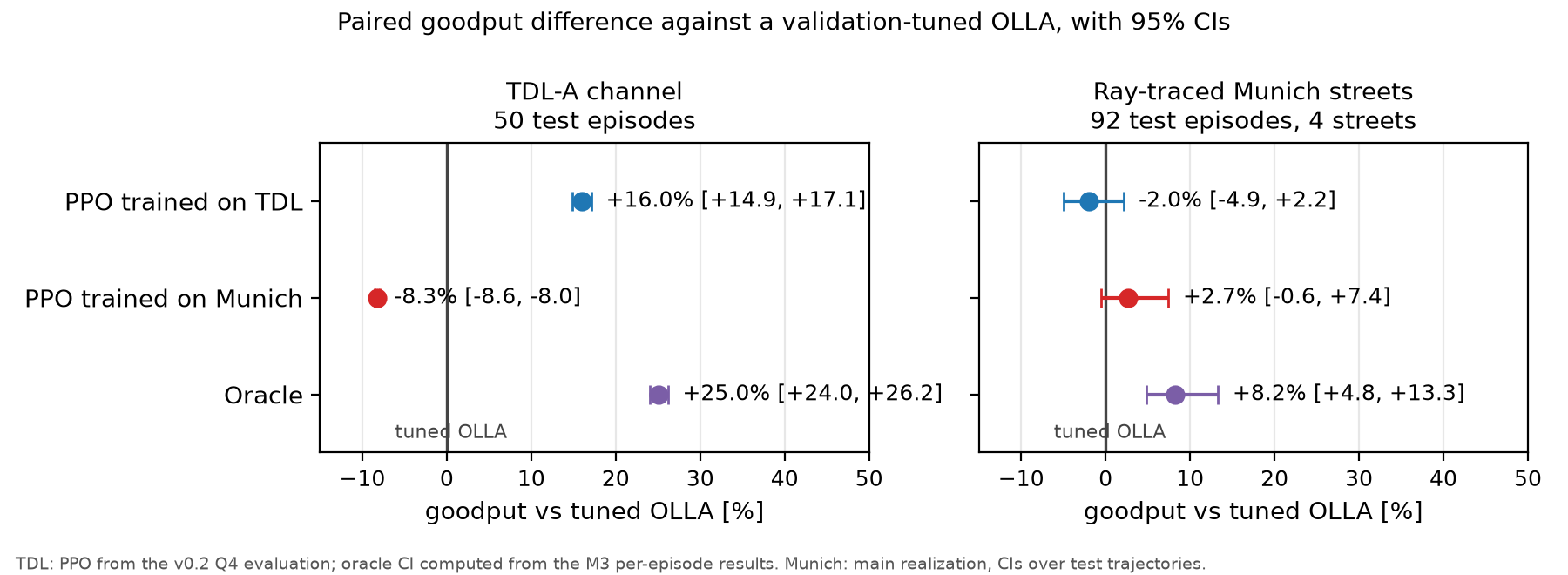
Paired goodput difference against Sionna's OLLA tuned on validation data, with 95% CIs. Left: the default TDL-A scenario, 50 held-out test episodes. Right: 92 episodes on four held-out ray-traced Munich streets (main ray-tracing realization; the CIs resample the 23 test trajectories). Each PPO is the mean of three training seeds; the CIs do not include training-seed variance. The oracle knows the channel of the slot being decided; its CI on TDL is computed from the M3 per-episode results. Details: TDL results, Munich results.
On the default TDL channel, PPO trained on linkgym delivers +16.0% goodput over a validation-tuned OLLA (95% CI [+14.9%, +17.1%], 50 held-out episodes). On ray-traced streets in Munich (Sionna RT, four held-out streets), that advantage is gone: there is no detectable difference from tuned OLLA, neither for PPO trained on TDL (-2.0%, CI [-4.9%, +2.2%]) nor for PPO trained on the Munich training streets (+2.7%, CI [-0.6%, +7.4%]). Training on the site does beat training on TDL, by +4.8% (CI [+4.0%, +5.5%]), in every route category and on two ray-tracing realizations. Each policy does best on the kind of channel it was trained on: PPO trained on Munich is 8.3% below tuned OLLA on TDL.
Recent RL link-adaptation studies on Sionna (see Related work) each build their own
environment. linkgym is a reusable, pip-installable Gymnasium environment,
registered as linkgym/LinkAdaptation-v0, with built-in baselines (fixed MCS, ILLA, OLLA,
oracle) and a fixed evaluation protocol. All policies are evaluated with common random
numbers: for a given seed, every policy faces the same channel and the same ACK draws.
Besides 3GPP TDL fading, the environment runs on channel traces: a published ray-traced
dataset of Munich streets, traces you generate from your own Sionna RT scene, or any
channel you can write as an array of gains.
pip install linkgym           # environment and baselines
pip install "linkgym[train]"  # adds Stable-Baselines3 and TensorBoard for the PPO example
From source, with the training extras:
git clone https://github.com/Tempip/linkgym.git
cd linkgym
pip install -e ".[train]"
Requires Python >= 3.11 (tested on 3.11 and 3.12); sionna-no-rt 2.1.x is installed
automatically. A CPU-only PyTorch build is enough. To avoid downloading CUDA wheels, install
it first with pip install torch --index-url https://download.pytorch.org/whl/cpu. The
simulator runs faster with one torch thread; call torch.set_num_threads(1) in your own
script (the package does not change it).
To generate traces with Sionna RT, install pip install "linkgym[rt]" in a separate
environment: installing it where you train can break imports on machines without a CUDA
GPU or LLVM
(why).
Create the environment and evaluate Sionna's OLLA with linkgym.evaluate:
import gymnasium as gym

import linkgym
from linkgym.baselines import OLLAPolicy

env = gym.make("linkgym/LinkAdaptation-v0", speed=3.0)  # any ScenarioConfig field
obs, info = env.reset(seed=0)
obs, reward, terminated, truncated, info = env.step(env.action_space.sample())

result = linkgym.evaluate(
    OLLAPolicy(bler_target=0.1), env_kwargs={"speed": 3.0}, seeds=[1000, 1001]
)
print(result["goodput_mbps"]["mean"], result["observed_tbler"]["mean"])
Train PPO with Stable-Baselines3 and evaluate it the same way. This needs the [train] extra
(pip install "linkgym[train]"); it is a short run, the results below use 1M steps:
import gymnasium as gym
from stable_baselines3 import PPO
from stable_baselines3.common.env_util import make_vec_env

import linkgym
from linkgym.baselines import SB3Policy

vec_env = make_vec_env(lambda: gym.make("linkgym/LinkAdaptation-v0"), n_envs=4, seed=0)
model = PPO("MlpPolicy", vec_env, gamma=0.0, seed=0).learn(total_timesteps=8_192)
print(linkgym.evaluate(SB3Policy(model), seeds=[1000])["goodput_mbps"]["mean"])
A longer walk-through is in examples/quickstart.ipynb.
Default scenario, held-out test seeds 1000-1009, 5 episodes each (50 episodes of 1000 slots). Means over the test seeds; PPO is the mean of 3 training seeds (std 0.04 Mbit/s across them). All policies except the oracle observe exactly the same delayed feedback (wideband SINR, HARQ ACK/NACK, MCS used).
| policy | goodput Mbit/s | observed TBLER |
|---|---|---|
| fixed MCS 14 | 23.34 | 0.277 |
| ILLA, no outer loop (target 0.1) | 19.45 | 0.524 |
OLLA, default step (target 0.1, delta_up 1 dB) |
30.35 | 0.103 |
OLLA, tuned on validation seeds (target 0.1, delta_up 0.25 dB) |
30.89 | 0.110 |
| PPO, gamma = 0 | 35.82 | 0.067 |
| oracle (ILLA on the channel of the current slot) | 38.62 | 0.026 |
PPO vs tuned OLLA, paired over the 50 test episodes: +4.93 Mbit/s (+16.0%) goodput per episode, 95% bootstrap CI [+4.65, +5.21] Mbit/s ([+14.9%, +17.1%]). The protocol, validation-based selection, the other comparisons and the figures are in docs/results/m3/README.md. These results hold for this TDL scenario only.
The Munich dataset: 15 streets around one rooftop base station, split by
street into train (8), val (3) and test (4). Test: 92 episodes of 1000 slots on 23
trajectories. OLLA was tuned on the val streets (target 0.05, delta_up 0.25 dB), PPO
trained on the train streets (3 training seeds, means reported), and the protocol was
committed before training. Paired differences with 95% cluster bootstrap CIs over test
trajectories; "holds" means the classification (better, worse, no detectable difference)
is the same on a second ray-tracing realization of the test streets.
| comparison | goodput difference | verdict |
|---|---|---|
| PPO trained on TDL - tuned OLLA | -0.71 Mbit/s (-2.0%), CI [-4.9%, +2.2%] | inconclusive |
| PPO trained on Munich - tuned OLLA | +0.96 Mbit/s (+2.7%), CI [-0.6%, +7.4%] | inconclusive |
| PPO trained on Munich - PPO trained on TDL | +1.67 Mbit/s (+4.8%), CI [+4.0%, +5.5%] | holds, in every route category |
| policy | goodput Mbit/s | observed TBLER |
|---|---|---|
| fixed MCS 14 | 21.79 | 0.325 |
| ILLA, no outer loop (target 0.1) | 30.64 | 0.320 |
OLLA, default step (target 0.1, delta_up 1 dB) |
35.52 | 0.172 |
OLLA, tuned on the val streets (target 0.05, delta_up 0.25 dB) |
35.82 | 0.129 |
| PPO trained on TDL | 35.11 | 0.125 |
| PPO trained on Munich | 36.78 | 0.113 |
| oracle | 38.77 | 0.110 |
Against tuned OLLA, by route category, PPO trained on TDL is worse on the line-of-sight street and PPO trained on Munich better on the NLoS streets; the other differences are inconclusive. Tuned OLLA is within 3 Mbit/s of the oracle here, which leaves less room than on TDL. With the default SNR normalization, 9% of the test slots are outages in which even the lowest MCS has a TBLER above 5%; a post hoc analysis shows that they account for tuned OLLA's observed TBLER of 0.129 against its 0.05 target. Protocol, per-category and per-route results, both realizations and the analysis: docs/results/v02/README.md.
Ray-traced channel traces of 15 streets around one rooftop base station in Sionna RT's
munich scene: 76 trajectories of 4000 slots (2 s at 15 m/s), 52 PRBs at 3.5 GHz, split
by street into train, val and test, plus a second ray-tracing realization of the test
streets. Published on Zenodo under the Open Database License (ODbL) 1.0, in two versions;
cite the version you use, the one fetch downloads:
- v1, DOI 10.5281/zenodo.23135098: the gain
per slot and PRB of a single-antenna link (
munich-v1, 67 MB, andmunich-v1-test-alt), forchannel="trace". The v0.2 results use it. - v2, DOI 10.5281/zenodo.23267742: the
ray-traced paths of the same trajectories (
munich-v2, 318 MB, andmunich-v2-test-alt), from whichlinkgym.pathsrebuilds the channel of every antenna of a transmit array and the gains of codebook beams; a single antenna gives back the v1 gains. The v2 record also holds the v1 files.
All versions, resolving to the latest, are under 10.5281/zenodo.23135097. The scene derives from OpenStreetMap data, (c) OpenStreetMap contributors.
linkgym.datasets.fetch downloads a file once, verifies its SHA-256 and returns its path:
import gymnasium as gym

from linkgym.datasets import fetch

path = fetch("munich-v1")  # 67 MB, cached in ~/.cache/linkgym (or $LINKGYM_DATA_DIR)
env = gym.make(
    "linkgym/LinkAdaptation-v0", channel="trace", trace_path=str(path), trace_splits=["train"]
)
obs, info = env.reset(seed=0)
print(env.unwrapped.channel_info)  # trajectory, start slot, split, route category, SNR
How it was generated, its statistics and its known limitations (the ray tracing does not converge within the ray budget; refraction is off) are in docs/channels.md; how to use the paths of v2 with an antenna array, in docs/paths.md.
Any channel you can write as linear power gains per trajectory, slot and PRB works: write
it with write_trace, label each trajectory with a split, and pass the file to the
environment.
import gymnasium as gym
import numpy as np

from linkgym.channels import write_trace

# |h|^2 for 3 trajectories of 2000 slots and 52 PRBs: here Rayleigh block fading
gain = np.repeat(np.random.default_rng(0).exponential(size=(3, 200, 52)), 10, axis=1)
write_trace(
    "my_channel.h5",
    gain,
    split=["train", "val", "test"],
    carrier_frequency_hz=3.5e9,  # must match the scenario
    subcarrier_spacing_hz=30e3,
    slot_duration_s=0.5e-3,
)
env = gym.make("linkgym/LinkAdaptation-v0", channel="trace", trace_path="my_channel.h5")
For ray-traced traces, the linkgym-traces command (from the rt extra) computes them
with Sionna RT from a JSON configuration: a scene (a built-in one or your own Mitsuba XML),
a transmitter and routes split by street. The
tutorial goes from a
scene to a trained and evaluated agent, step by step;
docs/channels.md documents
the trace format, the SNR modes and the generator.
Three modules can be used outside LinkAdaptation-v0, for example in a multi-user or
beam-management environment of your own:
linkgym.phy(stable): the link-level functions the environment's simulator uses.effective_sinrgives the EESM effective SINR.transmitgives the ACK, delivered bits and TBLER of a transport block, from uniforms you provide, so different policies face the same draws. See docs/phy.md.linkgym.beams(experimental): DFT codebooks for linear and planar arrays, steering vectors, beam gain, RSRP and best beam, consistent with Sionna RT's arrays. See docs/beams.md.linkgym.paths(experimental): trace format 2, which stores the ray-traced paths of a trace, andPathTraceSource, which rebuilds from them the channel of every antenna of any transmit array (size, spacing, orientation) and the gain of every beam of a codebook, as Sionna RT's synthetic arrays do.linkgym-traces generate --store-pathswrites such traces, and the Munich dataset v2 is one. See docs/paths.md.
Which parts of linkgym are stable, and what a patch or minor release may change, is set out in docs/api_stability.md.
linkgym/LinkAdaptation-v0 |
|
|---|---|
| Action | Discrete(26): MCS 3-28 of the 5G NR PDSCH MCS table 1 |
| Observation | Box(-1, 1, (12,)): the last 4 reports (wideband SINR, HARQ ACK/NACK, MCS used), delayed by the feedback delay |
| Reward | delivered bits of the slot divided by the TB size of MCS 28, in [0, 1] |
| Episode | 1000 slots, then truncated=True; never terminated |
| Channel | channel="tdl" (default): 3GPP TDL fading generated with Sionna; channel="trace": an HDF5 trace, a trajectory and window drawn per episode from trace_splits |
| Default scenario | single cell, single SISO link, 3GPP TDL-A, 100 ns delay spread, 3.5 GHz, 15 m/s, 52 PRB at 30 kHz, mean SNR drawn per episode from U(5, 20) dB, feedback delay 1 slot |
Every scenario field can be passed to gym.make. Timing, observation layout and info keys
are in docs/environment.md,
the channel options in
docs/channels.md.
TDL (v0.1), in Bash:
pip install -e ".[train]"
for gamma in 0 0.9; do
  for seed in 0 1 2; do
    python examples/train_ppo.py --gamma $gamma --seed $seed
  done
done
python examples/evaluate_all.py
PowerShell:
pip install -e ".[train]"
foreach ($gamma in "0", "0.9") {
  foreach ($seed in 0, 1, 2) {
    python examples/train_ppo.py --gamma $gamma --seed $seed
  }
}
python examples/evaluate_all.py
Munich (v0.2), after the TDL runs above (the evaluation also uses the gamma = 0 TDL
models). The first line downloads both dataset files to data/. In Bash:
LINKGYM_DATA_DIR=data python -m linkgym.datasets munich-v1 munich-v1-test-alt
for seed in 0 1 2; do
  python examples/train_ppo.py --gamma 0 --seed $seed --channel trace --trace-path data/munich-v1.h5 --eval-freq 100000
done
for phase in validation test q4 report; do python examples/evaluate_v02.py $phase; done
PowerShell:
$env:LINKGYM_DATA_DIR = "data"; python -m linkgym.datasets munich-v1 munich-v1-test-alt
foreach ($seed in 0, 1, 2) {
  python examples/train_ppo.py --gamma 0 --seed $seed --channel trace --trace-path data/munich-v1.h5 --eval-freq 100000
}
foreach ($phase in "validation", "test", "q4", "report") { python examples/evaluate_v02.py $phase }
Measured on an AMD Ryzen 7 7700X (8 cores, 16 threads), Windows 11, CPU only (torch 2.14.0+cpu, sionna-no-rt 2.1.0):
- TDL: each training run, 1,015,808 steps with 8
SubprocVecEnvworkers, took 654-657 s; the six runs took 67 minutes one after another.evaluate_all.py, on 8 worker processes: 42 s for the OLLA tuning grid on the validation seeds, then 535 s for all test evaluations. It writes the tables and figures todocs/results/m3/. - Munich: each training run took 1169-1201 s, including 12 validation passes. The
evaluate_v02.pyphases took 347 s (validation), 583 s (test) and 103 s (q4) on 8 worker processes;reportwrites the tables and figures todocs/results/v02/. The test phase refuses to run again once its results exist.
Numbers can differ slightly on other hardware, operating systems or library versions; the committed CSVs are the reference.
- A simplified link-level simulator: a single SISO link, a SINR-to-BLER abstraction with coarse BLER tables, no HARQ retransmissions, no interference, no channel estimation error.
- Few channels: one TDL scenario, and one ray-traced site with one base station, where the test split has four streets (one line-of-sight, one transition, two NLoS). The Munich results describe these streets, not sites in general.
- The ray tracing does not converge within the ray budget: the dataset is one deterministic realization, with refraction off. All Munich verdicts were the same on a second realization, which is one other ray budget, not an independent channel.
- The default SNR normalization divides each trajectory by its mean linear gain, which puts the weak stretches of trajectories with a large dynamic range into outage (9% of the Munich test slots); these slots raise every policy's observed TBLER.
- PPO uses Stable-Baselines3 default hyperparameters, 1M steps and 3 training seeds; the confidence intervals do not include training-seed variance.
- OLLA and PPO optimise different objectives: OLLA holds a TBLER target, PPO maximises goodput; the comparison is in goodput, with TBLER reported alongside.
- The oracle knows the current slot's channel and is not achievable in practice.
- A policy learned in this simulator adapts to its abstraction; the results may not transfer to real systems.
Full lists: TDL results, Munich results, Munich traces, simulator, environment.
Multi-antenna channels and beam management, one small release at a time, on top of the
building blocks released in 0.3 (linkgym.phy, linkgym.beams) and 0.4 (linkgym.paths);
the published results stay unchanged.
- 0.4 (released): trace format 2, which stores the ray-traced paths at the anchors, so
that the per-antenna channel can be rebuilt for any array and codebook; the generator
option to write it (
--store-paths), the reconstruction, theArrayChannelSourceinterface withPathTraceSource, and the Munich 3.5 GHz paths dataset (v2) on Zenodo. The element pattern and polarization are fixed at generation and recorded in the attributes. - 0.5: a cache of beam gains for a chosen array and codebook, and sampling and evaluation of several simultaneous users from a trace.
- 0.6 (optional): an FR2 (28 GHz) dataset and/or a statistical multi-antenna channel source based on 3GPP CDL.
Other planned work:
- A median-based normalization option for trace channels: the mean linear gain used now lets a short strong stretch push the rest of a trajectory into outage (channels).
- Include the agent's own pending actions in the observation when the feedback delay is larger than one slot.
- A variant with a continuous SINR-offset action.
- A reward variant with a TBLER constraint.
- Vectorised, batched environments for faster training.
Later:
- Ray-traced datasets of more sites and base stations, to test transfer across sites.
- PDSCH MCS table 2 (256-QAM, BLER data up to 25 dB).
Setup, checks and commit conventions are in CONTRIBUTING.md.
Link adaptation with RL on Sionna:
- sionna-rl: a reproducible study comparing PPO against Sionna's OLLA for single-link MCS selection.
- M. Tsampazi, N. N. Santhi, N. Perrotta, F. Dressler, T. Melodia, "ARIADNE: AI-RAN Informed Link Adaptation in Digital Twin Network Environments", European Wireless 2026. arXiv:2605.29772. RL (PPO) link adaptation integrated with Sionna SYS over ray-traced channels, compared against OLLA and SALAD.
Other RL environments for wireless networks:
- mobile-env: a Gymnasium environment for coordination in wireless mobile networks, such as multi-cell selection, with single- and multi-agent RL.
- ns-O-RAN Gym: a Gymnasium environment for online RL in 5G Open RAN on the ns-3-based ns-O-RAN simulator, with traffic-steering and energy-saving use cases.
- RFRL Gym: a reinforcement-learning training environment for cognitive radio applications in the RF spectrum, such as jamming, with multi-agent support.
Ray-traced channels with Sionna RT:
- ns3sionna: an ns-3 module that computes realistic channels by ray tracing with Sionna RT for network simulation.
- RL-AERPAW-DT: a Sionna RT digital twin of UAV-assisted communication in downtown Raleigh, compared with the AERPAW path-loss model, with a reinforcement-learning pipeline for UAV control in progress.
linkgym differs from the first group in being a reusable, registered Gymnasium environment rather than a single study, and from the second in modelling the link level (MCS selection on Sionna SYS) rather than network-level coordination.
If you use linkgym, please cite it:
@software{rodrigues2026linkgym,
  author  = {Rodrigues Souza, Pedro José},
  title   = {linkgym: A Gymnasium environment for 5G NR link adaptation},
  year    = {2026},
  version = {0.4.0},
  doi     = {10.5281/zenodo.23270700},
  url     = {https://github.com/Tempip/linkgym}
}
and, if you use the Munich traces, the dataset version you used: v1 for the gains, v2 for the paths.
@dataset{rodrigues2026munich,
  author    = {Rodrigues Souza, Pedro José},
  title     = {linkgym Munich ray-traced channel traces, v1},
  year      = {2026},
  version   = {v1},
  publisher = {Zenodo},
  doi       = {10.5281/zenodo.23135098}
}

@dataset{rodrigues2026munich_v2,
  author    = {Rodrigues Souza, Pedro José},
  title     = {linkgym Munich ray-traced channel traces, v2},
  year      = {2026},
  version   = {v2},
  publisher = {Zenodo},
  doi       = {10.5281/zenodo.23267742}
}
GitHub's "Cite this repository" button uses CITATION.cff.
The code is MIT licensed. See LICENSE.
The Munich dataset is licensed under the Open Database License (ODbL) 1.0; it derives from
OpenStreetMap data, (c) OpenStreetMap contributors. The same applies to the small samples of
it in tests/data/munich_sample.h5 and tests/data/munich_paths_sample.h5, and the route
figure docs/assets/munich_routes.png shows OpenStreetMap-derived buildings.
This project is not affiliated with or endorsed by NVIDIA. Sionna is a trademark of NVIDIA Corporation.