elevata® is an Architecture Runtime for modern data platforms.
It turns metadata into deterministic, executable data architecture. Architecture is defined declaratively and executed consistently across warehouses.
SQL becomes an artifact. Architecture becomes metadata.
The same metadata-defined architecture can be rendered, reviewed, and executed consistently on:
Snowflake · Databricks · Fabric · MSSQL · Postgres · DuckDB · BigQuery
without rewriting logic or introducing dialect-specific modeling.
elevata separates:
- Logical architecture
- Dialect rendering
- Execution backend
This makes data architecture portable, reproducible, governable, and auditable.




elevata is an Architecture Runtime for metadata-defined data platforms.
It models datasets, lineage, contracts, governance, and execution semantics as explicit metadata.
From these definitions, elevata derives deterministic Target Generation Plans and SQL Logical Plans, renders dialect-owned SQL, reviews architecture changes, and executes warehouse-native pipelines through controlled runtime scopes.
Target metadata generation, schema evolution, incremental loads, historization, approvals, and execution evidence are planned, validated, and applied deterministically.
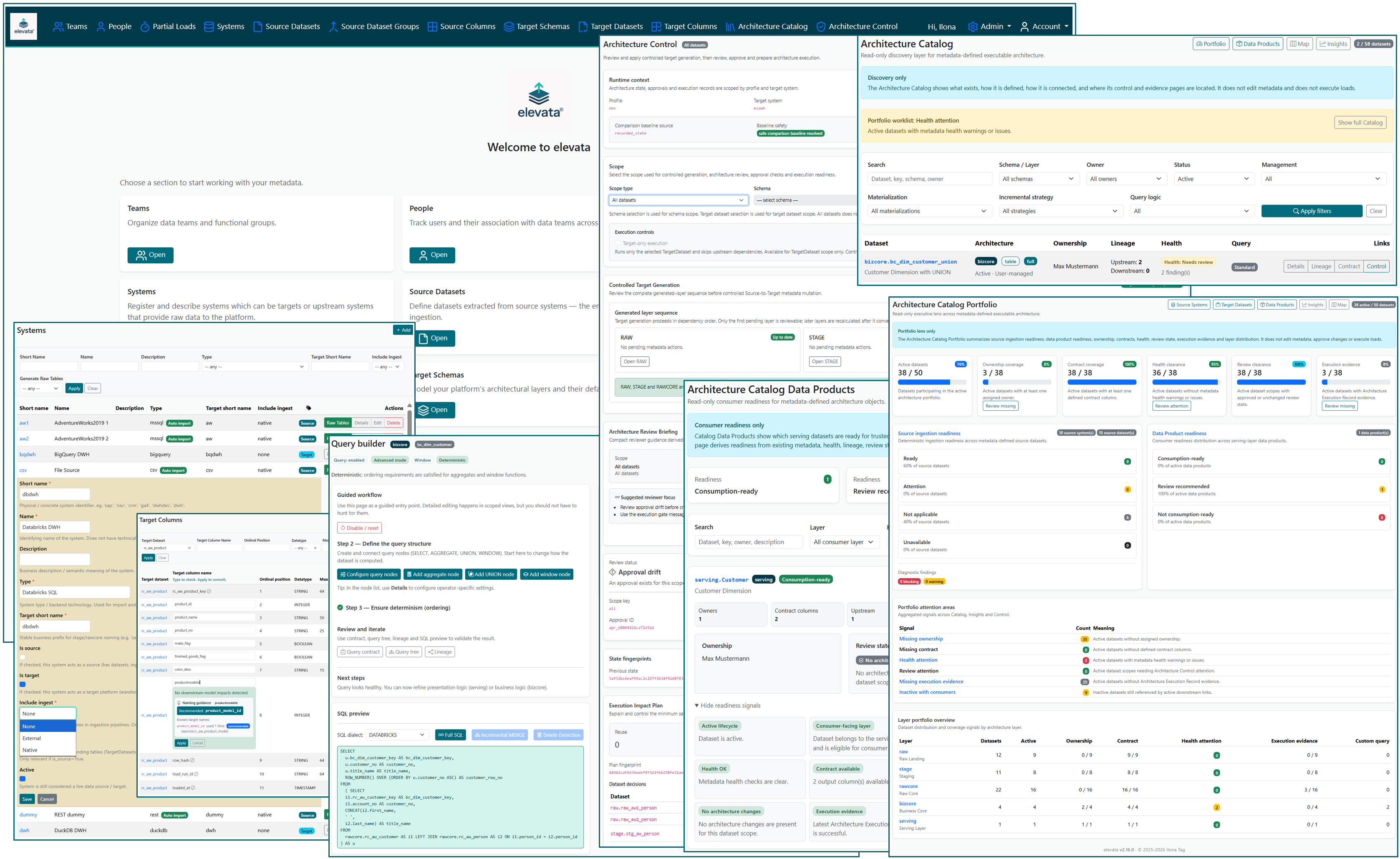
Architecture Runtime UI for discovering, controlling, modeling, and executing metadata-defined data architecture
Most data platforms encode architecture implicitly in SQL and pipeline code.
elevata makes architecture explicit.
- Metadata defines behavior.
- Dialects own SQL shape.
- Control makes changes reviewable and auditable.
- Execution is deterministic, observable, and evidence-based.
The result is governed, explainable, portable, and executable data architecture.
Modern data platforms often fail not because of missing tools, but because
architecture, lineage, and governance are encoded implicitly in SQL and pipeline code.
elevata exists to make these concerns explicit, declarative, and reproducible.
The Architecture Runtime concept behind elevata is described in the publication section:
These publications explain why modern data platforms need metadata-defined, deterministic, controllable, executable, and auditable architecture.
The core elevata architecture pipeline consists of five explicitly separated layers:
- Metadata Model
- Controlled Target Metadata Generation
- Deterministic SQL Logical Plan
- Dialect Rendering
- Warehouse-Native Execution
Each layer has its own contract. A Target Generation Plan describes metadata mutation; a SQL Logical Plan describes the query that is rendered and executed.
- Import or define source metadata, lineage, contracts, and execution semantics
- Review source metadata import outcomes before generation
- Open Review target generation and inspect the dependency-ordered RAW, STAGE, and RAWCORE sequence
- Review the exact Source-to-Target plan, create a Generation Approval where required, and apply the plan through guarded metadata mutation
- Discover the resulting architecture from Source Systems through Target Datasets to Data Products using Catalog, Portfolio, Insights, and Map
- Inspect generated SQL, lineage, contracts, health, quality review, reference integrity, and execution evidence
- Review the resulting physical architecture changes through Architecture Review Briefing and approve them through Architecture Control
- Bind scheduler-managed runs to an immutable Execution Run Plan and Planned Architecture State
- Execute approved or unchanged active scopes deterministically on your target warehouse
- Finalize structured outcomes so recorded Architecture State advances only after successful execution
- Audit execution through Run Plan evidence, Architecture Execution Records, load logs, and snapshots
Pipelines are executed dataset-driven and lineage-aware.
Execution supports full and incremental loads, historization, schema evolution, controlled reference members, and structured load logging.
Behavior is deterministic and observable.
Schema drift is reconciled through Architecture MigrationPlan-driven materialization:
renames, adds, type evolution and controlled rebuilds are derived from architecture state, while destructive changes remain explicitly policy-gated.
Scheduler-managed execution is bound to an immutable Execution Run Plan. The plan fixes the active dataset scope, execution order, Execution Impact decisions, review context, and architecture fingerprints for one batch. It is stored together with a matching Planned Architecture State snapshot.
Each dataset task validates its metadata against the planned snapshot and writes structured scheduler-step outcome evidence. Finalization advances the recorded Architecture State only after every required outcome succeeds, and it persists exactly the architecture applied by that run. Metadata changes made after Run Plan creation remain visible as post-plan drift and become input for a new run rather than silently redefining the active one.
Execution manifests, Run Plans, and dataset tasks contain active TargetDatasets only. Inactive generated targets remain reviewable architecture history but cannot re-enter execution implicitly.
Controlled Reference Members complement modeled rawcore references. Default members are maintained as artificial fallback rows, inferred members can be created during child dataset loads when a modeled TargetDatasetReference explicitly enables them, and Default Member Fallback can map still-unresolved child reference keys to the parent default member. Parent datasets remain authoritative: a later parent full load can replace inferred members with real source-backed rows. When controlled reference completion is enabled, referenced parent datasets become execution dependencies so parent readiness is enforced before child loads.
elevata makes source metadata import reviewable.
Metadata import results explain what was discovered across SQLAlchemy-backed systems, files and REST sources.
Instead of showing only that columns were processed, elevata distinguishes whether source columns were created, actually changed, unchanged, removed, or need manual review.
This gives users immediate confidence after import:
- Created columns are new in elevata metadata.
- Changed columns existed before and now differ from the previous technical metadata state.
- Unchanged columns were checked and still match the previous metadata state.
- Removed columns no longer exist in the imported source shape.
- PK columns show detected primary key candidates.
- Needs review highlights skipped datasets or unresolved metadata decisions.
The import review is deterministic, transient and read-only as a report. It does not introduce a new wizard, does not persist import history, and does not change the existing source import semantics.
elevata makes the handoff from source metadata into executable architecture inspectable before load execution.
For each SourceDataset, Source Ingestion Readiness evaluates metadata-defined conditions such as lifecycle and integration scope, RAW landing intent, native or external ingestion mode, integrated SourceColumns, active RAW TargetDataset links, file or REST configuration shape, JSON paths and incremental policy requirements.
Readiness is expressed through transparent states:
- Ready - no blocking or warning signal is present.
- Attention - metadata contains a blocking or warning signal that should be resolved or reviewed.
- Not applicable - the dataset is inactive, outside integration scope, or intentionally uses direct or federated access without elevata-managed RAW landing.
- Unavailable - the dataset cannot be evaluated as a valid source architecture object.
The same readiness semantics appear on SourceDataset detail pages, in the Architecture Catalog Source Systems view, in the Catalog Portfolio and in Source-to-RAW handoffs on the Catalog Map.
Readiness is deterministic and read-only. It does not connect to sources, resolve secrets, read files, call REST endpoints, import metadata, edit configuration or execute loads.
elevata provides a read-only Architecture Catalog for discovering metadata-defined executable architecture from Source Systems through Target Datasets to Data Products.
The Catalog shows what exists, how sources enter the platform, how datasets are defined and connected, how architecture is controlled, where execution evidence is available, how portfolio posture looks, and which readiness, quality and governance signals need attention.
The Source Systems view groups SourceDatasets by their owning Source System and shows source type, declared ingestion mode, lifecycle posture, readiness distribution, diagnostic counts, RAW landing intent and linked RAW TargetDatasets. Search and filters support readiness state, Source System, source type and ingestion mode.
The Target Datasets view supports search and filtering by schema, owner, lifecycle status, system-managed status, materialization type, incremental strategy and query logic.
Catalog detail pages summarize architecture metadata, ownership, health, upstream inputs, downstream consumers, column contract signals and the latest Architecture Execution Record for the dataset scope. SourceDataset detail pages expose the same Source Ingestion Readiness semantics used by the global Catalog views.
Catalog Detail also provides an on-demand Architecture Quality Review. It checks loaded target data against metadata-defined expectations such as non-nullable columns, duplicate surrogate or business keys, empty datasets and blank string business keys. The review is read-only, bounded and dialect-owned.
For datasets with modeled outgoing references, Catalog Detail also provides an on-demand Reference Integrity Review. It checks loaded target data for missing parent examples and keeps the review read-only, bounded and dialect-owned.
Reference Integrity Review is diagnostic. It does not create inferred members, apply Default Member Fallback, or repair data automatically. Controlled Reference Members are part of load execution and run only when the modeled reference explicitly enables the relevant behavior.
Catalog Portfolio places Source ingestion readiness beside Data Product readiness while keeping TargetDataset ownership, contracts, health, review state, execution evidence and layer distribution as separate posture signals. Readiness groups and actionable Portfolio KPIs open filtered Catalog worklists for focused drill-down.
Catalog Data Products show which serving-layer datasets are ready for trusted consumption. Readiness is derived from ownership, metadata health, query contracts, lineage, Architecture Control review state and execution evidence.
Catalog Insights highlight ownership gaps, metadata health findings, custom query logic, downstream consumer visibility, inactive datasets with consumers, missing execution evidence, and dataset-specific Architecture Control review status summaries.
Catalog Maps show the end-to-end entry path from Source Systems through SourceDatasets into RAW TargetDatasets, followed by the target-layer flow, dependency matrix and expandable direct dependency examples.
The Catalog does not edit metadata and does not execute loads. Architecture Quality Review and Reference Integrity Review do not persist review history, create inferred members or repair data automatically. Controlled load execution remains responsible for any enabled reference member handling. Architecture Control remains responsible for approval, execution, execution records and retention workflows.
elevata makes target metadata generation and physical architecture changes reviewable before mutation or execution.
Controlled Target Generation turns the existing source-to-target generator semantics into an immutable, inspectable contract:
Source Metadata
  ↓
Target Generation Plan + Review
  ↓
Generation Approval, when required
  ↓
Guarded Target Metadata Apply
  ↓
Architecture Change Report
  ↓
Architecture Approval
  ↓
Controlled or Scheduler Execution
The all-dataset view guides users through RAW → STAGE → RAWCORE. Only the first pending layer is actionable; later layers are recalculated after the preceding layer converges. The SourceDataset action Review target generation opens this controlled workflow instead of mutating target metadata directly.
Generation Approval and Architecture Approval are intentionally separate. Generation Approval authorizes the exact reviewed metadata mutation. Architecture Approval authorizes the resulting physical architecture change reported afterwards.
Architecture State, Change Reports, Promotion Reports, Approval Artifacts, Execution Impact Plans, immutable Execution Run Plans, Planned Architecture State snapshots, structured outcomes, and Execution Records expose deterministic fingerprints, MigrationPlan actions, policy decisions, review decisions, and execution evidence.
This supports controlled review, CI checks, scheduler integration, environment-to-environment architecture promotion, and exact state finalization while keeping execution guardrails inside the load runner.
The Architecture Control UI makes approval state, scope, policy status, change summary, Execution Impact decisions, execution preview, dependency mode, controlled reference readiness, captured output, and execution records visible for controlled scopes.
Architecture Review Briefing adds compact reviewer guidance directly inside Architecture Control. It summarizes the selected scope, review state, change volume, policy evaluation, destructive or blocking signals, execution readiness and suggested reviewer focus before approval or execution. Allowed and metadata-only policy decisions are shown as evaluated outcomes, while preflight and blocked decisions remain reviewer attention.
Generated TargetDataset lifecycle is controlled rather than destructive. Generator-owned targets that leave the complete eligible source scope are retained but marked inactive and retired. If they become eligible again, the same metadata objects are reactivated in place. Retirement is represented atomically as DATASET_REMOVED → RETIRE_DATASET → METADATA_ONLY; it does not imply an automatic physical drop.
For schema reviews, Architecture Control combines active datasets from the current state with matching datasets from the previous state so a retirement remains visible and approvable. Execution Preview, Execution Impact, manifests, and Run Plans remain strictly active-only.
A first recorded Architecture State can be established only by a verified full-scope initial deployment whose managed target was discovered as empty. An explicitly guarded recovery path exists for legacy interrupted initial deployments that completed physically before Planned Architecture State snapshots were introduced.
Users can inspect reports, open the Review Briefing details on demand, download report JSON, create Approval Artifacts, verify approvals, inspect Execution Impact, execute approved or no-change scopes, create immutable scheduler Run Plans, inspect the resulting Architecture Execution Record, review stored execution history, download record JSON, and apply execution record retention.
elevata models transformations explicitly using Query Trees.
Each TargetDataset may define a query tree composed of well-defined operators such as SELECT, JOIN, AGGREGATE, UNION and WINDOW. These operators are represented as metadata objects, not as opaque SQL fragments.
The Query Builder produces deterministic SQL with stable contracts, field-level lineage, and transparent query semantics.
elevata supports deterministic Metadata Naming Guidance while editing TargetColumns.
Guidance is derived from existing column mappings and previously used target names. It helps modelers reuse project-specific naming decisions without AI, without a global dictionary and without enforcing naming rules.
For direct source inputs, elevata uses the technical SourceColumn name. For upstream target inputs, it uses the immediate upstream TargetColumn name, so guidance follows the current modeling step instead of tracing back to the original source-system field.
Naming Guidance focuses on rawcore and bizcore technical naming decisions. Serving-layer friendly names and historized rawcore datasets are excluded from recommendation evidence.
Recommended names can be applied directly from the TargetColumn inline editor, but they remain advisory. Existing validation, collision checks and rename handling stay authoritative.
elevata evolves along four strategic axes:
1. Architecture Discovery & Trust
Keeping executable architecture discoverable across datasets, lineage, contracts, ownership, readiness, quality review, reference integrity, health and execution evidence.
2. Controlled Runtime Operation
Strengthening controlled target metadata generation, deterministic review, separate approval boundaries, immutable scheduler contracts, finalization, audit evidence, retention and runtime safety without adding unnecessary control layers.
3. Source & Ingestion Readiness
Keeping source onboarding, RAW landing intent, ingestion modes, file/API patterns, external ingestion and federated access explicit, inspectable and deterministic.
4. Platform Coverage & Runtime Hardening
Improving backend coverage, dialect behavior, schema evolution safety, historization, logging and reproducible execution across supported warehouses.
See /docs for architectural depth.
For a deeper architectural and strategic overview of elevata’s direction, see the elevata Platform Strategy.
elevata itself does not require personal data.
If used with customer datasets, responsibility for compliance remains with the implementing organisation.
The system supports pseudo-key hashing and consistent pseudonymisation-oriented strategies via its hashing DSL.
This project is an independent open-source initiative.
- It is not a consulting service.
- It is not a customer project.
- It does not store or process customer data.
- It is not in competition with any company.
The purpose of elevata is to contribute to the community by providing an Architecture Runtime for metadata-defined data platforms.
The project is published under the AGPL v3 license and open for use by any organization.
© 2025-2026 Ilona Tag - All rights reserved.
elevata® is an open-source software project for metadata-defined data architecture.
elevata® is a registered trademark in Germany.
Other product names, logos, and brands mentioned here are property of their respective owners.
Released under the GNU Affero General Public License v3 (AGPL-3.0).
See LICENSE for terms and NOTICE.md for third-party license information.