| title | Defect Detection |
|---|---|
| emoji | 🔍 |
| colorFrom | blue |
| colorTo | red |
| sdk | gradio |
| sdk_version | 6.19.0 |
| app_file | demo.py |
| pinned | false |
| license | mit |


Unsupervised anomaly detection for industrial inspection. A PatchCore model is fit per product category using only defect-free images; at test time it scores each image and produces a pixel-level heatmap localising anomalies.
The implementation uses a frozen ImageNet backbone (Wide-ResNet-50-2), a coreset-subsampled memory bank of normal patch features, and nearest-neighbour scoring. It ships a training pipeline, a TIFF exporter for the official MVTec evaluation, a FastAPI service, and a Gradio demo.
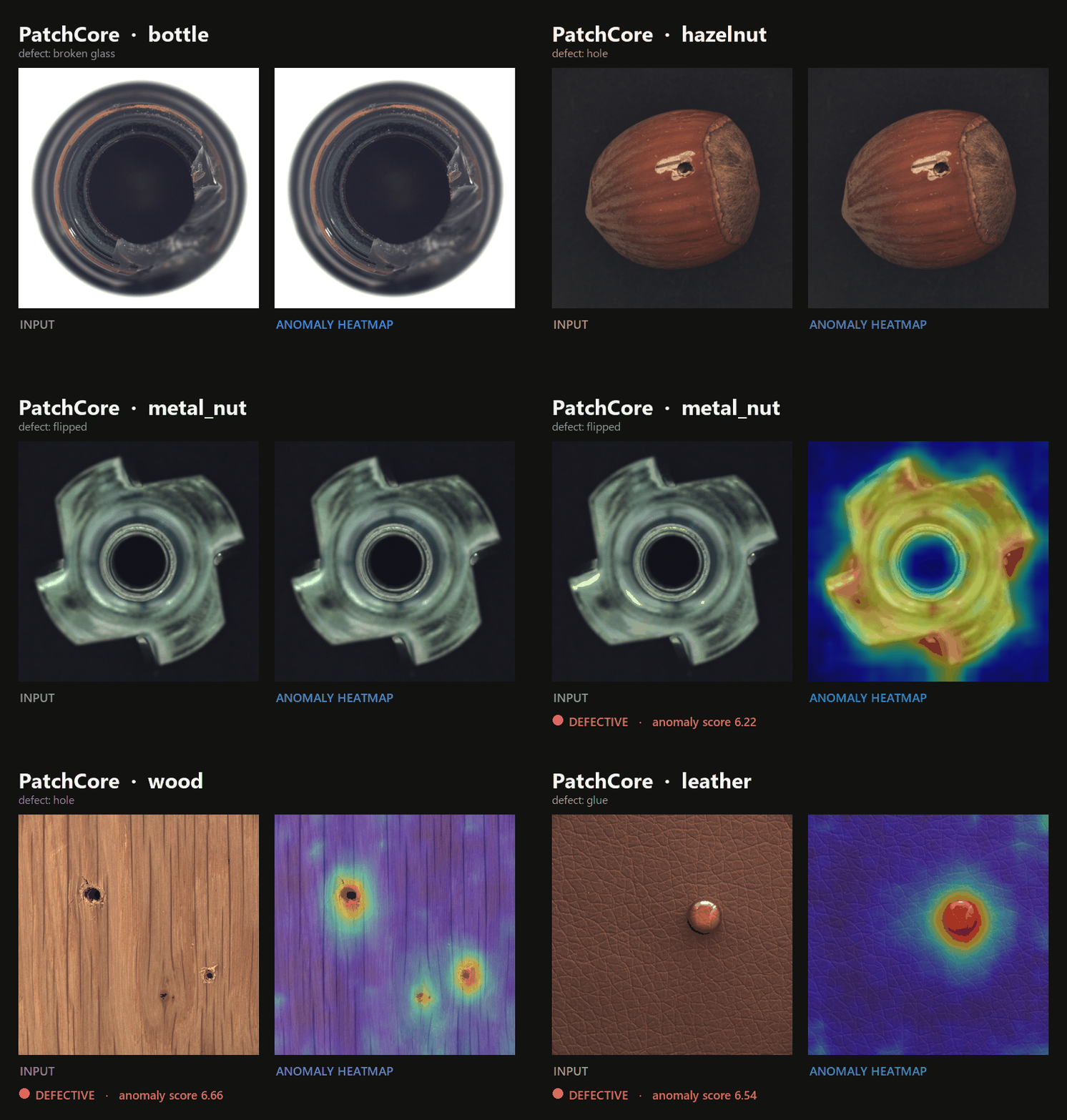
Evaluated on the 15 MVTec AD categories (image-level AU-ROC, and AU-PRO for localisation with a 0.3 FPR integration limit).
| Metric | Mean |
|---|---|
| Image-level AU-ROC | 0.904 |
| AU-PRO (localisation) | 0.917 |

Per-category numbers
| Category | AU-ROC | AU-PRO |
|---|---|---|
| leather | 1.000 | 0.985 |
| hazelnut | 1.000 | 0.956 |
| bottle | 0.998 | 0.958 |
| wood | 0.982 | 0.918 |
| carpet | 0.980 | 0.965 |
| metal nut | 0.979 | 0.927 |
| zipper | 0.933 | 0.953 |
| tile | 0.911 | 0.841 |
| toothbrush | 0.894 | 0.933 |
| transistor | 0.891 | 0.768 |
| capsule | 0.882 | 0.946 |
| cable | 0.877 | 0.900 |
| pill | 0.821 | 0.927 |
| screw | 0.708 | 0.931 |
| grid | 0.701 | 0.844 |
| mean | 0.904 | 0.917 |
Grid is trained at 256px rather than the default 224px; its fine periodic
texture benefits from the denser feature grid, which raised its AU-ROC from
0.637 to 0.701. Other categories showed no reliable gain from higher resolution
and are trained at 224px. Per-category resolution is configured in
src/config.py.
Example images in the figure above are from the MVTec AD dataset.
src/
  config.py              Per-category resolution / coreset settings
  dataset.py             MVTec dataset loader and image transforms
  patchcore.py           Backbone, memory bank, coreset, scoring
  train.py               Build a memory bank + calibrate a threshold
  inference.py           Load a model and predict on a single image
  export_anomaly_maps.py Write per-pixel heatmaps as TIFFs for evaluation
  utils.py               Offline analysis helpers
api/app.py               FastAPI inference service
demo.py                  Gradio demo (Hugging Face Spaces entry point)
evaluation/              Official MVTec evaluation scripts (vendored)
python -m venv venv
venv\Scripts\activate            # Windows
# source venv/bin/activate       # Linux / macOS
pip install -r requirements.txt
Download the MVTec AD dataset
and extract it so each category sits directly under data/:
data/<category>/train/good/*.png
data/<category>/test/<defect_type>/*.png
data/<category>/ground_truth/<defect_type>/*_mask.png
Builds the memory bank for one category and saves it, together with a
metadata.json holding the input resolution and a calibrated decision
threshold, under outputs/memory_bank/<category>/.
python -m src.train --data_root data --category gridResolution and coreset ratio default to the per-category values in
src/config.py and can be overridden with --image_size / --coreset_ratio.
The threshold is set to the 99th percentile of the (defect-free) training
scores, so no magic numbers are needed downstream.
python -m src.export_anomaly_maps --data_root data --category grid
python evaluation/evaluate_experiment.py \
    --anomaly_maps_dir outputs/anomaly_maps \
    --dataset_base_dir data \
    --output_dir outputs/metrics \
    --evaluated_objects grid
print_metrics.py renders the resulting metrics.json files as tables.
uvicorn api.app:app --reloadGET /categories— categories with a trained memory bankPOST /predict/{category}— anomaly score and defect flag for an uploaded imagePOST /predict/{category}/heatmap— the heatmap overlay as a JPEG
python demo.pyAt startup the demo downloads the trained memory banks from the
Junaidreal4/defect-detection-weights
model repo, so it runs without local training. Upload an image, pick its
category, and the model returns the overlay and score.
- Features. Layer2 and layer3 activations of a frozen Wide-ResNet-50-2 are concatenated (layer3 upsampled to layer2's resolution). These mid-level maps localise defects well; layer1 is too generic and inflates the patch count, layer4 is too semantic.
- Memory bank. Patch features from all normal images are subsampled with a greedy k-center (farthest-point) coreset, which spreads the retained patches across the feature manifold far better than uniform sampling. The pool is capped and seeded for reproducible builds.
- Scoring. Each test patch is scored by its distance to the nearest memory bank entry; the maximum patch score is the image-level anomaly score, and the per-patch scores form the heatmap.
- Memory banks and metadata are written per category under
outputs/, which is git-ignored along with the dataset and generated artifacts. - Anomaly maps are exported at the original image resolution so they align with the full-resolution ground-truth masks used by the evaluation script.
This project is released under the MIT License. The evaluation/
directory contains the official MVTec evaluation scripts and retains its own
license (evaluation/LICENSE.txt).