
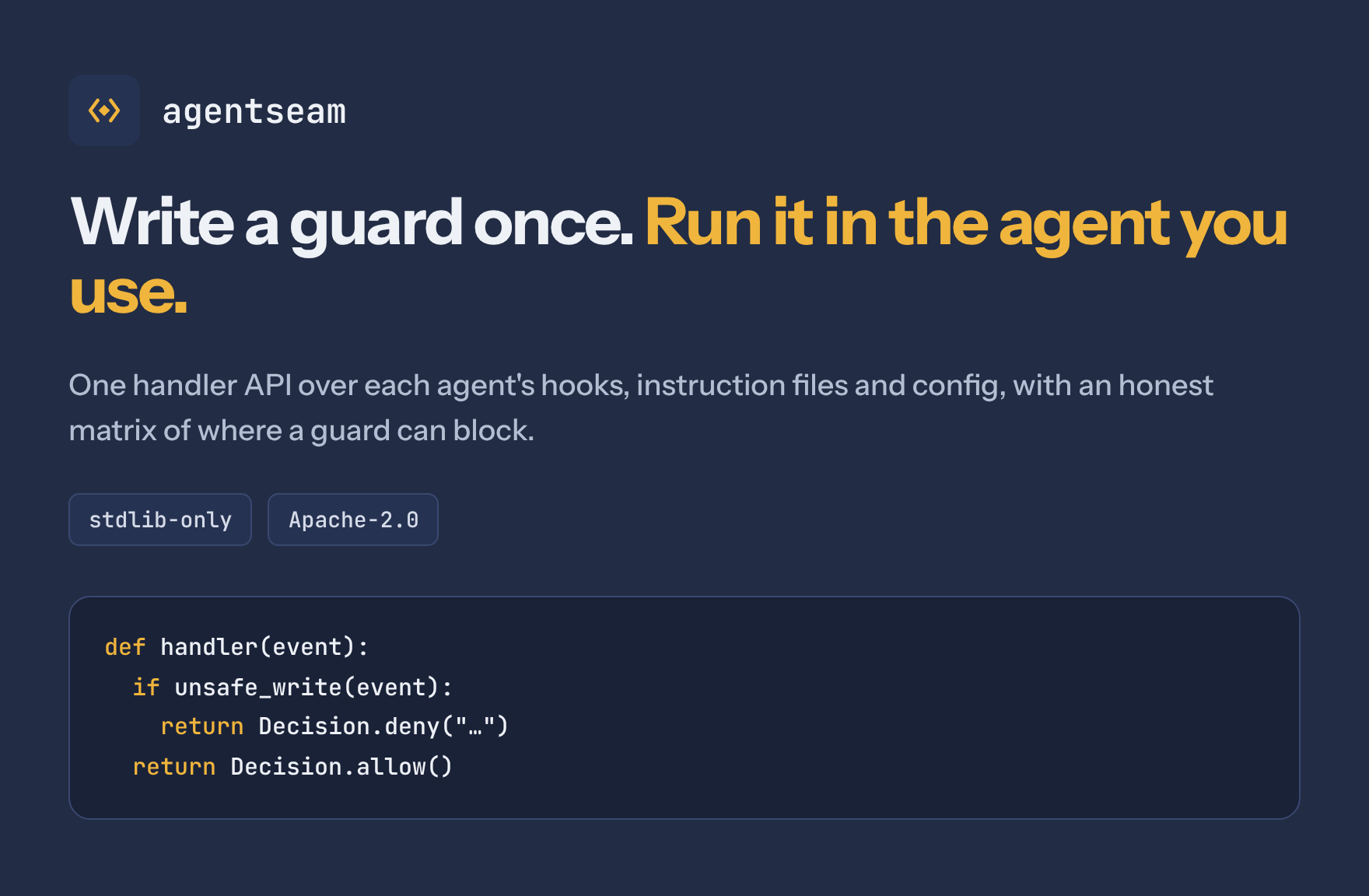
Open-source guardrails for AI coding agents: rules the agent reads, checks that run as it writes, and gates at commit and in CI. agentseam is the layer underneath: one handler API over every coding agent's hooks, instruction files, plugins and config, with a verified matrix of what each agent can actually enforce.
chock · chock-catalog · chock.sh (launching soon)




agentseam is a stdlib-only Python library and CLI that turns every coding agent's own hook system into one normalized event and one Decision, and records, per agent and per lifecycle event, what that agent can really do with it. Write a guard once and agentseam install wires it into the agent's own config. When an agent cannot enforce something, agentseam says so instead of installing a hook that silently does nothing. Free and open source (Apache-2.0).
Coding agents already ask before they run a shell command. What they do not check is the code they write:
SQL injection in a Spring repository, a wildcard IAM grant, an MCP server pinned to @latest, a secret
written into agent memory. A guard at the agent's own pre_tool hook can refuse that write; a rule in the
prompt is forgotten when the context fills. Every agent invented its own hook system, so such a guard is
normally written once per agent, or for one agent and then stops. agentseam is the layer that makes it
one guard for 16 agents, and the matrix keeps the claim honest: a guard is only called enforced where
the agent can enforce it.
The Quick start handler is a guard. It reads the normalized pre_tool event and refuses content carrying
an AWS access key ID; agentseam turns each vendor's payload into that one event and turns the returned
Decision back into the vendor's own way of saying "no".
| A guard returns | What the agent does with it | Where it cannot |
|---|---|---|
Decision.deny(reason) |
refuses the tool call; the reason goes back to the agent | an agent with no pre_tool surface (aider, Copilot CLI, Replit, Zed) never asks |
Decision.escalate(reason) |
hands the call to the agent's own human-approval path | where the agent has no approval prompt at that gate, it blocks instead |
Decision.transform(new_input) |
runs the tool with a rewritten input (a redacted value, say) | degrades to escalate, never to a silent pass |
Decision.allow() |
lets it through | n/a |
The full outcome set is allow, deny, escalate, transform, warn and vouch; ask and rewrite are
deprecated aliases of escalate and transform. A handler that raises is turned into a refusal in the agent's own dialect. What agentseam
cannot fix is the host: if the hook process dies or times out, a best-effort agent runs the tool anyway.
No LLM, no tokens. agentseam makes no model call and src/agentseam imports no networking module
(checked with grep -rn "import socket\|urllib\|http.client\|requests" src/agentseam, empty at 104da73).
A handler is your own local code: whatever it costs, it costs no tokens, and a refusal adds one short
reason to the agent's context. Shift left: the known classes are refused in the agent's own turn,
before they reach commit, review or CI.
chock is on PyPI, but the release there (0.15.2, 30 Sep 2026) is older than the engine this page describes. Install the frozen engine from its commit (Python 3.11 or newer):
pip install "chock @ git+https://github.com/open-coder-ai/chock@992711af4cf8d4fd9c4c861f10ef6e53374d75d7"agentseam itself is pip install agentseam (Python 3.9 or newer, no dependencies); the Quick start below runs end to end.
The guardrails built on agentseam, the chock engine and the chock-catalog policies, are adopted in two ways, and the chock.sh builder is a third.
| Way | For | What you get |
|---|---|---|
| In your repository | teams | commit gates enforced at commit and in CI; every clone runs chock sync --repo . once, because git never clones hooks |
| In your coding agent, as plugins | one person, no repo changes | in-agent checks, best-effort, failing open; not run in CI |
| One Claude Code plugin from a selection | trying it | the chock.sh builder (launching soon) gives a chock install --selection '…' --apply command |
In your repository:
chock init .
chock add <id> --ref <catalog commit> --verify-sha <sha256> --skip-compile   # once per policy
chock sync --repo . --ci
Commit the result. Plugin route: the five plugin repos are claude, cursor, copilot, codex and devin; each README has its client's install lines. Chock adds no new place your code goes: checks run where the agent writes. The agent still sends its context to its own model provider; chock adds no additional destination.
An adapter per agent owns three things: payload parsing, the response dialect and the config shape.
Adapters are data (src/agentseam/data/vendors/<agent>.json, validated against schema.json) plus a
small family module when a vendor speaks a new dialect. The matrix is data too, and
matrix.enforcement_level(agent, event) is the authority for every grade below.
192 cells (16 agents by 12 events), from matrix.enforcement_level() run at 104da73: 101 none, 55 detect, 34 best-effort, 2 enforceable, 0 enforced.
| Level | Meaning | Agents at pre_tool today |
|---|---|---|
| enforced | the agent blocks, and fails closed if the hook dies | none |
| enforceable | it blocks and can be told to fail closed, but doesn't by default | 1: Cursor |
| best-effort | it blocks, but fails open (a crashed hook allows) | 11: Claude Code, VS Code Copilot, Codex CLI, Gemini CLI, Windsurf, Devin, Grok CLI, Antigravity, Kimi Code, Junie, Tabnine |
| detect | observable after the fact only; prevention is not available | 0 (55 cells at other events) |
| none | no hook surface at all | 4: aider, Copilot CLI, Replit, Zed |
A row is only claimed when a verified: {basis, version, date} record backs it. Run agentseam doctor to
see what is wired on this machine and flag rows not re-verified in 90 days. Grading never exceeds
evidence: enforcement_level() caps every grade by what its own basis can support, so a vendor-docs
row cannot back enforced. A pre-tool guard is one layer, not the whole defence: pair it with a git hook or
CI gate that the agent cannot skip.
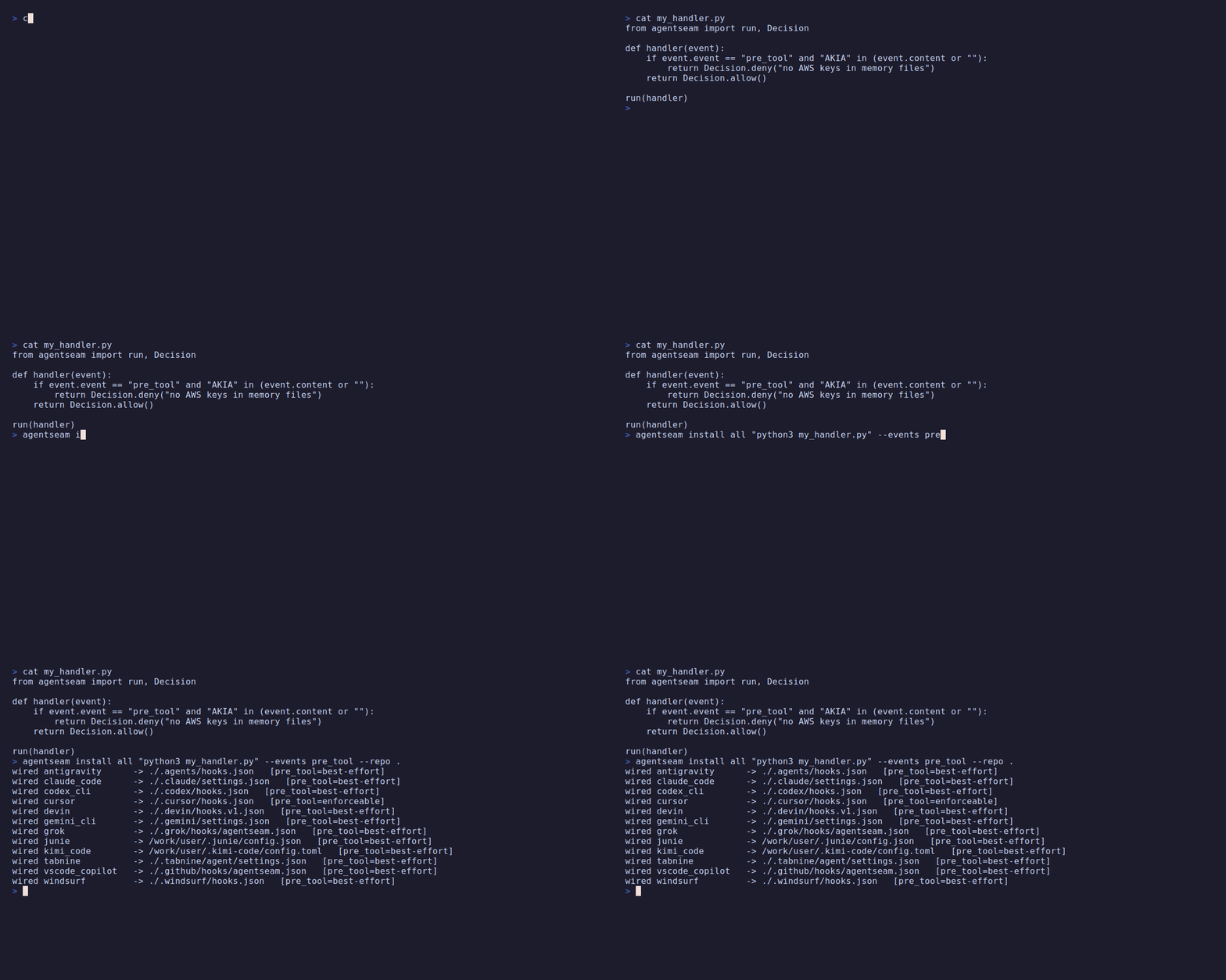
mkdir demo && cd demo && git init -q
cat > my_handler.py << 'EOF'
from agentseam import run, Decision

def handler(event):
    if event.event == "pre_tool" and "AKIA" in (event.content or ""):
        return Decision.deny("no AWS keys in memory files")
    return Decision.allow()

run(handler)
EOF
pip install agentseam
agentseam install all "python3 my_handler.py" --events pre_tool --repo .
That one handler now runs in Claude Code, Cursor, VS Code Copilot, Codex, Gemini CLI,
Windsurf and six more. The install output tells you which agents get best-effort
blocking, which get the stronger enforceable gate (Cursor, today), and which do not
appear in the output at all because they have no hook surface to wire (aider, Copilot CLI,
Replit, Zed). Nothing here is emulated: install writes real per-agent config files, the same
files Claude Code, Cursor and the rest read on their next run, and uninstall removes only the
entries agentseam itself wrote. Most land under --repo; two do not, because the vendor reads
them from the user's home directory: Junie's ~/.junie/config.json and Kimi Code's
~/.kimi-code/config.toml.
unadapted is a fourth, deliberately separate state from none: agentseam has no hook
adapter for that agent yet, which is a claim about us, not about the agent, since it still
receives instruction files and simply cannot have its tool calls gated here. A
Decision.transform(...) on an agent that cannot transform degrades to escalate, never
to a silent pass-through.
| Agent | What it enforces | Config file | Verified |
|---|---|---|---|
| Claude Code | block + rewrite | .claude/settings.json |
live-run · 2026-09-07 |
| VS Code Copilot | block + rewrite | .github/hooks/*.json |
live-run-partial · 2026-08-28 |
| Cursor | block + rewrite (all tools, fail-open by default); stop returns a follow-up message |
.cursor/hooks.json |
live-run-partial · 2026-09-23 |
| Gemini CLI | block + rewrite (fail-open) | .gemini/settings.json |
vendor-source · 2026-08-28 |
| OpenAI Codex CLI | block + rewrite (fail-open) | .codex/hooks.json |
live-run-partial · 2026-08-28 |
| Windsurf | block via exit code only; no file-write event | .windsurf/hooks.json |
third-party-install · 2026-08-26 |
| Devin | block + rewrite (fail-open) | .devin/hooks.v1.json |
vendor-docs · 2026-08-26 |
| Grok CLI | block on PreToolUse only (fail-open) | .grok/hooks/agentseam.json |
vendor-docs · 2026-08-26 |
| Antigravity | block, and can refuse to let the agent stop (fail-open) | .agents/hooks.json |
vendor-docs · 2026-08-26 |
| Kimi Code CLI | block on 3 of its 20 events (fail-open) | ~/.kimi-code/config.toml |
vendor-docs · 2026-08-26 |
| Junie CLI | block + ask + rewrite, all native (fail-open) | ~/.junie/config.json |
vendor-docs · 2026-08-26 |
| Tabnine CLI | block on 6 of its 11 events, incl. post-tool (fail-open) | .tabnine/agent/settings.json |
vendor-docs · 2026-08-26 |
| Zed | no hook surface at all; instruction files only | none | vendor-docs · 2026-08-26 |
| Aider | no hook surface at all; instruction files only | none | vendor-docs · 2026-08-26 |
| Replit | no hook surface found in its docs; instruction files only | none | vendor-docs · 2026-08-26 |
| Copilot CLI marketplace bundle | packaging identity only; dispatches through the VS Code Copilot adapter | none | vendor-docs · 2026-08-29 |
Of the 12 agents that claim pre_tool at all, 4 (Claude Code, Codex CLI, Cursor, VS Code
Copilot) rest on a live run against the real agent; seven of the other 8 rest on documentation
or a third-party install, and Gemini CLI on a read of the vendor's own source. None of those
eight rests on a live run. Run agentseam matrix --evidence before you trust any row you didn't witness yourself.
Anything that wants to watch or shape an agent's life uses the same event stream:
| Observability | one JSONL stream across the agents an event set wires, ready to feed OTel or DuckDB (examples/event_log.py) |
| Notifications | desktop notification on stop or prompt (examples/notify.py) |
| Cost tracking | token and cost meters that work regardless of which agent ran |
| Process gates | TDD enforcement, "tests before push" |
| Context injection | inject memory or instructions at session start |
Multi-agent repos hand-maintain near-identical files (CLAUDE.md, AGENTS.md, .cursor/rules/*,
.github/copilot-instructions.md, GEMINI.md, .windsurfrules, codex.md) and they drift.
agentseam instructions --text "Prefer pnpm. Tests live beside source."updated AGENTS.md
created CLAUDE.md
created .junie/guidelines.md
...
covered by AGENTS.md: codex_cli, copilot, cursor, gemini_cli, kimi_code, vscode_copilot, windsurf, zed
16 agents reached with 9 files written, because 8 of them read AGENTS.md natively and a second copy
would only drift. Content is a marker-delimited block, so anything a human wrote in those files is
preserved, and instructions --list shows what a repo already tells its agents without writing.
Every agent has a settings file with an allow/deny model, and no two are the same kind of object: Claude Code evaluates an ordered rule list, Gemini CLI keeps tool-name allowlists, Codex runs a Starlark program over command prefixes, VS Code holds a map of auto-approve patterns.
agentseam permissions --rule 'deny:shell:curl *' --rule 'allow:shell:npm test'# claude_code -> .claude/settings.json
{"permissions": {"allow": ["Bash(npm test)"], "deny": ["Bash(curl *)"]}}
# vscode_copilot -> .vscode/settings.json
{"chat.tools.terminal.autoApprove": {"npm test": true}}
# unrepresentable: Rule('deny', 'shell', 'curl *') -- this map has no deny: setting a
# pattern false withholds auto-approval but still lets a human approve the command
VS Code has no deny, so agentseam returns the rule unrendered with the reason and exits non-zero rather than hand back a guardrail that stops nothing. Put it in CI and you learn that your policy does not survive the trip to an agent before you rely on it. Every agent in the matrix appears in the output, with a recorded model or the reason there is none; a test pins that the two sets add up to the matrix exactly.
Claude Code's row rests on a full live run; Codex CLI, Cursor and VS Code Copilot each on a partial one. If you have another of these agents installed, an hour turns its row from "the vendor says so" into evidence:
python3 tools/capture.py detect
python3 tools/capture.py install --agent cursor
# ... use the agent for a minute ...
python3 tools/capture.py report
python3 tools/capture.py uninstall --agent cursor
The probe always allows, so it cannot interfere with real work, and payloads are reduced to shape
before anything touches disk: keys and types survive, values do not. agentseam probe does the opposite on
purpose (it denies, crashes and stalls), so it only runs in a throwaway directory a harness creates and
removes. See tools/VERIFY.md. A report's driver and basis fields say how it was
obtained: witnessed (a real vendor client, watched), tested (an automated check, no vendor client)
or recorded (a witnessed run replayed). evidence_report.validate() refuses a report that claims more
than its driver earned; docs/coverage-gaps.md lists which gates are still open.
agentseam stops nothing by itself; it carries guards. The guards below ship in chock-catalog, which
registry.yaml at chock-catalog f25f5a3 (policies unchanged since 9a64623) lists as 71 policies: 35 enforced at commit, 11 in-agent (best-effort) and 25
advisory, with 4,280 eval cases of which 4,098 run automatically. Each policy is a manifest, labelled by tier.
| Class of flaw | Policy | Tier (registry.yaml) |
|---|---|---|
| Injection, XXE, SSRF, unsafe deserialization, path traversal and trust-all TLS in Java and Kotlin | java-security |
enforced at commit |
| Host code execution, unpinned MCP servers, shell-reaching tools and approvals switched off in agent code and config | agentic-code-security |
enforced at commit |
| Wildcard IAM grants | block-wildcard-iam |
enforced at commit |
MCP servers and agent components pinned to @latest |
block-unpinned-agent-components, verify-mcp-allowlist |
enforced at commit |
| Unpinned GitHub Actions, packages outside an allowlist | pin-github-actions, verify-dependency-exists |
enforced at commit |
| Bidi and tag Unicode in source | block-invisible-unicode |
enforced at commit |
| A change that strips an accessible name an element already had | no-a11y-regression |
enforced at commit |
| Hard-coded secrets and secret files | scan-secrets |
enforced at commit |
Destructive commands, --no-verify, curl | sh, edits to the agent's own guard config |
block-destructive-commands, block-no-verify, block-curl-pipe-sh, protect-agent-config |
enforced at commit, or best-effort in-agent |
The in-agent tier is exactly the agentseam matrix: a catalog policy is never labelled stronger than
enforcement_level() grades the agent it runs in. No agent reaches enforced. Chock does not replace
code review, your SAST suite or a penetration test; it refuses known classes while the agent writes, so they are fixed before review.
Tiers: commit is a git hook or CI gate that exits non-zero. in-agent is the agent's pre-tool hook: best-effort, and it fails open. advisory is rule text the agent reads. No agent reaches enforced today: 0 of 192 matrix cells are graded enforced. OWASP mappings are partial: 10 of 10 Agentic risks have a policy, 7 have a slice refused at commit, none is fully covered. The engine is frozen at the commit above. Chock does not stop every attack: it closes common, known entry points before they ship.
Does agentseam use an LLM? No. It makes no model call and imports no networking module in src/agentseam.
Does my code leave my machine? agentseam adds no new place your code goes: handlers run locally in the hook process. The agent still sends its context to its own model provider.
Which agents does it work with? 16 are in the matrix, 12 of them with a hook adapter; see Supported agents.
How do I install it, through the repo or through plugins? pip install agentseam for the library. For
guardrails, see Install above: the repository route (commit and CI) or the five plugin repos (in-agent).
What does it cost? Free and open source (Apache-2.0). A check costs no tokens; a refusal adds one short reason to the agent's context.
Does it replace SAST or code review? No. It catches known classes in the agent's turn; review, SAST and testing still run.
Which OWASP and CWE items does it cover? agentseam maps none itself. The catalog's OWASP mappings are
partial and labelled so; see chock-catalog docs/coverage.md.
llms.txt: a short machine-readable summary of this repo.src/agentseam/matrix.pyandsrc/agentseam/data/matrix.json: the capability matrix as data.src/agentseam/data/vendors/: one JSON entry per config-driven agent, validated byschema.json.registry.yaml: every catalog policy with its tier and eval counts.docs/coverage.md: catalog coverage, with partial mappings labelled..claude-plugin/marketplace.json: the Claude plugin marketplace.
The 13 public repositories:
| Repository | What it is |
|---|---|
| agentseam | Core: One handler API over every coding agent. |
| chock | Core: Author a policy once, enforce it on every agent. |
| chock-catalog | Policies: The policies, each labelled by what it enforces, with replayed evals. |
| context-report | Evidence: A signed report of whether an agent artifact works. |
| chock-threat-intel | Evidence: A weekly threat ledger, each entry scored against the catalog. |
| chock-claude-plugins | Plugins: The catalog as Claude Code plugins (generated). |
| chock-copilot-plugins | Plugins: The catalog as Copilot CLI and VS Code plugins (generated). |
| chock-cursor-plugins | Plugins: The catalog as Cursor plugins (generated). |
| chock-codex-plugins | Plugins: The catalog as Codex plugins (generated). |
| chock-devin-plugins | Plugins: The catalog as Devin plugins (generated). |
| chock-quickstart | Template: What chock init leaves behind. |
| chock-example | Template: A working adoption, one policy per layer. |
| .github | Community: Org profile and community health files. |
The most valuable contribution needs no code. Most rows in the matrix rest on vendor documentation rather
than on anyone watching the agent run. One command reports what your installed version does, and the
result becomes a verified record with your handle on it:
python3 tools/experiment.py run --agent <agent> --driver harness --report \
    --agent-version <version> --reporter @yourhandle > report.json
--driver harness makes it a witness: it runs your installed agent. Without it the driver falls back to
reference, which reports basis: vendor-docs: a contract test, not evidence of what your build does.
Paste the result into an evidence report;
a result that contradicts the matrix is the one we most want. The walk-through is in
CONTRIBUTING.md.
| First contribution | Where to start |
|---|---|
Turn a vendor-docs row into a live-run row |
have the agent installed? tools/VERIFY.md, an hour, no code |
| Add an agent adapter | a vendor config entry, a matrix row and real-payload fixtures (steps); Goose, Crush and OpenCode are researched and unbuilt |
| Correct a matrix row that claims too much | the matrix correction template |
| Write a guard others can adopt | ship it as a policy in chock-catalog |
| Bugs and docs | a good first issue |
pytest -q and ruff check . are the whole local loop; the runtime path stays stdlib-only and every commit
is signed off (git commit -s). Adding an adapter must never require touching contract.py,
dispatch.py or any consumer; if it does, the abstraction is wrong. More: Bundles ·
Design · per-vendor examples · ARCHITECTURE.md ·
SECURITY.md.
Apache-2.0. See LICENSE.