


DevOps & Cloud Engineer | Critical Infrastructure & Reliability
With over 20+ years as Principal Manager in critical national infrastructure at the Transmission Company of Nigeria, I bring deep expertise in high-reliability systems, operational excellence, and secure environments.
I am currently pursuing an MSc in DevOps & Cloud Computing at IU International University of Applied Sciences, with strong results:
- DevOps – 96% (Distinction)
- Advanced Research Methods – 90% (Distinction)
- Cloud Computing Project – 84% (Good)
My GitHub showcases practical CI/CD pipelines, cloud-native ML deployment, infrastructure automation, and domain-driven projects such as GridPulse 330 (an interactive SCADA/EMS-style contingency simulation for 330 kV transmission systems).
📂 View Personal Portfolio Website


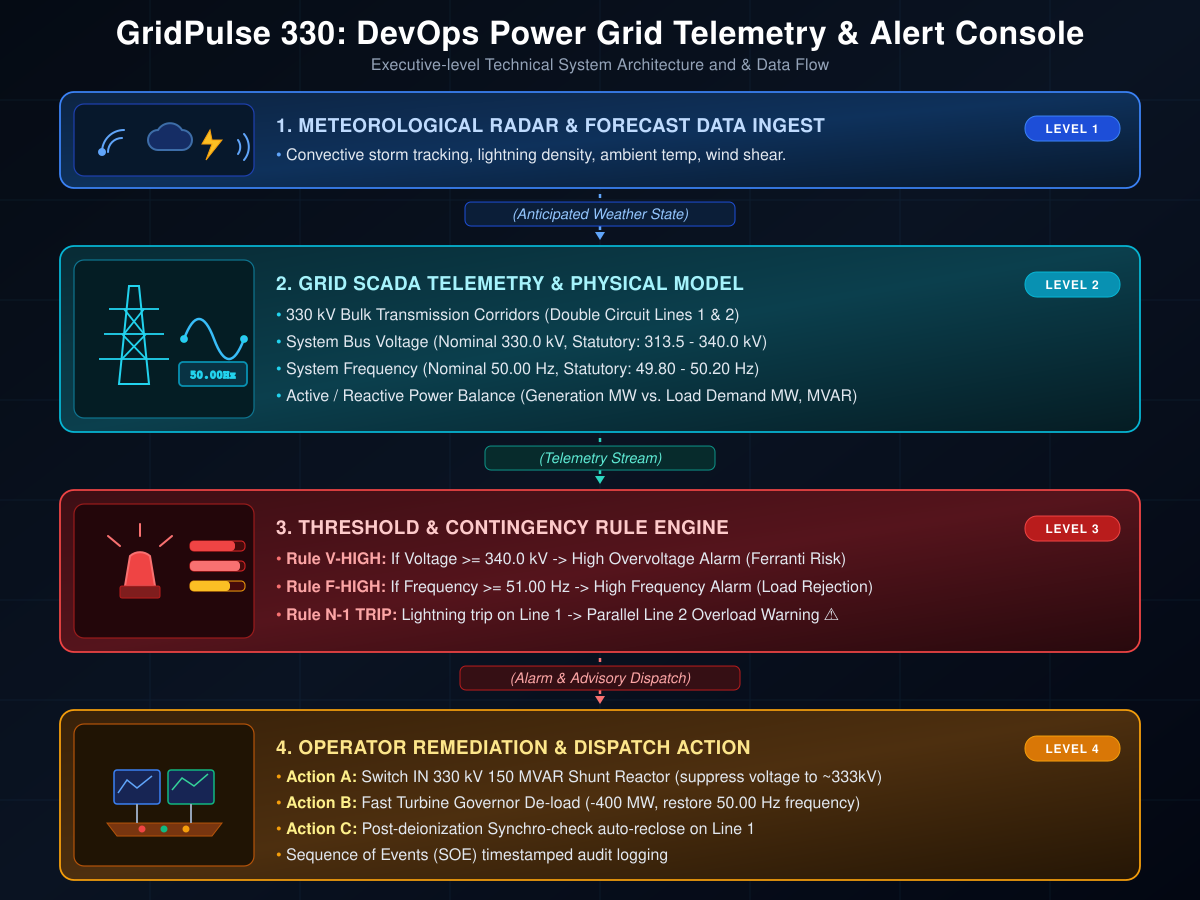
An enterprise-grade SCADA/EMS Telemetry & Contingency Console designed for National Control Center (NCC) power dispatchers, bridging meteorological forecasting with real-time electrical grid stability.
Bulk 330 kV Extra-High-Voltage (EHV) networks face sudden catastrophic collapse during severe convective storms:
-
Turbine Rotor Overspeed (
$f > 51.00\text{ Hz}$ ): Sudden industrial load rejections cause mechanical torque to exceed electrical load, accelerating synchronous rotors past statutory ceilings. -
The Ferranti Effect (
$V > 340.0\text{ kV}$ ): Long, lightly loaded bulk transmission links accumulate massive shunt capacitive charging ($Q_{\text{charging}}$ ), producing destructive overvoltage surges.
- 📡 Doppler Radar Horizon Integration: Anticipates atmospheric storm fronts and lightning threats in real-time, predicting physical line trips before they occur.
- 🚨 Statutory Dual-Threshold Engine: Triggers instantaneous visual and acoustic alarms when 330 kV bus voltages (
$>340\text{ kV}$ ) or grid frequencies ($>51.00\text{ Hz}$ ) breach safety limits. - ⚡ Double-Circuit Corridor Protection: Monitors transmission lines (e.g., Ikeja West – Oshogbo) with ANSI 87L differential protection and dynamic
$N-1$ thermal transfer modeling. - 🎛️ Closed-Loop Dispatch Playbook: Instant operator restoration controls — switch in 150 MVAR Shunt Reactors, ramp generation down (-400 MW), and execute synchrocheck auto-reclose.
- 📜 Sub-Second SCADA Sequence of Events (SOE): Immutable event audit stream capturing transient waveforms, relay activations, and operator commands for root-cause analysis (RCA).
- Frontend & UI: React 19, TypeScript, Tailwind CSS v4, Lucide Icons
- Tooling & Build: Vite 8, Bun / Node.js
- Mathematical Modeling: Swing equations, Ferranti capacitance derivations, governor droop simulation
- Deployment: Vercel Edge CI/CD Pipeline
👉 Explore Live Production Console • View Codebase & Architecture Docs
Handshake AI Skills Studio × OpenAI Multiplayer Game Challenge




Project overview: VAULT FIVE is a deployed, browser-based multiplayer vault-cracking game demonstrating real-time state synchronization, server-authoritative game logic, identity-aware authorization, serverless architecture, and DevOps automation.
Players create or join private rooms using a four-character code, compete through three timed rounds, earn points, and attempt to unlock a fictional $1,000,000 jackpot. The jackpot is strictly an in-game reward with no real cash value, wagering, or payout.
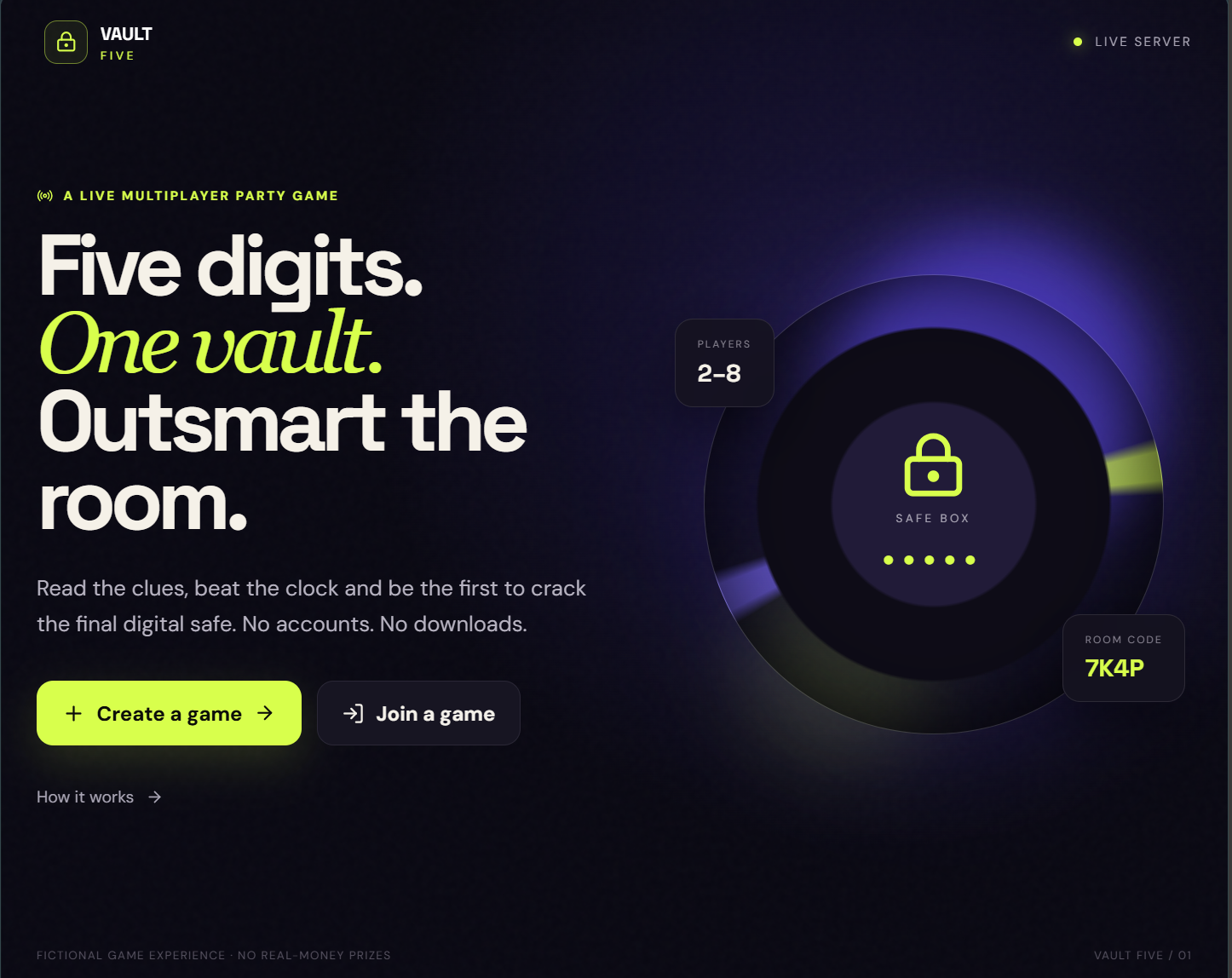
Figure 1 — Responsive landing page for hosting or joining multiplayer rooms. Click the image to launch the live game.
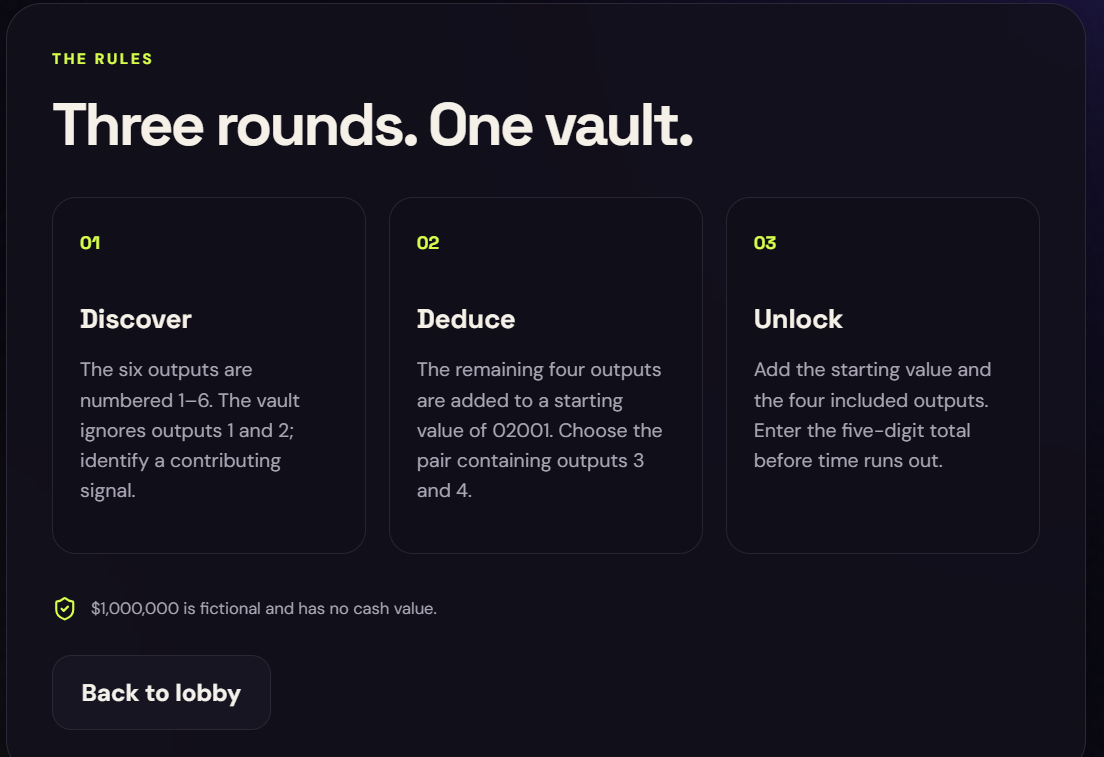
Figure 2 — Player instructions and timed round structure.
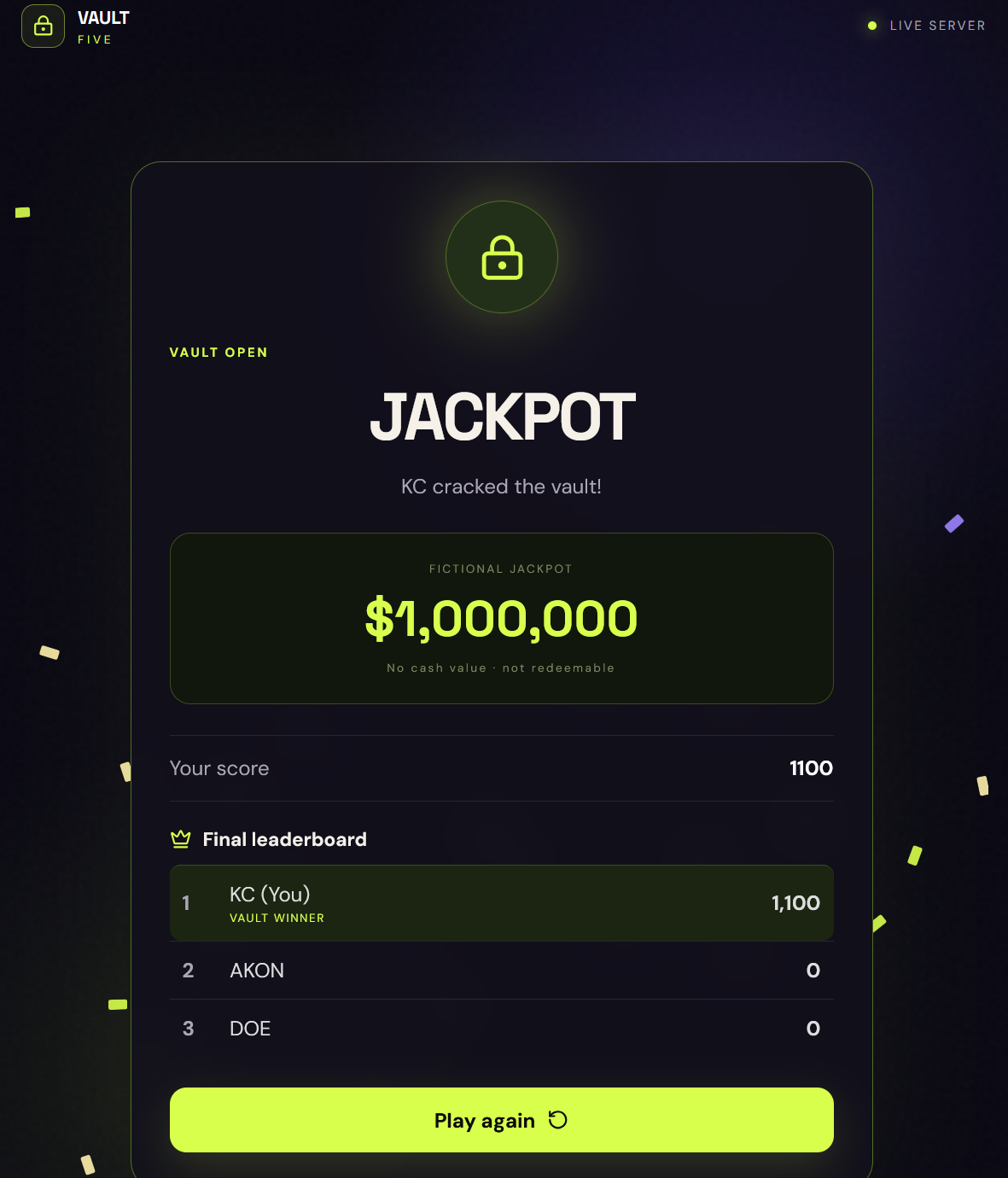
Figure 3 — Successful vault unlock, winner announcement, and final leaderboard.
The central engineering problem was coordinating independent browser sessions without allowing each client to determine its own game state.
The solution combines Supabase Realtime communication, persistent PostgreSQL state, and a server-authoritative Edge Function that validates player actions, manages rounds, calculates scores, and determines the winner.
This separates user-interface rendering from trusted game-state transitions.
- 🎮 Real-Time Multiplayer: Create and join private game rooms across different browsers and devices.
- 🔐 Invisible Authentication: Supabase anonymous authentication enables gameplay without a visible registration process.
- ⏱️ Synchronized Rounds: Server-managed deadlines coordinate Discover, Deduce, and Final Vault.
- 🏆 Fair Scoring: Server-side answer verification, score calculation, winner selection, and leaderboard generation.
- 📡 Realtime Updates: WebSocket-based broadcasts, complemented by authoritative state polling to recover from missed updates.
- 🔄 Replay: Players can restart the experience after completing a game.
- 📱 Responsive Interface: Browser-based gameplay without a separate installation.
| Layer | Technology | Engineering Responsibility |
|---|---|---|
| Frontend | React 19, TypeScript, Vite 6 | Responsive gameplay and state rendering |
| Hosting | Vercel | Static frontend deployment |
| Identity | Supabase Auth | Anonymous player sessions and JWT identity |
| Backend | Supabase Edge Functions | Authoritative game logic and validation |
| Realtime | Supabase Realtime | WebSocket-based state notifications |
| Persistence | PostgreSQL | Rooms, players, rounds, submissions, and scores |
| Authorization | JWT checks and PostgreSQL RLS | Room-scoped access and data protection |
| CI | GitHub Actions | Static checks, automated tests, and production build |
| Operations | GitHub Actions synthetic checks | Production endpoint verification and retained results |
📐 Explore Architecture, State Lifecycle & Security Design
✅ Continuous Integration
The GitHub Actions CI workflow runs on pull requests and pushes to main:
- Reproducible dependency installation using
npm ci - TypeScript static checks
- Automated architectural smoke tests
- Production Vite build verification

✅ Production Synthetic Monitoring
A separate GitHub Actions workflow runs scheduled, non-mutating production checks every hour and supports manual execution.
It verifies:
- The deployed frontend returns HTTP
200. - The protected game API rejects unauthenticated access with HTTP
401. - Probe durations and results are recorded.
- Synthetic result artifacts are retained for 14 days.
The initial manually triggered production health workflow passed both checks.
These probes verify specific endpoint behaviors; they are not a substitute for authenticated end-to-end gameplay testing, latency percentiles, or a formal availability SLO.

✅ Deployment & Operations
- GitHub-integrated Vercel deployment
- Environment-variable and backend-secret separation
- Production troubleshooting using Vercel and Supabase logs
- Documented release checks, incident triage, and rollback considerations

- Server-authoritative state: Clients submit actions, not trusted scores or victory declarations.
- Identity-aware access: JWT validation and room membership checks enforce API permissions.
- Row Level Security: PostgreSQL policies support protected data access.
- Secret isolation: Vault combination and service credentials are kept outside the frontend.
- State recovery: Periodic authoritative state reads help clients recover when Realtime notifications are missed.
- Incident-driven improvements: Multiplayer testing exposed authentication, synchronization, feedback, and winner-attribution issues that were investigated and corrected.
VAULT FIVE reinforced several important principles:
- Distributed state must have a trusted authority. Browser clients cannot independently decide round outcomes.
- Realtime delivery needs a recovery mechanism. Broadcast notifications are complemented by state reconciliation.
- Security boundaries must be explicit. Authentication, authorization, validation, and secrets belong in trusted backend services.
- Deployment is only one part of delivery. Automated checks, incident investigation, and operational documentation improve maintainability.
- Reliability claims require evidence. Production probes, multiplayer walkthroughs, and architectural tests serve different verification purposes.
- 📊 API request latency distributions and error-rate dashboards
- 🔔 Automated failure notifications and alert routing
- 🧪 Multi-client load testing and concurrency verification
- 🛡️ Abuse protection, rate limiting, and further security hardening
- 🔄 Automated release gating and isolated staging environments
These are planned improvements, not currently verified production capabilities.
Real-Time Systems • Distributed State Management • Cloud-Native Development • Serverless Architecture • TypeScript • PostgreSQL • WebSockets • CI/CD • GitHub Actions • Production Monitoring • Security Engineering • Incident Response • Reliability Engineering


👉 Play VAULT FIVE • View Complete Engineering Case Study
MSc DevOps & Cloud Computing Coursework
I designed and developed a contract-first microservices-based Movies API to demonstrate end-to-end API engineering, automated testing, and reproducible performance evaluation.
Key Highlights:
- OpenAPI v3 contract-first design with full CRUD, RBAC, and error handling
- Comprehensive testing (unit, integration, contract) + k6 load testing
- GitHub Actions CI/CD pipeline with reproducible artifacts
- Performance baselines (P50 < 100ms, P95 < 500ms)
Skills Demonstrated: Microservices architecture, OpenAPI, performance engineering, CI/CD, technical documentation.
MSc DevOps Module | Grade: 96% (Distinction)
I built a full-stack web application with a complete enterprise-grade CI/CD pipeline.
Key Highlights:
- Automated build, test, and deploy using Jenkins, Maven, Selenium, JUnit, and GitHub Actions
- Security scanning with Dependabot and structured logging
- Agile/Scrum methodology with Jira + GitHub Copilot
Skills Demonstrated: CI/CD orchestration, automated testing, security practices, DevOps tooling.
🔐 An Empirical Study of IEEE 802.11 & WPA3 Adoption Gaps and Feature Prioritization in Campus & Public Wi-Fi Hotspots
MSc Course | Grade: 90% (Distinction)
I designed an empirical research proposal to deliver evidence-based prioritization of IEEE 802.11 features and WPA3 capabilities for dense, multi-AP environments.
Research Scope:
- ⚡ Performance benchmarking in high-density scenarios
- 🚶 Roaming & handover resilience for latency-sensitive applications
- 🛡️ Security evaluation — WPA2-to-WPA3 migration and management frame protection
Key Deliverable: Prioritized deployment roadmap for secure cloud-edge networking and zero-trust access.
📂 View Repository
📄 Full PDF Proposal
MSc Cloud Computing Project | Grade: 84% (Good / 2.0)
I designed and deployed a cloud-native ML recommender system for power grid operations. The prototype analyzes grid assets and generates prioritized risk-based maintenance recommendations to support predictive reliability management.
Built With:
- Python 3.11, scikit-learn, pandas, joblib
- FastAPI (REST API for real-time recommendations)
- Docker
- AWS (ECR, S3, Elastic Beanstalk, EC2, IAM, CloudWatch)
Key Highlights:
- Trained tabular ML model for outage risk ranking and maintenance prioritization
- Developed and exposed a
/recommendREST API endpoint - Containerized and deployed the service to AWS Elastic Beanstalk
- Comprehensive documentation and operational considerations
Why this project matters: It bridges my 20+ years of grid operations experience with modern cloud and machine learning technologies.
📂 View Repository
📄 Project Report
-
MSc DevOps & Cloud Computing – IU International University of Applied Sciences, Germany (Ongoing)
Current GPA: 80.5% -
BSc (Hons) Computing & IT – University of Derby, UK (2020)
First Class Honours
Principal Manager – Grid System Operations
Transmission Company of Nigeria | 20+ Years in Critical Infrastructure
- ⚡ Mission-Critical Operations: Lead 24/7 high-voltage transmission grid operations, supporting 99.9%+ system reliability.
- 🛡️ Incident & Risk Management: Coordinate real-time incident response, emergency restoration, and operational risk mitigation.
- 🖥️ Systems & Compliance: Oversee SCADA/EMS operations, grid stability, and regulatory compliance.
- ☁️ Cloud & DevOps Transformation: Apply operational expertise to cloud-native engineering, CI/CD automation, observability, and AI/ML-driven reliability solutions.
- 🚀 Engineering Leadership: Bridge critical infrastructure operations with modern DevOps, Cloud, and Site Reliability Engineering practices.
- Email: samuelakanimo@hotmail.com
- LinkedIn: linkedin.com/in/samuel-peter-5117223b
Let’s connect if you’re building resilient, secure, and intelligent systems where operational excellence meets modern cloud and automation.