Google Cloud Rapid Agent Hackathon · GitLab Track · Arize Phoenix Track
Anomaly detected → root cause found → Merge Request opened. Under 60 seconds. Human reviews a ready-to-merge fix — not a raw incident.


Full 3-minute walkthrough: problem → architecture → live pipeline → GitLab MR · zero credentials required
Live Dashboard: neuroscale-agents.streamlit.app · Landing Page: sodiq-code.github.io/neuroscale-landing
When a Kubernetes inference service breaches its P99 latency SLO at 2 AM:
- Arize Phoenix fires an alert
- PagerDuty wakes an on-call engineer
- Engineer SSHs in, reads dashboards, manually works through a runbook
- Engineer edits YAML, opens a PR, waits for review
- Resolution: 30–90 minutes. Cost: $100K+/hour in downtime.
The industry has automated monitoring. Nobody has automated the remediation. That's the gap NeuroScale Agents closes.
Arize Phoenix
     │
     ▼
 ┌──────────┐   anomaly    ┌────────────────┐   plan    ┌──────────────┐   MR
 │  Watcher │ ──────────▶  │ Diagnostician  │ ────────▶ │   Operator   │ ──────▶ GitLab
 └──────────┘              └────────────────┘           └──────────────┘
      ↑                           ↑                            ↑
  Arize MCP                 RAG Runbooks               GitLab MCP
  (get-spans)              (TF-IDF search)           (branch + commit + MR)
| Agent | Role | Tech |
|---|---|---|
| Watcher | Polls Arize Phoenix; scores anomaly severity | Arize MCP · get-spans · get-trace |
| Diagnostician | RAG runbook retrieval; Gemini 2.0 Flash LLM root-cause; generates YAML patch | Gemini 2.0 Flash (google-genai) · TF-IDF RAG · Kyverno-compliant YAML |
| Operator | Executes the fix: branch → commit → MR → HITL notification | GitLab MCP · create_branch · create_merge_request |
| Orchestrator | A2A coordinator; routes between agents; manages confidence gate | A2A pattern · Python orchestration |
Human-in-the-loop gate: The Operator opens a Merge Request — it never merges unilaterally. Confidence ≥ 90% → auto-merge eligible with 15-min SLA. Below 90% → mandatory human review.
git clone https://github.com/sodiq-code/neuroscale-agents
cd neuroscale-agents
pip install -r requirements.txt

bash scripts/verify-all.sh   # → 7/7 PASS
bash scripts/demo-run.sh     # → full A2A pipeline end-to-end
DEMO_MODE=true is the default. All Arize and GitLab calls are simulated with realistic data.
Live: https://neuroscale-agents.streamlit.app
Or run locally:
streamlit run dashboard/app.py
# → opens at http://localhost:8501
Real-time web UI showing the full A2A pipeline:
- Live metric cards — P99 latency, error rate, confidence score
- One-click simulation — inject an anomaly and watch all three agents respond
- Agent execution log — step-by-step trace of Watcher → Diagnostician → Operator
- Architecture diagram — full pipeline visualization
Uses the same real agent code in demo mode — not a mockup.
The dashboard streams live events via scripts/stream_runner.py (SSE JSON lines → /api/stream).
bash deploy/cloud-run.sh <YOUR_GCP_PROJECT_ID>╔══════════════════════════════════════════════════════════════════╗
║ NeuroScale Agents — Live Demo ║
║ Autonomous AI SRE for Kubernetes ║
╚══════════════════════════════════════════════════════════════════╝
━━━ Beat 4: Watcher Detects ━━━━━━━━━━━━━━━━━━━━━━━━━━━━━━━━━━━━
🚨 ANOMALY DETECTED
Service : demo-iris-2
P99 : 1134ms (threshold: 500ms)
Error rate: 14.2% (threshold: 5%)
Severity : CRITICAL
━━━ Beat 5: Diagnostician Analyses ━━━━━━━━━━━━━━━━━━━━━━━━━━━━━
🔍 Root cause : Predictor pod CPU limits too low for current request volume
📖 Runbook : RB-001-cpu-throttling-kserve
🎯 Confidence : 90.0%
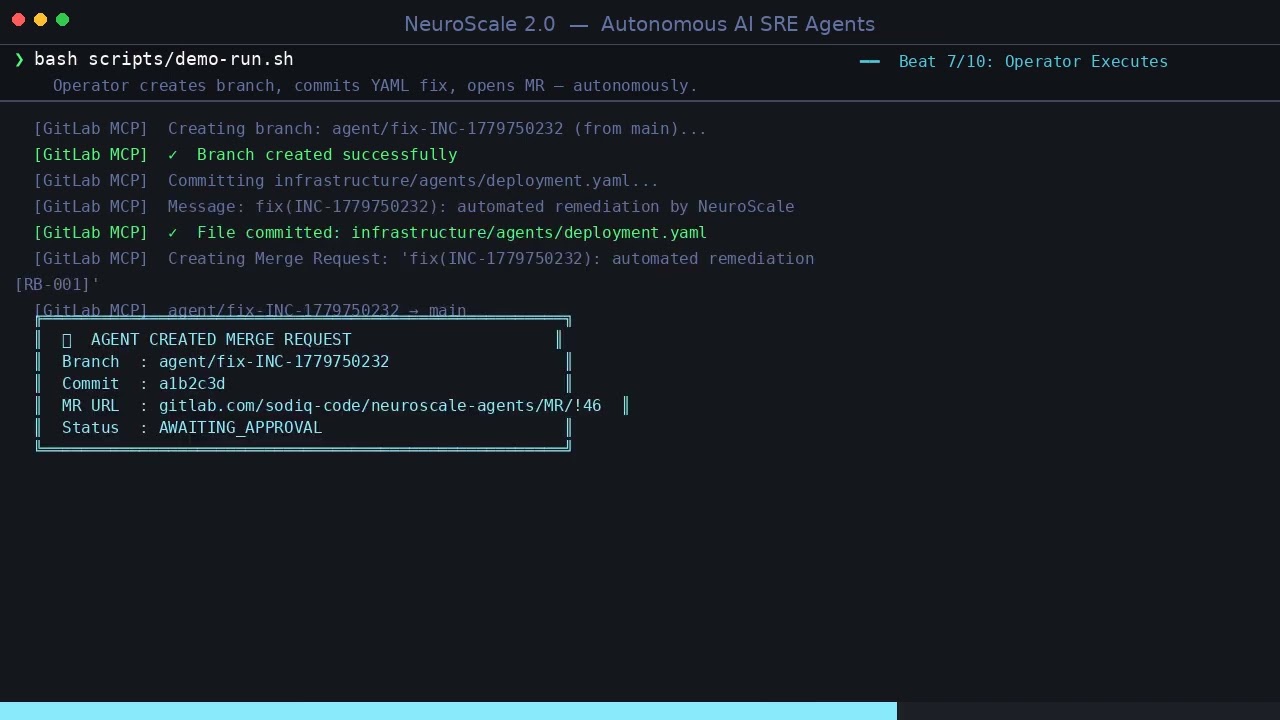
━━━ Beat 7: Operator Executes ━━━━━━━━━━━━━━━━━━━━━━━━━━━━━━━━━━
⚙️ Branch : agent/fix-INC-1779750242
📝 Commit : a1b2c3d
🔀 MR URL : https://gitlab.com/sodiq-code/neuroscale-agents/-/merge_requests/46
🔔 Status : AWAITING_APPROVAL
╔══════════════════════════════════════════════════════════════════╗
║ ✅ DEMO COMPLETE — Detection-to-MR: < 60 seconds ║
╚══════════════════════════════════════════════════════════════════╝

Demo video:
assets/demo_v2.mp4— updated 3-min walkthrough. YouTube mirror: youtu.be/t-zyw6tyBo8
Each agent exposes a typed interface. The Orchestrator calls agents sequentially:
# Watcher → Orchestrator
anomaly = {
    "incident_id": "INC-1779750248",
    "model_name": "demo-iris-2",
    "severity": "CRITICAL",
    "metrics": {"p99_latency_ms": 1134.0, "error_rate_pct": 14.2},
    "agent_hypothesis": "CPU throttling on predictor pod"
}

# Diagnostician → Operator
plan = {
    "root_cause": {"description": "...", "runbook_ref": "RB-001", "confidence": 0.90},
    "yaml_patch": "resources:\n  limits:\n    cpu: 2000m\n    memory: 2Gi\n",
}

# Operator → result
result = {
    "branch": "agent/fix-INC-1779750248",
    "mr_url": "https://gitlab.com/.../merge_requests/46",
    "status": "AWAITING_APPROVAL"
}agents/tools/gitlab_mcp.py— MCP client:create_branch,commit_file,create_merge_request- Every fix is a GitLab MR with Kyverno compliance checklist embedded in the description
- HITL gate: agent opens MR, never merges unilaterally
agents/tools/arize_mcp.py— MCP client:get-spans,get-trace- Watcher polls on configurable interval; reads
p99_latency_ms,error_rate_pct,total_spans - In production: set
ARIZE_API_KEY+ARIZE_SPACE_IDin env,DEMO_MODE=false
agents/diagnostician.py—_gemini_root_cause()callsgemini-2.0-flashviagoogle-genaiSDK- LLM receives Arize span data + matched runbook context; returns structured root-cause JSON
- Graceful fallback to TF-IDF rule-based analysis when API is unavailable (quota / no key)
- Set
GOOGLE_API_KEYin env to activate; omit for zero-credential demo mode
neuroscale-agents/
├── agents/
│   ├── orchestrator.py        ← A2A coordinator (entry point)
│   ├── watcher.py             ← Arize Phoenix polling + anomaly scoring
│   ├── diagnostician.py       ← RAG retrieval + root cause analysis
│   ├── operator_agent.py      ← GitLab branch + commit + MR creation
│   ├── config.py              ← DEMO_MODE toggle + thresholds
│   └── tools/
│       ├── arize_mcp.py       ← Arize Phoenix MCP client
│       ├── gitlab_mcp.py      ← GitLab MCP client
│       └── rag_store.py       ← TF-IDF runbook retrieval engine
├── dashboard/
│   └── app.py                 ← Streamlit web dashboard
├── runbooks/                  ← RAG knowledge base (5 runbooks)
├── infrastructure/            ← Kubernetes manifests (GitOps layer)
├── scripts/
│   ├── verify-all.sh          ← 7/7 verification suite
│   ├── demo-run.sh            ← Full 10-beat CLI demo runner
│   └── stream_runner.py       ← SSE-streaming A2A pipeline (used by dashboard)
├── deploy/
│   └── cloud-run.sh           ← One-command Cloud Run deploy
├── Dockerfile                 ← Container image
├── requirements.txt
└── LICENSE                    ← MIT
bash scripts/verify-all.sh[PASS] 1/7 agents/config.py — DEMO_MODE default true
[PASS] 2/7 agents/watcher.py — WatcherAgent importable
[PASS] 3/7 agents/diagnostician.py — DiagnosticianAgent importable
[PASS] 4/7 agents/operator_agent.py — OperatorAgent importable
[PASS] 5/7 agents/tools/rag_store.py — semantic_search returns results
[PASS] 6/7 agents/tools/gitlab_mcp.py — list_merge_requests callable
[PASS] 7/7 agents/orchestrator.py — full pipeline end-to-end
7/7 PASS — all agents verified
Why TF-IDF RAG? Zero infrastructure to run locally. The RunbookRAGClient interface is unchanged in production — only the backend swaps to Vertex AI Search.
Why Gemini 2.0 Flash for root-cause? Structured JSON reasoning over span data + runbook context in one call. Flash is fast enough (< 2s) to fit within the 60-second SLO target. The _gemini_root_cause() method returns a typed dict; the existing confidence gate and YAML generation pipeline are unchanged.
Why HITL at the MR stage? The agent does the expensive work: detection, diagnosis, compliance check, YAML authoring. The human gets a binary decision on a fully-prepared fix — 30 seconds, not 45 minutes.
Why 90% confidence gate? Below 90%, diagnostic has meaningful uncertainty. Above it, the agent has matched a known runbook with high-fidelity Arize signal. Configurable in agents/config.py.
Built for the Google Cloud Rapid Agent Hackathon — GitLab + Arize Phoenix tracks · Powered by Gemini 2.0 Flash.