
Turn chores into a game your kids actually want to play.
A Home Assistant integration for family chore management, smart rewards, and streak tracking.





Originally created by vinnybad/choremander. This fork adds 15 Lovelace cards, a bonus points system, streak tracking, reward approval flow, a penalty system, and much more.
- How It Works
- Installation
- Setup
- Chores & Rewards
- Chore Scheduling
- Dynamic Chore Visibility
- Bonus Points System
- Notifications
- Penalties
- Achievement Badges
- Timed Tasks
- Task Groups
- Quests
- Challenges
- Pool Mode (Savings Jars)
- Dashboard Cards
- Services
- Jackpot Rewards
- Completion Sounds
- Finding IDs
- Troubleshooting
- Tips
- Create chores — assign them to children, set point values and schedules
- Kids complete chores — tap on the child card to tick off chores, earn points, build streaks
- Parents approve — chores set to "requires approval" go into a pending queue
- Kids claim rewards — when they have enough points, they claim a reward
- Parents approve claims — points are only deducted once a parent approves
- Bonus points — weekend multipliers, streak milestones, and perfect week bonuses add extra motivation
All data is stored locally in Home Assistant. Nothing leaves your instance.
TaskMate is a default HACS integration — no custom repository needed:
- Open HACS → search "TaskMate"
- Click Download
- Restart Home Assistant
- Add the integration: Settings → Devices & Services → Add Integration → TaskMate
Or use the one-click buttons:


Already installed TaskMate as a custom repository from before it was accepted into HACS? It keeps working and keeps receiving updates — you can safely remove the custom repository entry, HACS now tracks it by default.
- Download the latest release
- Copy the
taskmatefolder to/config/custom_components/taskmate/ - Restart Home Assistant
- Home Assistant 2024.1 or newer
- A modern browser for the dashboard cards: current Chrome, Firefox, Edge, or Safari. The cards use Web Components, Web Audio, and ES2020 features and will not work in Internet Explorer or pre-2022 browsers.
All TaskMate data — children, chores, points, reward claims, completion history — is stored inside your Home Assistant instance via HA's native storage helpers. Nothing is sent to any external service.
- Settings → Devices & Services → Add Integration → search "TaskMate"
- Choose your points name (Stars, Coins, Points, Bucks — whatever motivates your children) and an icon. Both can be changed later in the panel.
That's the only thing the config flow asks. There is no "Configure" button on the integration card — all day-to-day management lives in the TaskMate panel below. (The legacy options/configure flow was removed in v4.0.)
After installing, a TaskMate entry appears in the Home Assistant sidebar. This is the management hub for everything — open it and you'll find:
- Children — add children, set avatars, gift points
- Chores — create and edit chores, reorder, bulk-add, save/apply templates
- Rewards — create rewards with a fixed point cost (standard, jackpot, or savings-pool)
- Penalties / Bonuses — one-tap point deductions and awards
- Groups — coordinate rotation chores (sticky / spread)
- Quests / Challenges — multi-step and time-boxed goals
- Badges — built-in catalogue plus custom achievement badges
- Templates — reusable chore sets
- Notifications — route approval alerts to parent devices and per child
- Settings — points name & icon, default card design, history retention, streak mode, weekend multiplier, difficulty multipliers, and the bonus-points system
The Activity section shows a live feed, and chore/reward approvals are handled right in the panel. It's fully translated in all supported languages and updates in real time via WebSocket.
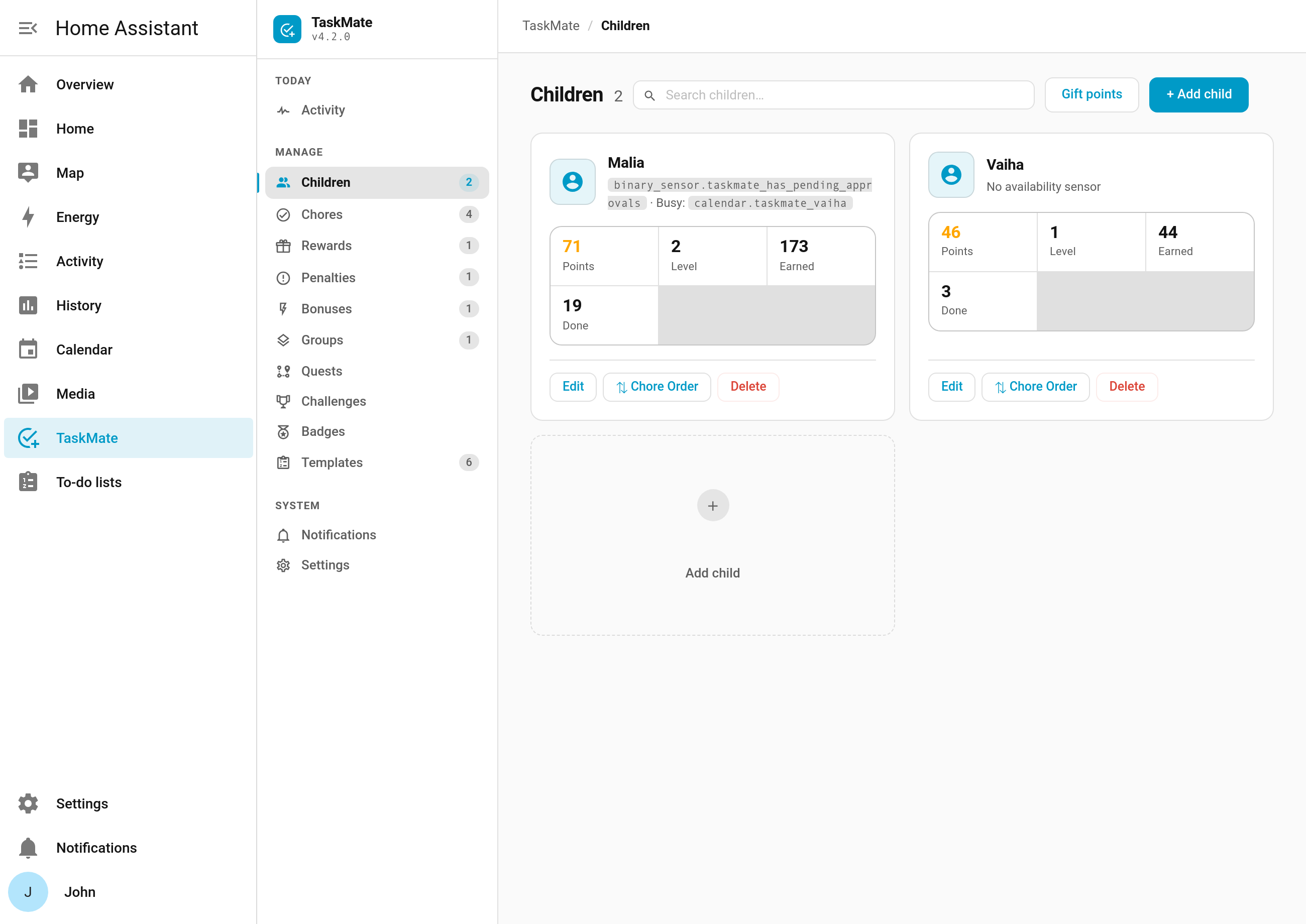
See the Admin Panel wiki page for details.
Lovelace resources are registered automatically on startup — no manual setup needed.
- Edit your dashboard → Add Card
- Search "taskmate" or scroll to Custom cards
- Select a card, set
sensor.taskmate_overviewas the entity, configure options, save
| Field | Description |
|---|---|
| Name | Display name shown on the child card |
| Description | Optional subtitle (enable with show_description in the card editor) |
| Points | Stars earned on completion |
| Time of Day | Morning Afternoon Evening Night Anytime — filters which card shows this chore |
| Scheduling Mode | Specific Days — choose which days of the week the chore appears. Recurring — set a repeating interval. Scheduling options are configured on the next page of the setup flow. |
| Due Days | (Specific Days mode) Days of the week this chore appears on the child card. Leave empty for every day. |
| Recurrence | (Recurring mode) How often the chore can be completed — Every 2 Days, Weekly, Every 2 Weeks, Monthly, Every 3 Months, Every 6 Months. Window is rolling from last completion date (midnight-rounded). |
| Daily Limit | How many times per day this chore can be completed |
| Requires Approval | If on, completion is pending until a parent approves — points held until approved |
| Completion Sound | Sound played when ticked off — overrides the card default |
| Visibility Entity | (Optional) Home Assistant entity ID that controls when this chore appears on the child card. Leave empty to always show the chore. Examples: binary_sensor.dishwasher, sensor.soil_moisture, input_boolean.guest_mode. See Dynamic Chore Visibility for details. |
| Visibility Operator | How to compare the entity's current state with your target value. Options: Equals, Not Equal, ≥, ≤, >, <. See Dynamic Chore Visibility for guidance. |
| Visibility State | The value to compare against. For text operators (Equals, Not Equal), enter any state value like on, home, or away. For numeric operators, enter a number like 30 or 50.5. |
| Type | How to Set | Description |
|---|---|---|
| Standard | Set Points Cost |
Fixed cost set by the parent |
| Jackpot | Enable "Jackpot" toggle | A shared family goal — everyone deposits into one pooled jar (jackpots are always pool-mode) and it's redeemed once the combined total reaches the cost |
Claiming is a two-step process — children can't instantly redeem rewards without parental oversight:
- Child taps Claim → pending claim created, points not yet deducted
- Parent sees the claim in the Claims tab of the Parent Dashboard card
- Approve → points deducted, reward granted
- Reject → claim cancelled, no points affected
Chores have two scheduling modes set in Step 1 of the add/edit chore flow.
Choose which days of the week the chore appears on the child card. Leave empty to show every day. Use due_days_mode on the child card to hide or dim non-scheduled days.
The chore has a rolling recurrence window. Once completed, it cannot be done again until the window expires — measured in days from the date of last completion (midnight-rounded).
| Recurrence | Window |
|---|---|
| Every 2 days | 2 days |
| Weekly | 7 days |
| Every 2 weeks | 14 days |
| Monthly | 30 days |
| Every 3 months | 90 days |
| Every 6 months | 180 days |
Optional settings for recurring chores:
- Day of Week — for Weekly/Every 2 Weeks, pin the chore to a specific day
- Start Date — for Every 2 Days, set the anchor date for the rhythm
- First Occurrence — Available Immediately (default) or Wait for First Scheduled Occurrence
Child card behaviour: Use recurrence_done_mode on the child card to control what happens when a recurring chore has been completed and is waiting to reset — dim (default), hide, or show.
Show or hide chores based on the state of a Home Assistant entity. Chores only appear on the child card when the visibility condition is met.
When you create or edit a chore, set the Visibility Entity (e.g., binary_sensor.dishwasher), Visibility Operator (e.g., Equals), and Visibility State (e.g., running). The chore appears on the child card only when the entity's current state matches your condition.
Examples:
- Dishwasher chores — Set entity to
binary_sensor.dishwasherwith operatorEqualsand stateon. Chores only appear when the dishwasher is running. - Soil moisture — Set entity to
sensor.soil_moisturewith operator≤and state30. Chores only appear when moisture is 30% or lower. - Guest mode — Set entity to
input_boolean.guest_modewith operatorNot Equaland stateon. Chores only appear when guests are not over. - Temperature threshold — Set entity to
sensor.temperaturewith operator>=and state25. Chores only appear when it's warm enough.
| Operator | Use When | Example |
|---|---|---|
| Equals | Entity state matches exactly (case-insensitive) | Entity: binary_sensor.dishwasher, State: on — show when entity is "on" |
| Not Equal | Entity state does not match | Entity: input_boolean.guest_mode, State: on — show when guests are NOT over |
| ≥ (Greater or Equal) | Numeric entity value is at or above threshold | Entity: sensor.battery_percent, State: 80 — show when battery ≥ 80% |
| ≤ (Less or Equal) | Numeric entity value is at or below threshold | Entity: sensor.soil_moisture, State: 30 — show when moisture ≤ 30% |
| > (Greater Than) | Numeric entity value is above threshold | Entity: sensor.temperature, State: 25 — show when temperature > 25°C |
| < (Less Than) | Numeric entity value is below threshold | Entity: sensor.snow_depth, State: 10 — show when snow < 10 cm |
- Optional — Leave Visibility Entity empty to always show the chore
- Entity types — Works with any entity:
binary_sensor,sensor,input_boolean,switch,number, etc. - Update frequency — Visibility is checked every 30 seconds (coordinator refresh interval)
- Safe fallback — If the entity becomes unavailable, the chore defaults to visible
- Frontend only — Visibility only hides chores from the child card. Parent services like
taskmate.complete_chorewill still work on hidden chores - Numeric handling — Numeric operators automatically convert entity state to a number. If conversion fails, the operators fall back to string matching.
Chores that only appear when equipment is in use:
- Dishwasher loading chores when
binary_sensor.dishwasherison - Laundry folding when
binary_sensor.dryerison
Seasonal or conditional chores:
- Snow shovelling when
sensor.snow_depth> 5 cm - Watering plants when
sensor.soil_moisture≤ 40% - Yard work when
binary_sensor.guest_modeisoff
Time-based or system state:
- Tasks only when home alone (entity not set to
away) - Tasks only during school days (custom
input_boolean.school_day) - Tasks only when a family member is home (entity is
home)
All bonus settings live in the Settings tab of the TaskMate panel (sidebar → TaskMate → Settings).
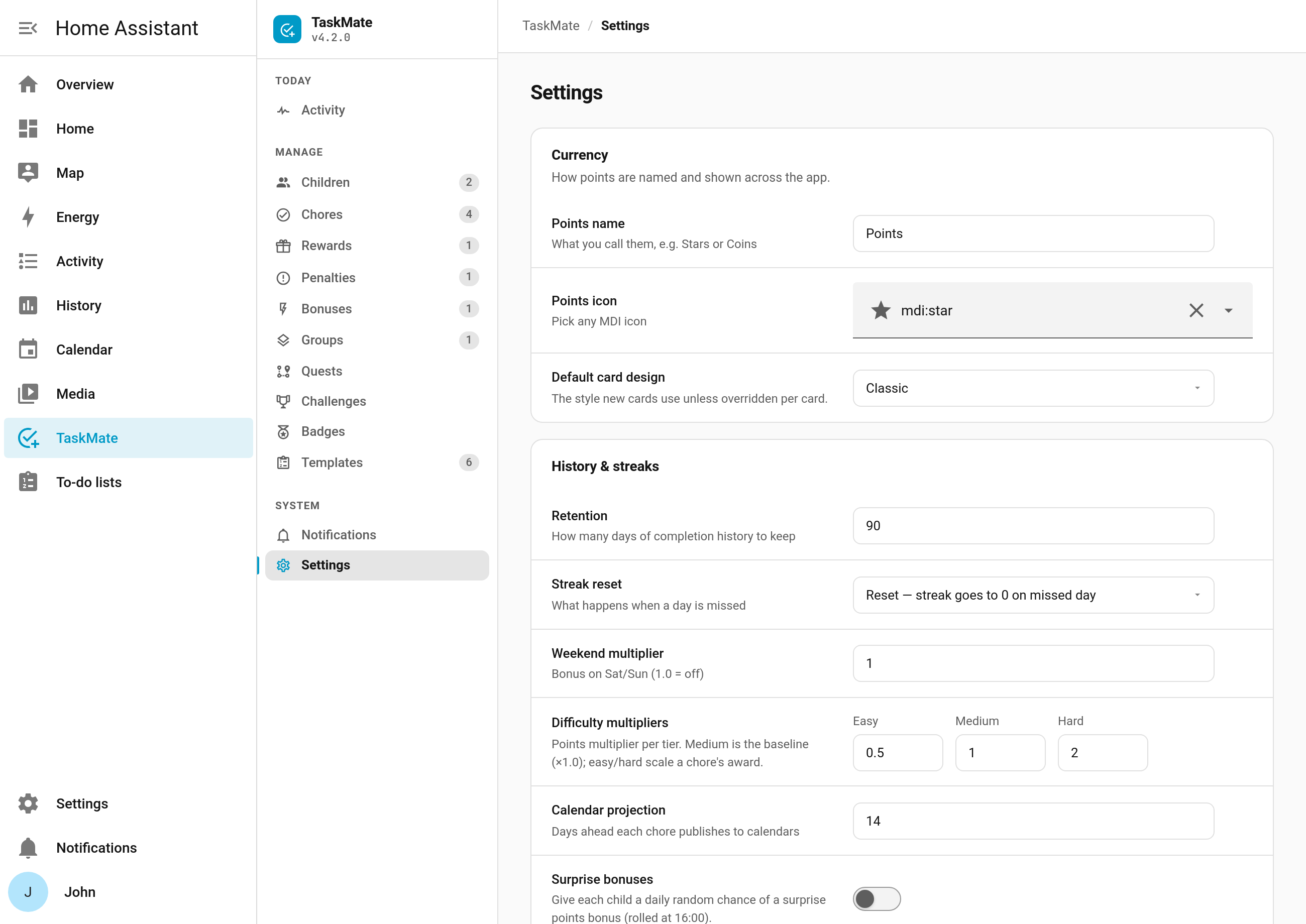
Children earn extra points for completing chores on Saturdays and Sundays.
- Default multiplier: 2.0× — a 10-point chore on Saturday earns 20 points
- The multiplier applies to the completion date, not the approval date
- Configure:
1.0to5.0(set1.0to disable)
Bonus points are awarded when a child hits a streak milestone. Fully configurable — enter your own milestones as days:points pairs:
3:5, 7:10, 14:20, 30:50, 60:100, 100:200
| Default Streak | Default Bonus |
|---|---|
| 3 days | +5 pts |
| 7 days | +10 pts |
| 14 days | +20 pts |
| 30 days | +50 pts |
| 60 days | +100 pts |
| 100 days | +200 pts |
- Milestones are re-earnable after a streak resets
- Use the Streak Milestone Bonuses toggle as a master on/off switch
- Leave the configuration field empty to disable all milestones without turning off the toggle
- Invalid formats fall back to the default list with a validation error shown on save
Children earn a bonus when they complete at least one chore every day Monday–Sunday.
- Checked automatically every Monday at midnight
- Default: 50 points — configurable from 10 to 500
- Enable Perfect week needs all tasks to require every chore due that day to be done (not just one) before the day counts
Stricter streaks: the matching Streak needs all tasks toggle applies the same rule to daily streaks — a day only extends the streak once every chore due that day is complete. Both default to off, preserving the original "any one chore" behaviour.
| Setting | Default | Description |
|---|---|---|
| Weekend Points Multiplier | 2.0 |
Multiplier on Sat/Sun (1.0 = off) |
| Streak Milestone Bonuses | on |
Master toggle |
| Streak Milestone Configuration | 3:5, 7:10, 14:20, 30:50, 60:100, 100:200 |
Custom days:points pairs |
| Streak needs all tasks | off |
Only extend a streak once every chore due that day is done |
| Perfect Week Bonus | on |
Toggle |
| Perfect Week Bonus Points | 50 |
Points per perfect week |
| Perfect week needs all tasks | off |
A day counts only when every chore due that day is done |
| Streak Reset Mode | reset |
reset — streak drops to 0 on a missed day; pause — streak is preserved |
| History Days to Keep | 90 |
Completion history retention, 30–365 days |
TaskMate can notify parents when a chore requiring approval has been completed.
When a child completes a chore that has Requires Approval turned on:
- A persistent notification is always created in HA — visible in the notification bell in the sidebar
- If a notification target is configured in the panel's Notifications tab, a push notification is also sent
Open the Notifications tab of the TaskMate panel (sidebar → TaskMate → Notifications). There you can:
- Add one or more parent notification targets, each pointing at a notify service such as
notify.mobile_app_your_phone, with an individual enable toggle - Route notifications per child to a specific notify service
- Send a test notification to confirm a target works
Leave all targets empty to use persistent (in-app) notifications only.
Note: Targets must be in the
notifydomain (e.g.notify.mobile_app_...). Services from other domains are ignored with a warning in the HA logs.
Tip: Use
binary_sensor.taskmate_has_pending_approvalsin your own automations for more customised notification logic.
Deduct points from a child for unwanted behaviour — the flip side of the reward system.
- Create named penalties (e.g. "Not going to bed = 10 points") via the Penalties Card or the
taskmate.add_penaltyservice - Open the Penalties Card, select the child, and tap Apply on the relevant penalty
- Points are deducted immediately and logged in the activity feed as
Penalty: <name>
- Select the child using the tabs at the top (hidden if only one child)
- Tap Apply to deduct points instantly — the tile flashes and a toast confirms the action
- Tap the pencil icon to enter edit mode: add new penalties, edit name/points/icon/description, or delete
# Create a penalty
service: taskmate.add_penalty
data:
  name: "Not going to bed"
  points: 10
  description: "Refused bedtime after two warnings"   # optional
  icon: mdi:bed-clock                                 # optional, any MDI icon

# Apply a penalty to a child
service: taskmate.apply_penalty
data:
  penalty_id: abc12345    # see Finding IDs
child_id: a8c8376aMilestone-based recognition layered on top of the existing chores / streak / reward systems. 15 built-in badges across four tiers (Bronze / Silver / Gold / Platinum), plus full support for parent-created custom badges with multi-criterion AND rules.
| Tier | Examples |
|---|---|
| Bronze | First Chore, First Reward, 100 Points, 10 Chores Completed |
| Silver | 500 Points, 50 Chores, 3-Day Streak, First Perfect Week |
| Gold | 1000 Points, 100 Chores, 7-Day Streak, 5 Perfect Weeks |
| Platinum | 5000 Points, 30-Day Streak, 10 Perfect Weeks |
Built-ins can be enabled / disabled and have their point_bonus, tier, assignment, and notify-on-earn edited. Their criteria, name, description, and icon are frozen so installs stay consistent.
Define your own with any combination of metric thresholds (AND-evaluated):
total_points≥ Ntotal_chores≥ Ntotal_rewards≥ Ncurrent_streak≥ Nbest_streak≥ Nperfect_weeks≥ Nfirst_chore(1 = earned on first completion)first_reward(1 = earned on first reward claim)
Empty criteria = manual-award only (parent presses "Award to..." to grant it).
taskmate-badges-card— full grid view per child. Earned tiles in tier colour, locked tiles greyed with progress bars showing closest-criterion completion percentage.taskmate-child-card— inline strip of up to 5 most-recently-earned badges below the points readout (auto-hidden when zero earned). Tap → opens the admin panel's badges section. Disable withshow_badges: false.- Admin panel — Badges section — Catalogue / Custom / Award History tabs. Award History shows AUTO / MANUAL / SILENT source pills and supports one-click revoke (auto-reverses any point bonus credited).
Each child gets sensor.taskmate_badges_<slug>:
- State: count of earned badges
- Attributes:
earned[](withearned_at,tier, etc.),available[](withprogress_pct),total_badges
On first install of v3.8.0, existing kids get badges silently retroactive-awarded for milestones they've already passed (e.g. a kid with 200 points instantly has the "100 Points" badge). Silent backfill never fires notifications and never credits point_bonus — the feature works on day one without point inflation.
The taskmate.rebuild_badges service re-runs this sweep on demand (e.g. after enabling a previously-disabled built-in).
Persistent HA notification + optional mobile push when a badge auto-earns. Per-badge notify_on_earn toggle (default true). When 3+ badges earn in a single evaluation, notifications batch into a single combined message.
# Add a custom badge
service: taskmate.add_badge
data:
  name: "Holiday Helper"
  description: "Earned for big effort during school holidays"
  icon: mdi:beach
  tier: silver
  point_bonus: 30
  criteria:
    - { metric: total_chores, operator: ">=", value: 20 }
    - { metric: current_streak, operator: ">=", value: 3 }
  assigned_to: [c1, c2]            # empty = all kids
  notify_on_earn: true

# Manually award a badge
service: taskmate.award_badge_manually
data:
  badge_id: abc12345
  child_id: a8c8376a

# Revoke an awarded badge (reverses any point_bonus that was credited)
service: taskmate.revoke_badge
data:
  awarded_badge_id: xyz98765       # see the panel's Award History tab

# Re-evaluate all badges across all children silently
service: taskmate.rebuild_badges
Other services: taskmate.update_badge, taskmate.remove_badge (custom only — built-ins protected).
Duration-based chores where children earn points based on how long they spend on an activity — ideal for reading, practising instruments, or homework.
- Set a chore's Task Type to
timedin the admin panel - Configure the rate (e.g. 10 points per 5 minutes) and optional daily cap
- The child starts, pauses, and stops a timer on their card
- Points are calculated as
floor(total_seconds / (rate_minutes × 60)) × rate_points
Services: taskmate.start_timed_task, taskmate.pause_timed_task, taskmate.stop_timed_task
See the Timed Tasks wiki page for full details.
Coordinate related rotation-mode chores so they're assigned to the same child (sticky) or spread across different children (spread). For example, a "Dinner Duties" group ensures that the child who sets the table also clears it.
- Sticky — all chores in the group follow the leader chore's assignment
- Spread — chores in the group are assigned to different children
Manage groups via the admin panel or the taskmate.add_task_group / taskmate.update_task_group / taskmate.remove_task_group services.
See the Task Groups wiki page for full details.
A Quest is an ordered chain of chores a child works through step by step. They complete each chore in sequence, and when the final step is done (and approved, if that chore requires approval), they earn a one-time bonus on top of the points from the chores themselves. Think of it as a themed multi-step mission — "Morning Routine", "Saturday Tidy-Up", "Get Ready for School".
Create and manage quests in the Quests tab of the TaskMate panel (you need at least one chore first):
| Field | Default | Description |
|---|---|---|
| Name / Description / Icon | mdi:map-marker-path |
Display details |
| Steps | — | The ordered list of chores that make up the quest (pick from your existing chores) |
| Bonus points | 25 |
One-time reward granted when the last step is completed |
| Assigned to | all children | Which children can take the quest — leave empty for everyone |
| Repeatable | off | When on, progress resets after completion so the child can run it again; when off, it stays done once finished |
| Active | on | Turn off to hide a quest without deleting it |
Key points:
- Progress is per child — each child works through the chain independently, and the panel shows each child's current step.
- Steps advance only when the current step's chore is completed (and approved, if required) — they must be done in order.
- A repeatable quest tracks how many times each child has completed it.
- If a chore used as a step is later deleted, the step shows as a missing chore; the rest of the quest is unaffected.
- Completing a quest fires a
taskmate_quest_completedevent (withchild_id,quest_id,bonus, …) you can use in your own automations.
A Challenge is a time-boxed target that refreshes every period. Within each daily or weekly window, a child works toward a goal — complete N chores, or earn N points — and the moment they hit it they get a one-time bonus. Progress and the reward reset automatically when the period rolls over, so a daily challenge is a fresh goal every day. Unlike a Quest (a fixed chore chain), a Challenge just measures output over a window.
Create and manage challenges in the Challenges tab of the TaskMate panel:
| Field | Default | Description |
|---|---|---|
| Name / Description / Icon | mdi:trophy-outline |
Display details |
| Scope | daily |
The reset window — daily (resets at midnight) or weekly (resets Monday) |
| Metric | chores |
What counts toward the target — chores completed or points earned |
| Target | 3 |
The value the child must reach within the period |
| Bonus points | 15 |
Reward granted once per period when the target is met |
| Assigned to | all children | Which children the challenge applies to — leave empty for everyone |
| Active | on | Turn off to pause a challenge without deleting it |
Key points:
- Only approved chore completions count toward progress; bonus subtasks are excluded.
- The bonus is awarded once per period — hitting the target again in the same day/week doesn't pay out twice.
- Progress is tracked per child against the same shared target — it's not a head-to-head race between siblings.
- Daily challenges reset at midnight; weekly challenges reset on Monday (ISO week). A target met just before the boundary does not carry into the next period.
- Completing a challenge fires a
taskmate_challenge_completedevent (withchild_id,challenge_id,scope,bonus, …) for use in automations.
Children can save up for expensive rewards over time by depositing points into a dedicated savings pool. Points are locked once deposited — there is no withdrawal.
- Enable pool mode per reward in the admin panel
- Children deposit points via the Rewards Card or
taskmate.allocate_points_to_pool - Once the pool reaches the reward cost, the child can claim it
See the Pool Mode wiki page for full details.
Header colours: Every card has a configurable
header_coloroption in the visual editor, with its own vibrant default. Change it to match your dashboard theme or differentiate kid vs parent cards.
Design styles (v4.2.0+): Every card also has a
card_designoption — choose Classic (the original look), Playroom (warm, rounded, picture-book), Console (dark, neon game-HUD), or Clean Pro (minimal, flat). Set it per card in the visual editor or in YAML (card_design: playroom), or leave it on Global default (card_design: global) to follow the integration-wide style set in the panel's Settings → Default card design. Styles are scoped per card, so you can mix and match across a dashboard.
| Card | Best For | Purpose |
|---|---|---|
| Child Card | Kids | Complete chores — big buttons, sounds, celebrations |
| Rewards Card | Kids | View rewards, track progress, claim |
| Approvals Card | Parents | Approve/reject pending chore completions |
| Points Card | Parents | Manually add or remove points |
| Reorder Card | Parents | Drag-and-drop chore display order |
| Parent Dashboard Card | Parents | All-in-one: approvals, claims, overview, points |
| Overview Card | Parents | At-a-glance all-children progress |
| Activity Card | Parents | Full activity timeline |
| Streak Card | Both | Streak history and achievement badges |
| Weekly Card | Parents | Mon–Sun bar chart and stats |
| Points Graph Card | Parents | Points over time, multi-child line graph |
| Reward Progress Card | Kids | Full-screen motivational reward display |
| Leaderboard Card | Both | Competitive ranking by points, streak, or weekly |
| Penalties Card | Parents | Apply point-deduction penalties |
| Bonuses Card | Parents | Apply one-tap point bonuses |
| Points Display Card | Kids | Big, kid-friendly points readout |
| Calendar Card | Both | One-day view of chores assigned to each child |
Kid-friendly chore completion. The entire row is tappable — no small targets. Supports colourful animated badges, confetti celebrations, and completion sounds. Tapping a completed chore undoes it.
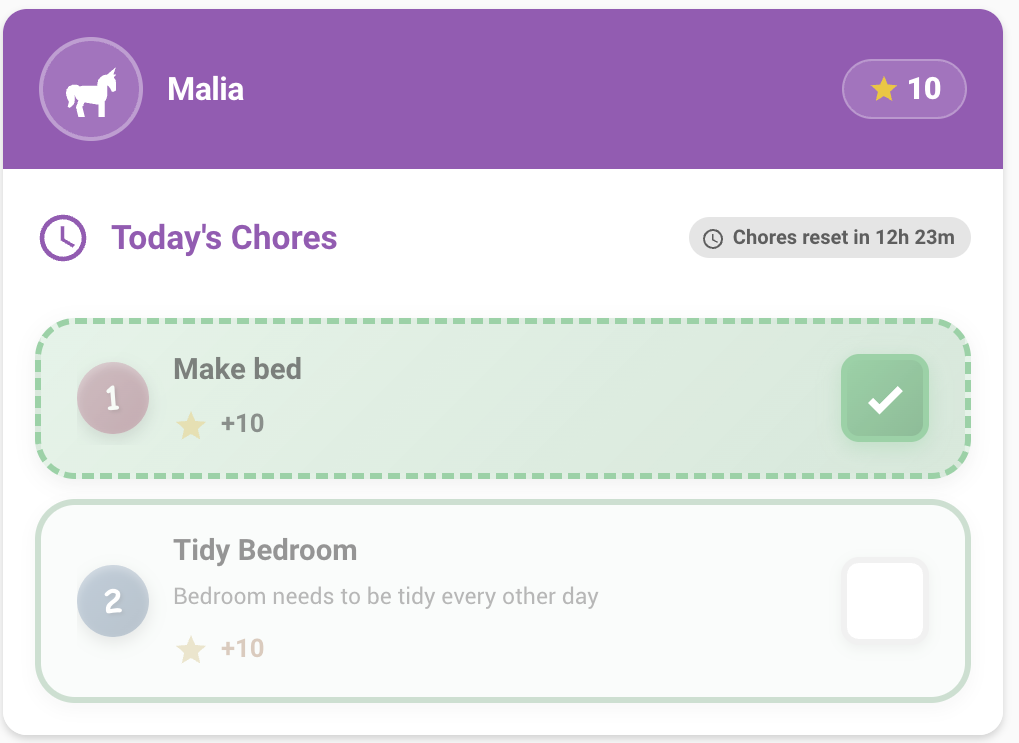
type: custom:taskmate-child-card
entity: sensor.taskmate_overview
child_id: a8c8376a            # required — see Finding IDs
time_category: anytime        # any period id (built-in or custom) | anytime | all
due_days_mode: hide           # hide | dim | show — chores not scheduled today
recurrence_done_mode: dim     # dim | hide | show — recurring chores waiting to reset
elapsed_time_mode: dim        # dim | hide | show — time-of-day chores whose period has passed
show_countdown: true          # show midnight reset countdown
show_description: false       # show chore description below name
default_sound: coin           # default completion sound
undo_sound: undo              # sound when undoing
header_color: "#9b59b6"
elapsed_time_mode — controls what happens to time-of-day chores once that time window has passed without completion. Set to dim (default) to grey them out and make them non-interactive, hide to remove them entirely, or show to leave them active. Chores set to Anytime are never affected. Chores that were completed still show with their green done style regardless.
Time-of-day periods are fully customisable in Settings → Time-of-day boundaries in the TaskMate admin panel: rename the built-in four, change their hours and icons, or add as many of your own (school run, bedtime, …) as you like. Periods can't overlap; gaps between them fall back to Anytime, and a period that still has chores assigned can't be deleted until they're reassigned. A chore's or card's time_category accepts any period id.
Shows all available rewards with progress bars and claim buttons. After claiming, the button shows "Awaiting parent approval" until approved. If you don't set child_id, the card shows a child picker at the top so you can choose who is claiming (for households with more than one child). Jackpot rewards show pooled deposit controls and a colour-coded contribution bar per child instead of a single claim button.
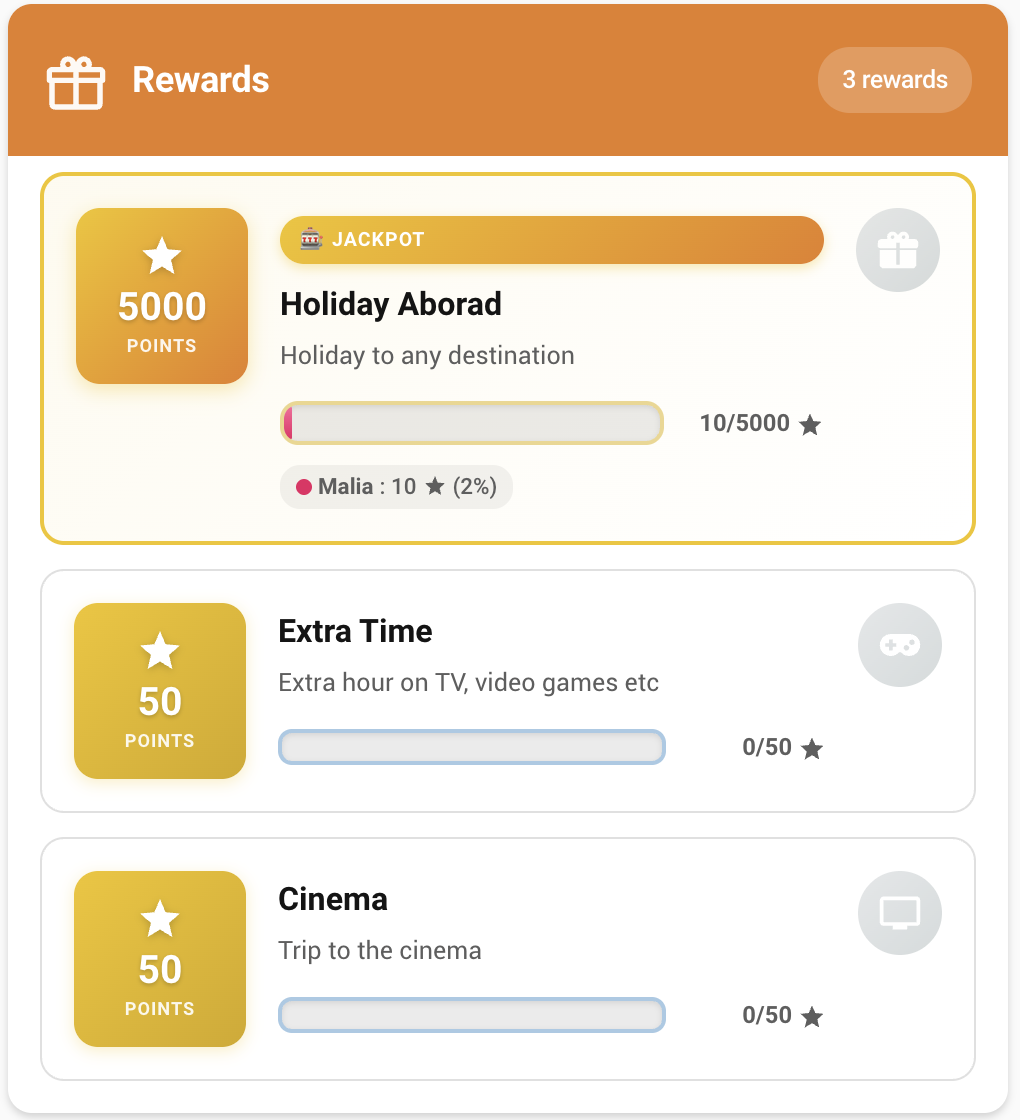
type: custom:taskmate-rewards-card
entity: sensor.taskmate_overview
child_id: a8c8376a            # optional — pin to one child; omit to show a child picker
show_child_badges: true       # show which children are assigned each reward
deposit_amounts: [10, 50, 100] # optional — quick-deposit button amounts for pool/jackpot rewards (default [1, 5, 10])
header_color: "#e67e22"
Pool deposits: Jackpot and savings-pool rewards show quick-deposit buttons plus an Amount field where a child can type any custom amount — handy for large goals. Set
deposit_amountsto change the quick buttons (e.g.[10, 50, 100]); the custom field always accepts any value and is capped to the child's spendable balance and the pool's remaining room.
Review and approve or reject chore completions requiring parent sign-off. Items are grouped by date and time of day.
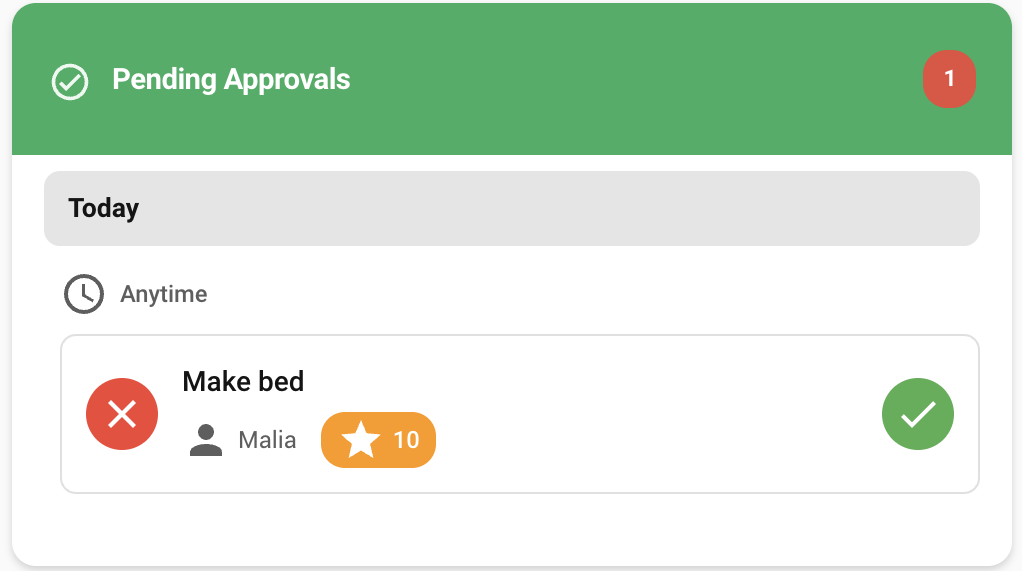
type: custom:taskmate-approvals-card
entity: sensor.taskmate_overview
title: Pending Approvals      # optional
child_id: a8c8376a            # optional — filter to one child
header_color: "#27ae60"Manually award bonus points or deduct points for consequences — useful for situations outside the normal chore flow.
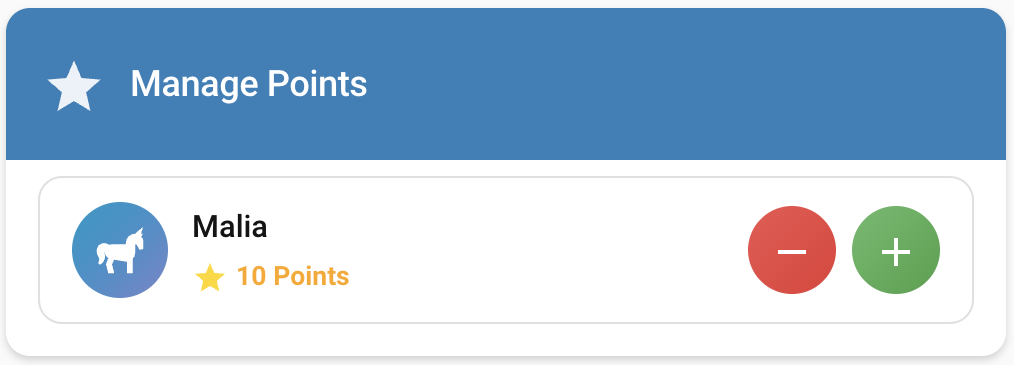
Each child row shows two rows of quick-tap buttons — one for adding, one for removing. Tap a button to apply instantly with no dialog. The ⋯ button opens a dialog for a custom amount with an optional reason.
type: custom:taskmate-points-card
entity: sensor.taskmate_overview
title: Manage Points
quick_add_amounts: [1, 5, 10]      # configurable add buttons
quick_remove_amounts: [1, 5, 10]   # configurable remove buttons
show_dialog: true                  # show ⋯ for custom amount + reason
header_color: "#2980b9"Drag-and-drop interface to set the order chores appear for each child.
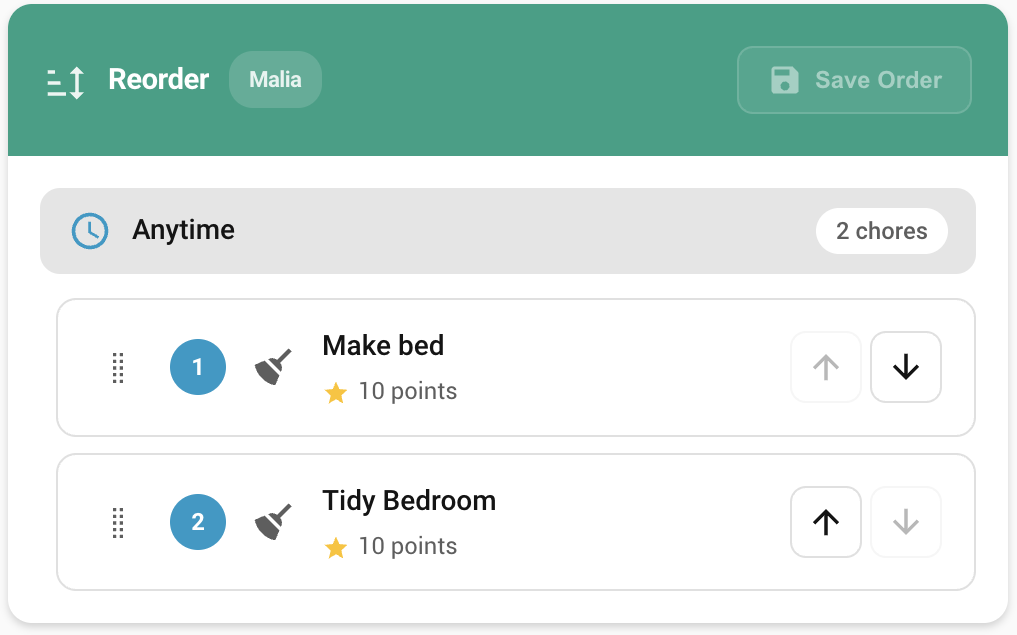
type: custom:taskmate-reorder-card
entity: sensor.taskmate_overview
child_id: a8c8376a
title: Reorder Chores
header_color: "#16a085"The most useful parent card — four tabs in one:
- Overview — all children's progress and points
- Approvals — pending chore completions with inline approve/reject
- Claims — pending reward claims with approve/reject
- Points — quick +/- buttons per child
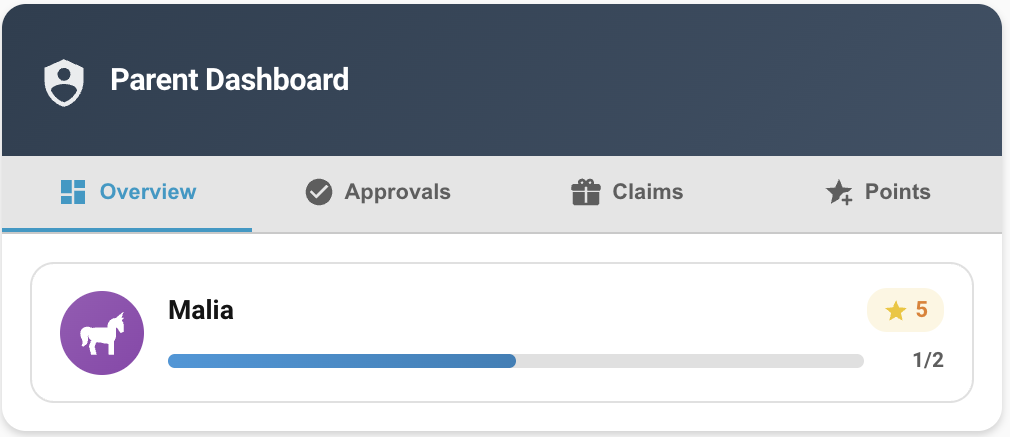
type: custom:taskmate-parent-dashboard-card
entity: sensor.taskmate_overview
title: Parent Dashboard
quick_points_amount: 5        # points per +/- button press
show_claims: true             # show the Claims tab
header_color: "#c0392b"At-a-glance view of every child — today's chore progress bars, current points, and a pulsing red badge when approvals are pending. Progress counts only chores due today — chores with due_days set are excluded from the total on days they are not scheduled.
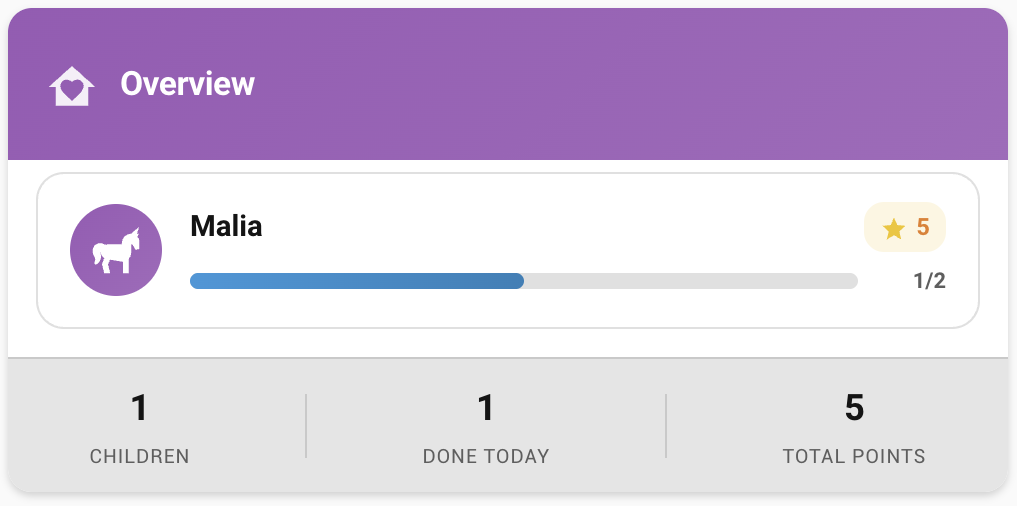
type: custom:taskmate-overview-card
entity: sensor.taskmate_overview
title: TaskMate
header_color: "#8e44ad"Scrollable timeline of everything — chore completions, manual point adjustments, bonus point events (weekends, streaks, perfect weeks), and reward claims. Grouped by Today / Yesterday / date.
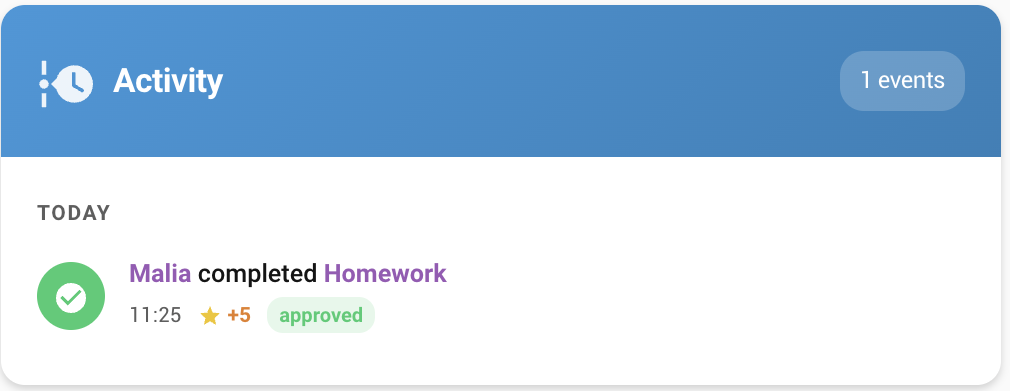
type: custom:taskmate-activity-card
entity: sensor.taskmate_overview
child_id: a8c8376a            # optional — filter to one child
max_items: 30
show_undo: true               # optional — set false to hide undo buttons (kid-friendly dashboards)
header_color: "#2471a3"Per-child streak display with a dot history grid, current and best streak, and achievement badges.
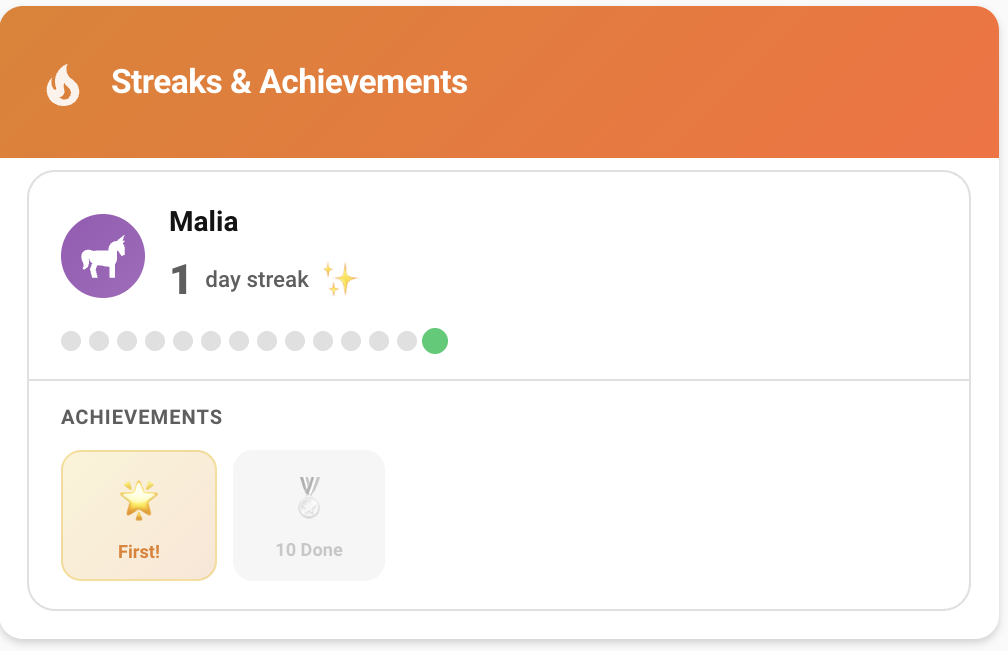
type: custom:taskmate-streak-card
entity: sensor.taskmate_overview
child_id: a8c8376a            # optional — filter to one child
streak_days_shown: 14         # days shown in the dot history grid
header_color: "#e74c3c"Monday–Sunday bar chart
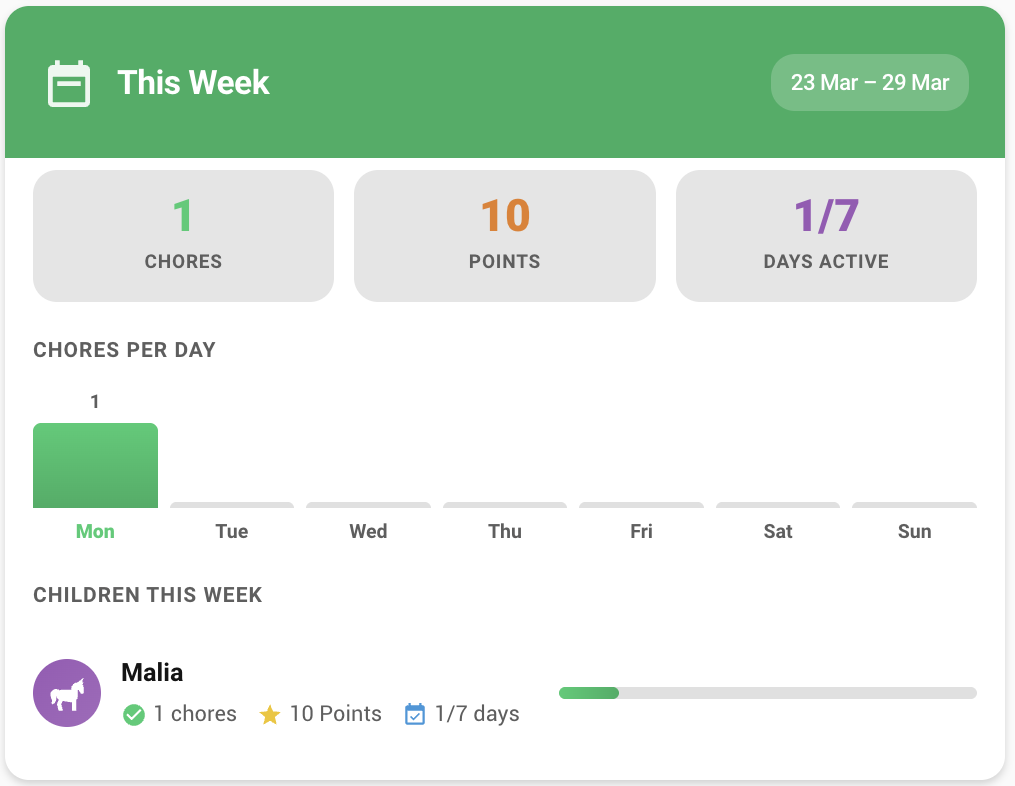
type: custom:taskmate-weekly-card
entity: sensor.taskmate_overview
child_id: a8c8376a            # optional — filter to one child
header_color: "#27ae60"Canvas-based line graph
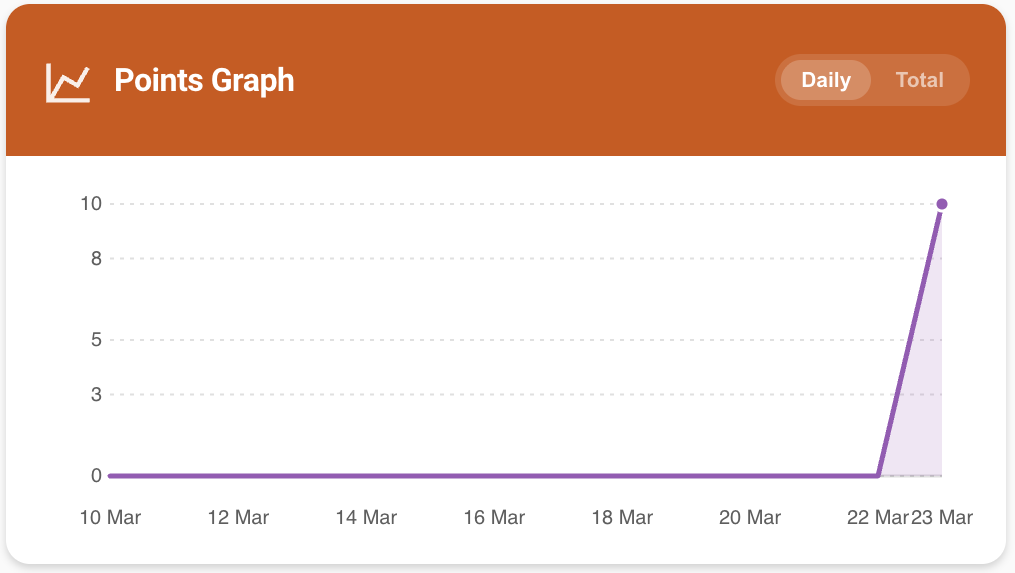
type: custom:taskmate-graph-card
entity: sensor.taskmate_overview
child_id: a8c8376a            # optional — filter to one child
days: 14                      # date range: 3–90
header_color: "#d35400"Full-screen motivational display
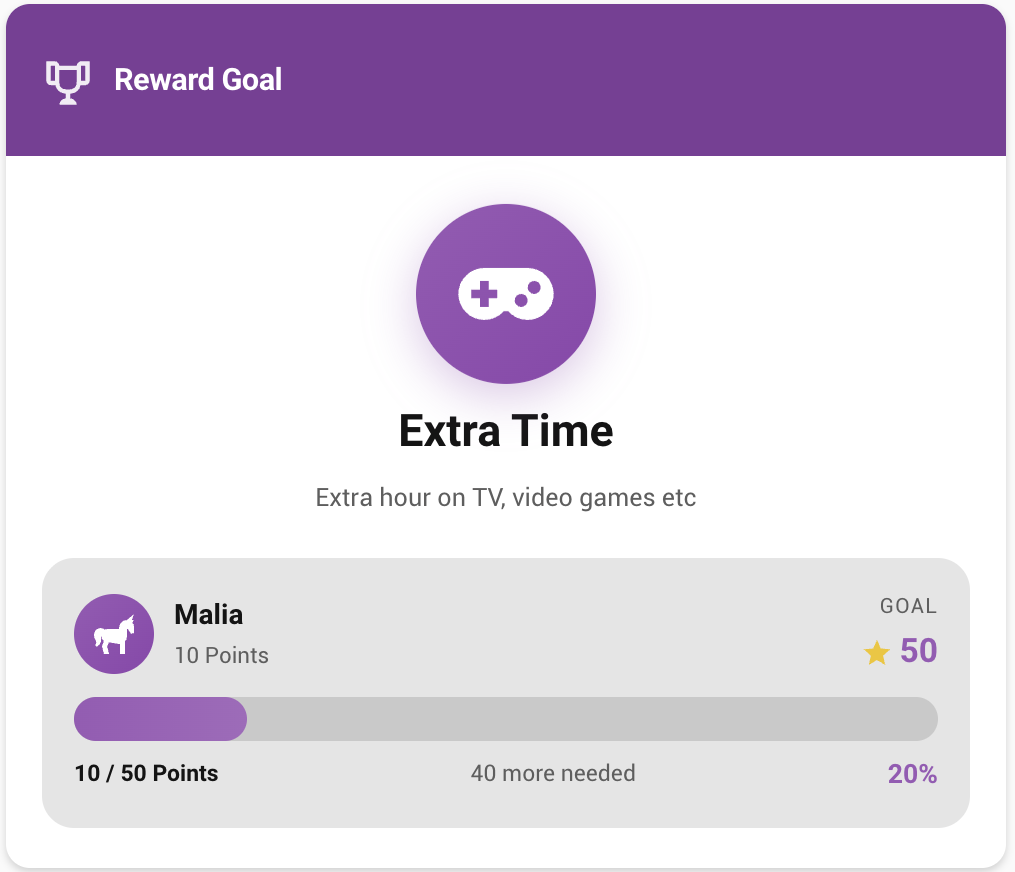
type: custom:taskmate-reward-progress-card
entity: sensor.taskmate_overview
reward_id: abc123             # required — see Finding IDs
child_id: a8c8376a            # optional — show one child's contribution
title: Reward Goal
header_color: "#7d3c98"Competitive ranking
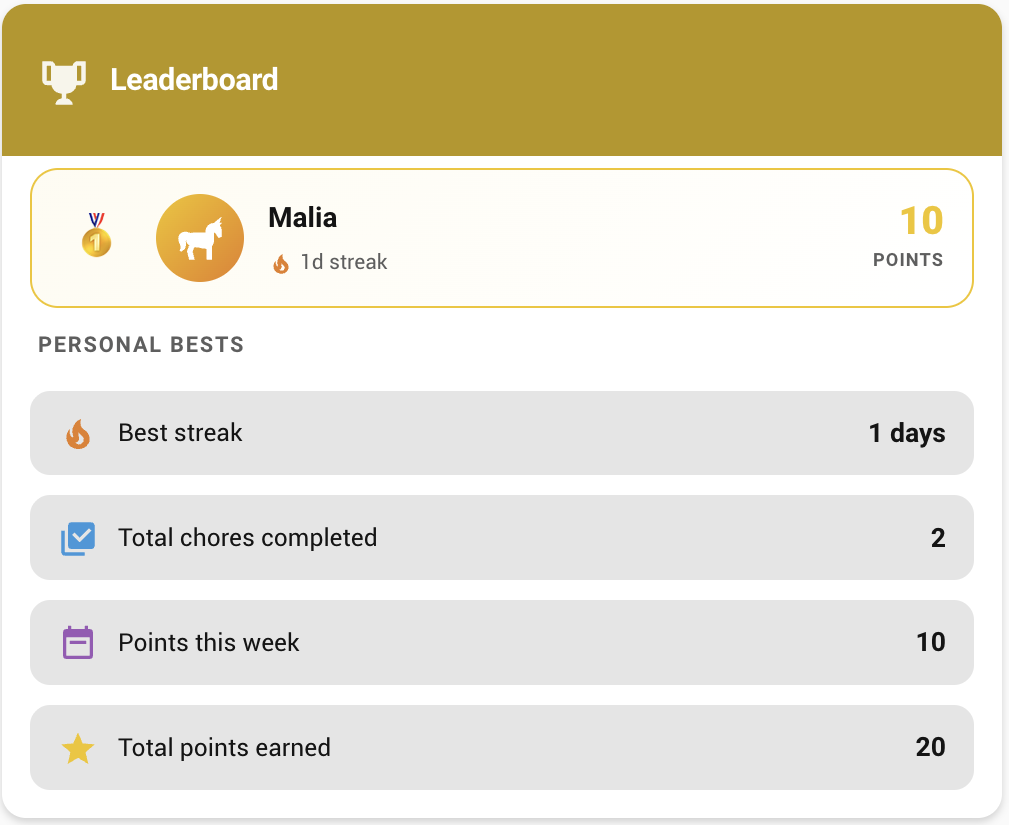
type: custom:taskmate-leaderboard-card
entity: sensor.taskmate_overview
sort_by: points               # points | streak | weekly
show_streak: true
show_weekly: true
header_color: "#b7950b"Parent-facing card for applying point-deduction penalties. Select the child using tabs, then tap Apply next to the relevant penalty. Tap the pencil icon to add, edit, or delete penalty definitions.
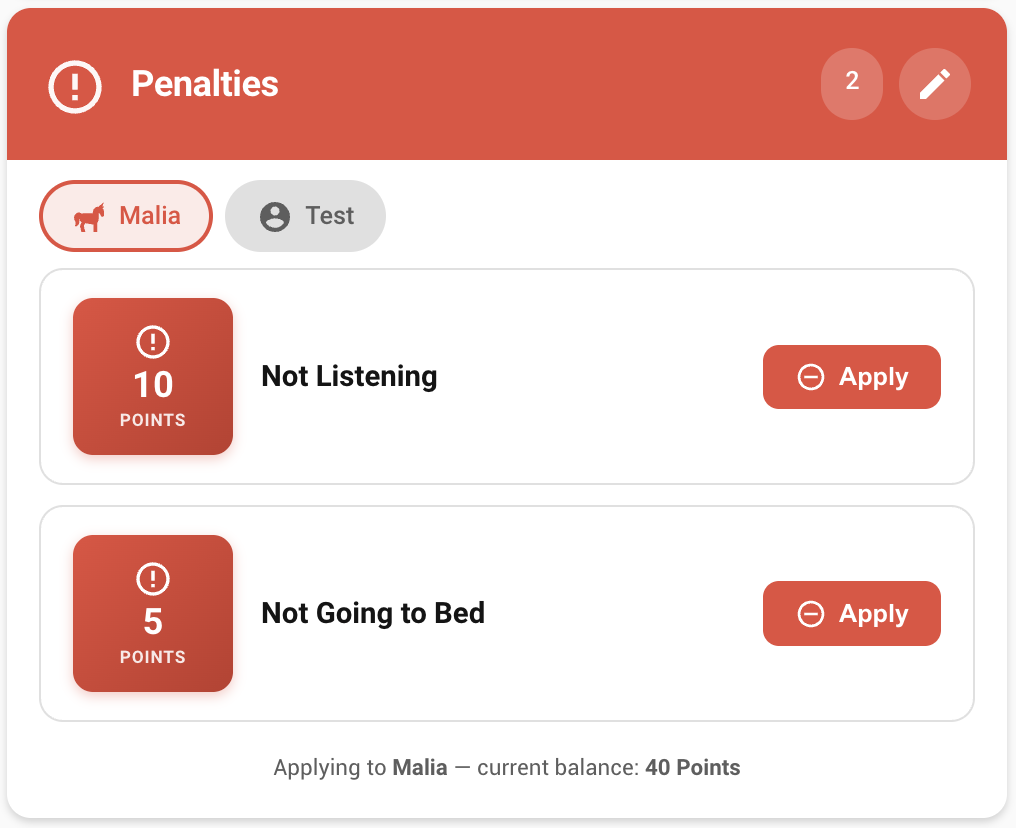
type: custom:taskmate-penalties-card
entity: sensor.taskmate_overview
title: Penalties
header_color: "#e74c3c"Parent-facing counterpart to the Penalties Card. Define one-tap point bonuses and apply them to any child from the card. Use the pencil icon to add, edit, or delete bonus definitions.
type: custom:taskmate-bonuses-card
entity: sensor.taskmate_overview
title: Bonuses
header_color: "#27ae60"
Managing Bonuses via Services:
# Create a bonus
service: taskmate.add_bonus
data:
  name: "Helped a sibling"
  points: 15
  description: "Voluntary help without being asked"   # optional
  icon: mdi:hand-heart                                # optional

# Apply a bonus to a child
service: taskmate.apply_bonus
data:
  bonus_id: abc12345    # see Finding IDs
child_id: a8c8376aBig, kid-friendly readout of current points. Supports three modes: a single child, every child side-by-side, or the combined family total. Pair it with the Child Card on a tablet dashboard.
type: custom:taskmate-points-display-card
entity: sensor.taskmate_overview
mode: single            # single | multi | cumulative (default: single)
child_id: a8c8376a      # required when mode: single
header_color: "#2980b9"
card_design: global # global | classic | playroom | console | cleanproOne-day view of the chores assigned to each child. Each child gets a section showing the chores scheduled for the selected day, colour-coded by state: green = approved, amber = pending approval, grey = due but not completed. Rotating-assignment chores (alternating, random, balanced) render dimmed on days other than today so you can see they rotate.
Use the ◀ / ▶ buttons to step through days, or the calendar icon to jump back to today. Set child_id to show only a single child.
type: custom:taskmate-calendar-card
entity: sensor.taskmate_overview
title: Task Calendar
child_id: a8c8376a            # optional — show only one child
header_color: "#3498db"TaskMate exposes services you can call from automations, scripts, or Developer Tools.
v3.7.0+: All entity ID fields (
child_id,chore_id,reward_id, etc.) now show as dropdown selectors in the HA automation editor with entity names as labels. You can still type raw hex IDs if you prefer.
| Service | Parameters | Description |
|---|---|---|
taskmate.complete_chore |
chore_id, child_id |
Mark a chore as completed |
taskmate.approve_chore |
completion_id |
Approve a pending chore completion |
taskmate.reject_chore |
completion_id |
Reject a pending chore completion |
taskmate.add_chore |
name, points*, assigned_to*, time_category*, one_shot*, requires_approval* |
Create a chore dynamically |
taskmate.skip_chore |
chore_id |
Skip today's assigned child in a rotation chore |
taskmate.set_chore_manual_start |
chore_id, child_id |
Override which child starts the rotation |
taskmate.complete_bonus_subtask |
chore_id, bonus_subtask_id, child_id |
Complete a bonus subtask within a chore |
| Service | Parameters | Description |
|---|---|---|
taskmate.start_timed_task |
chore_id, child_id |
Start or resume a timed task timer |
taskmate.pause_timed_task |
chore_id, child_id |
Pause a running timed task |
taskmate.stop_timed_task |
chore_id, child_id |
Stop timer and submit for approval |
| Service | Parameters | Description |
|---|---|---|
taskmate.claim_reward |
reward_id, child_id |
Create a pending reward claim |
taskmate.approve_reward |
claim_id |
Approve a reward claim (deducts points) |
taskmate.reject_reward |
claim_id |
Reject a reward claim |
taskmate.allocate_points_to_pool |
child_id, reward_id, points |
Deposit points into a reward's savings pool |
| Service | Parameters | Description |
|---|---|---|
taskmate.add_points |
child_id, points, reason* |
Manually add points to a child |
taskmate.remove_points |
child_id, points, reason* |
Manually remove points from a child |
| Service | Parameters | Description |
|---|---|---|
taskmate.add_penalty |
name, points, description*, icon*, assigned_to* |
Create a new penalty definition |
taskmate.update_penalty |
penalty_id, name*, points*, description*, icon*, assigned_to* |
Update an existing penalty |
taskmate.remove_penalty |
penalty_id |
Delete a penalty definition |
taskmate.apply_penalty |
penalty_id, child_id |
Apply a penalty — deducts points immediately |
| Service | Parameters | Description |
|---|---|---|
taskmate.add_bonus |
name, points, description*, icon*, assigned_to* |
Create a new bonus definition |
taskmate.update_bonus |
bonus_id, name*, points*, description*, icon*, assigned_to* |
Update an existing bonus |
taskmate.remove_bonus |
bonus_id |
Delete a bonus definition |
taskmate.apply_bonus |
bonus_id, child_id |
Apply a bonus — awards points immediately |
| Service | Parameters | Description |
|---|---|---|
taskmate.add_task_group |
name, policy, chore_ids* |
Create a task group (sticky or spread) |
taskmate.update_task_group |
group_id, name*, policy*, chore_ids* |
Update a task group |
taskmate.remove_task_group |
group_id |
Delete a task group |
| Service | Parameters | Description |
|---|---|---|
taskmate.set_chore_order |
child_id, chore_order |
Set the chore display order for a child |
taskmate.preview_sound |
sound |
Preview a completion sound in the browser |
* optional
See the Services wiki page for full parameter details, examples, and side effects.
Example — award bonus points from an automation:
service: taskmate.add_points
data:
  child_id: a8c8376a
  points: 10
reason: "Helped with the shopping"Enable Jackpot mode on a reward for big family goals — a holiday, a theme-park trip, a board game everyone wants. Jackpots are always pooled: each assigned child deposits points into the shared jar (deposited points are locked in), and once the combined total reaches the cost the reward can be redeemed — so a goal no single child could afford on their own is reached together. The rewards card shows each child's contribution as a colour-coded bar segment.
Because jackpots are inherently pooled, the reward editor manages pool mode for them automatically — there's no separate Pool toggle to set. See Pool Mode (Savings Jars) for how depositing and redeeming work.
The child card plays a sound when a chore is ticked off. All synthesised sounds are generated via the Web Audio API — no external files needed.
| Sound | Type | Description |
|---|---|---|
coin |
Synth | Classic video game coin collect |
levelup |
Synth | Triumphant ascending arpeggio |
fanfare |
Synth | Celebratory trumpet fanfare |
chime |
Synth | Pleasant bell chime |
powerup |
Synth | Ascending sweep with sparkle |
undo |
Synth | Sad descending womp-womp (played on undo) |
fart1–fart10 |
Audio file | Real fart sounds (CC0 — BigSoundBank.com) |
fart_random |
Audio file | Random fart sound 1–10 |
none |
— | Silence |
Fart sounds require the audio files placed at /config/www/taskmate/fart1.mp3 through fart10.mp3.
Priority order: chore-level sound → card default_sound → coin
Several card options and service calls require a child_id, chore_id, reward_id, etc.
Open the TaskMate Admin Panel (sidebar) → Settings tab → flip Show IDs. Every entity card/row across all tabs displays its hex ID in a monospace badge with a click-to-copy button.
Since v3.7.0, all entity ID fields in the HA automation editor and Developer Tools → Services show as dropdown selectors with entity names. You can pick "Noah" instead of typing ef19c56175c14bd9 — no need to look up the ID at all.
- Go to Developer Tools → States
- Find
sensor.taskmate_overview→childrenarray for child IDs - Find
sensor.taskmate_chores→choresarray for chore IDs - Find
sensor.taskmate_rewards→rewardsarray for reward IDs - Find
sensor.taskmate_incentives→penalties/bonusesarrays for penalty/bonus IDs
Home Assistant limits a single entity's attribute payload to 16 KB for the
recorder. TaskMate therefore splits its data across several global sensors
and per-child sensors. Cards configured with entity: sensor.taskmate_overview
keep working unchanged — every TaskMate card internally merges attributes from
the overview sensor and its companion sensors at render time.
| Entity | State | What lives here |
|---|---|---|
sensor.taskmate_overview |
total children | children summary, points_name, points_icon, today_day_of_week, totals, streak / perfect-week settings |
sensor.taskmate_chores |
total chores | chores list (definitions), todays_completions |
sensor.taskmate_chore_availability |
total chores available today | chore_availability: {chore_id: {child_id: bool}} |
sensor.taskmate_rewards |
total rewards | rewards, pending_reward_claims, pool_allocations |
sensor.taskmate_activity |
total completions all-time | recent_completions (last 35), recent_transactions (last 20) |
sensor.taskmate_incentives |
penalties + bonuses count | penalties, bonuses |
sensor.taskmate_pending_approvals |
pending approvals count | chore_completions, reward_claims (detailed lists) |
sensor.taskmate_<child>_points |
points for that child | child_id, current_streak, best_streak, total_* |
sensor.taskmate_<child>_stats |
chores completed by that child | assigned_chores, streak / totals |
Automations that read the old overview attributes (e.g. sensor.taskmate_overview.attributes.chores) should instead read from the matching companion sensor listed above.
Cards show "Custom element doesn't exist"
- Hard refresh the browser (Cmd+Shift+R / Ctrl+Shift+R)
- Check Settings → Dashboards → Resources — the
/taskmate/*.jsresources should be listed - If resources are missing, restart Home Assistant — they are registered automatically on startup
Cards show "Entity not found"
- Make sure you're using
sensor.taskmate_overviewas the entity (notsensor.taskmate_pending_approvals) - Verify the TaskMate integration is loaded: Settings → Devices & Services → TaskMate
Chore description not showing
- Enable Show chore description in the child card editor
- Make sure the chore actually has a description set in Settings → Manage Chores
Points not updating after completing a chore
- If the chore requires approval, points are held in "pending" until a parent approves
- The pending points are shown separately in the child card header
Streak not incrementing
- Streaks update at midnight. If you complete chores late at night and check before midnight, the streak counter won't have updated yet
- If Streak Reset Mode is set to
reset, missing a single day resets the streak to 0
Resources keep disappearing after restart
- Restart Home Assistant — Lovelace resources are registered automatically on startup
- If the problem persists after restarting, check the HA logs for errors from the
taskmateintegration
- Two dashboards — One for children (Child Card + Rewards Card), one for parents (Parent Dashboard). Children don't need to see the approval queue
- Completion % — Set this lower for optional or weekly chores. If a chore is done twice a week, set it to ~30%. This prevents infrequent chores from inflating reward costs
- Due Days — Use these so Monday's homework doesn't appear on Saturday. Set
due_days_mode: hideon the child card - Chore descriptions — Add short instructions like "Put the lid back on the bin" and enable
show_description: truein the card editor - Streak mode: Pause — If you go on holiday, "Pause" mode means children don't lose their streak. "Reset" mode is stricter and more motivating for consistent households
- Weekend Multiplier — Great for incentivising chores on days children have more free time. Set it to
1.5for a gentler boost or3.0for a big incentive - Jackpot rewards — Use these for big shared goals. A family holiday, a trip to a theme park, a new board game — something everyone works toward together
- Header colours — Each card has its own default colour. Customise them in the visual editor to make the children's dashboard bright and fun, and the parent dashboard more neutral
- Per-chore sounds — Set
completion_sound: fanfareon harder chores to make completing them feel more rewarding than easy ones - Time-of-day cards — Set
time_category: morningon a card for the breakfast routine andelapsed_time_mode: dimso missed morning chores grey out automatically once it's afternoon — no clutter, no guilt trips
See GitHub Releases for the full changelog.
License: MIT · Data stays local in your Home Assistant instance